WASHINGTON– WASHINGTON (AP) — President Donald Trump has berated and belittled many of his European counterparts who are expected to attend next week’s NATO summit in Turkey. But host Recep Tayyip Erdogan has taken advantage of his close ties to the American leader to secure his presence at the Ankara event, an appearance that could
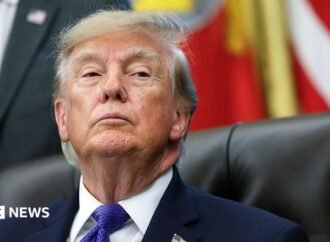
WASHINGTON– WASHINGTON (AP) — President Donald Trump has berated and belittled many of his European counterparts who are expected to attend next week’s NATO summit in Turkey. But host Recep Tayyip Erdogan has taken advantage of his close ties to the American leader to secure his presence at the Ankara event, an appearance that could even come accompanied by a major gift related to Turkish defense.
“I wouldn’t have elected most people,” Trump said last week. “But he called me and said, ‘Please, I have it in Türkiye. You have to be there. The United States has to be there.'” And that’s why I’m going out of respect for President Erdogan.”
Leveraging that respect has helped Erdogan avoid the disarray that Trump’s absence would cause in the alliance, particularly at a time when the Republican president has been repeatedly threatening to withdraw U.S. forces from Europe and reduce the U.S. role in NATO, unnerving allies.
Trump, who has frequently praised Erdogan and called him “a great leader,” has long chided other NATO countries for their defense spending. He claimed last year’s commitment to collectively push forward as a huge personal victory. More recently, he has clashed with members of the alliance for not supporting his war against Iran.
But Trump has sweetened the deal for Erdogan by also hinting that he could make headlines during his visit related to aircraft engines and the possible sale of F-35 fighter jets, banned for years due to Turkey’s closeness to Moscow.
Trump’s affinity for strong leaders has long made him an admirer of Erdogan, who amassed power in Turkey first as prime minister and now in his 13th year as president.
“His relationship with Erdogan, which is quite strong, is consistent with what appears to be a pattern of his preference,” said Philip Gordon, who served as national security adviser to Vice President Kamala Harris. “It has often been noted that he appears to have better relations with adversaries and autocrats, and certainly says kinder things about them than about his allies.”
Gordon, now at the Brookings Institution, added: “Erdogan is making the most of it.”
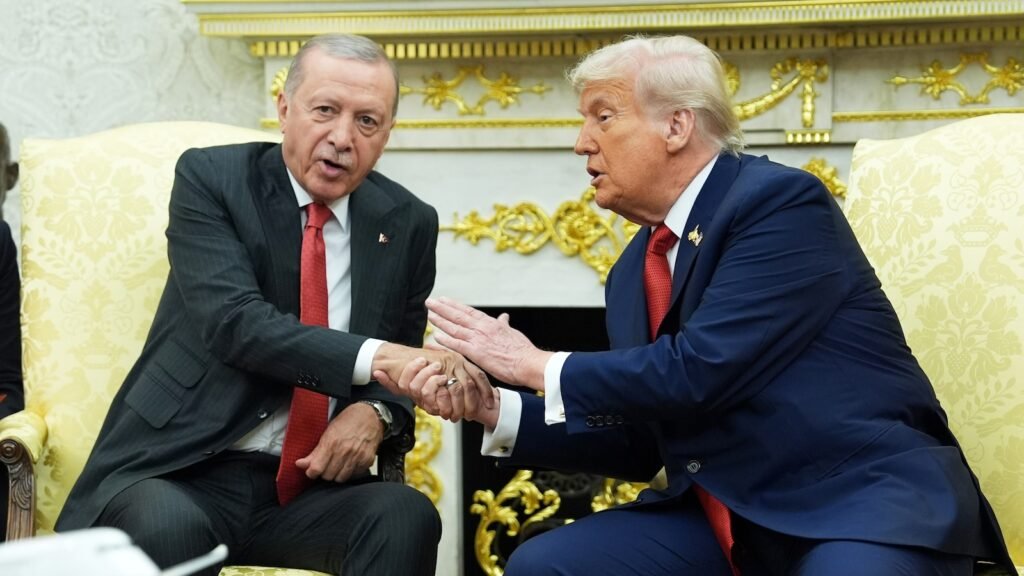
Trump, who is expected to have a bilateral meeting with Erdogan on the sidelines of the NATO summit, will be the first U.S. president to visit Turkey since Democrat Barack Obama in 2015. By contrast, Democratic President Joe Biden kept Erdogan at arm’s length over Turkey’s democratic backsliding and its close ties to Russia.
Opposition parties and human rights organizations have accused Erdogan of undermining democracy and limiting freedom of expression. They say baseless investigations and prosecutions of human rights activists, journalists, opposition politicians and others remain a persistent problem in Türkiye.
Soner Cagaptay of the Washington Institute said Erdogan and Trump “connected” personally during Trump’s first term. When Biden extended an invitation in 2024 for Erdogan to visit the United States after Türkiye backed Finland and Sweden’s membership in NATO, Erdogan decided not to go.
“That was Erdogan’s way of signaling to Trump, ‘Hey, you’re probably going to win the election,’” Cagaptay said. “I think Trump saw that as a giant gesture.”
During a meeting with NATO Secretary General Mark Rutte last week, a journalist asked Trump if he would bring “a big gift bag for Erdogan” on the trip, noting that Ankara wants F-110 jet engines and F-35 fighter jets.
“Yes, I think so,” Trump responded. “Yeah, I’m probably going to do something that will make him very happy.” Trump had also suggested in September that the United States could soon begin selling F-35s to Türkiye.
Türkiye was excluded from the program in 2019, after it purchased Russian-made S-400 missile defense systems. U.S. officials fear that Turkey’s use of the Russian system could allow Moscow to gather information about the F-35’s capabilities.
At the Oval Office meeting, Vice President JD Vance said Washington was exploring ways to sell the planes to Turkey, and emphasized that any sale would ensure Turkey complied with US law. There is significant bipartisan opposition on Capitol Hill, including from influential Republicans like Sen. Jim Risch of Idaho, chairman of the Senate Foreign Relations Committee, to selling the F-35s to Turkey while Ankara is in possession of Russian missile defense systems.
Meanwhile, the F-110 jet engines Türkiye intends to buy would power its domestically produced KAAN fighter jets. Last week, the State Department took a step toward making those sales, sending key lawmakers notice that it planned to circumvent congressional opposition to more than $700 million in jet engine sales to Ankara, according to two people granted anonymity to discuss the details of a non-public notification.
“In this case, the State Department did not even attempt to justify its decision,” New York Rep. Gregory Meeks, the top Democrat on the House Foreign Affairs Committee, said in a statement last week. “It invoked no emergency authority, provided no written justification, and for months refused to make a good faith effort to inform me of the implications of the sale for the U.S.-Turkey relationship, Turkey’s continued possession of the Russian S-400 system, and other regional security concerns.”
The relationship between the United States and Türkiye is also thawing in other ways. Earlier this year, Trump’s Justice Department dropped a major case against Turkish state-owned bank Halkbank, which had been accused of helping Iran evade U.S. sanctions.
When he returned to the White House for his second term, Trump appointed a close friend as ambassador to Turkey: Tom Barrack, a longtime ally who also served as chairman of his inaugural committee. “Barrack is playing a crucial role as a facilitator of the relationship,” said Ahmet Kasim Han, professor of international relations at Ankara’s TED University.
Erdogan and Trump have had frequent phone calls to discuss Syria, Gaza and the Middle East in general, and Turkey joined Trump’s Peace Board meant to oversee the ceasefire in Gaza. Trump claimed this month that he asked Erdogan to stay out of the war in Iran and that the Turkish leader complied, although there is no indication that Turkey ever intended to get involved.
Trump expressed his admiration for Erdogan even while standing alongside Israeli Prime Minister Benjamin Netanyahu at a joint news conference last year. Netanyahu, whose government is at odds with Ankara, had hoped to gain Trump’s support in rolling back Turkish influence in Syria, but instead found himself watching Trump praise Erdogan and urge Netanyahu to be “reasonable.”
Last year, after meeting Trump at the NATO summit in The Hague, Erdogan told reporters that the American president quickly returns his calls, an anecdote that illustrates their close ties.
“With my friend Trump, we are opening the door to a new era in Turkish-American relations,” Erdogan said. “The telephone diplomacy process between us has never exceeded 24 hours until now. When we call, the other party responds within 24 hours.”
___
Fraser reported from Ankara.
Keep following us for the latest insights.