
Receive the daily Popular Science newsletter💡 Breakthroughs, discoveries and DIY tips delivered six days a week. By registering, you confirm that you are over 16 years of age, will receive newsletters and promotional content, agree to our Terms of Use, and acknowledge the data practices in our Privacy Policy. You can unsubscribe at any time.
There’s a particular kind of trance that occurs when you stare at a bright, flickering campfire, the kind where you don’t even notice that your marshmallow has gone from a toasty treat to an active volcano to some kind of science experiment gone horribly wrong, all while you were staring right at it.
Fire has fascinated us since we knew how to control it. It warms us, feeds us and illuminates our homes. But there’s clearly something else going on: Along with premium entertainment and live sports, streaming services like Netflix somehow find room in their programming for hours of fireplace footage.
For humans, however, fire is more than just a matter of practicality: it is closer to a fixation.
Dr. Daniel MT Fessler, an evolutionary anthropologist at the University of California, Los Angeles, has a theory as to why. He argues that children who grow up making campfires out of necessity actually lose interest in fire once they master it. The fascination that many of us carry into adulthood, he maintains, may simply be unfinished business.
“Once people get good at making fire,” Fessler says, “they’re not as interested in it anymore.”
Master it and the magic will disappear.
Fessler’s original research on this topic dates back more than two decades, when he and his wife, an anthropologist, spent nearly three years conducting ethnographic research in southwest Sumatra, a large Indonesian island west of Java. They lived in a community where most households cooked over wood fires and only a few had transitioned to kerosene stoves.
In these communities, Fessler observed, children were around fires from the time they could walk and often had more unsupervised free time than most American children. Six-year-old children gathered embers from the family kitchen fire so they could “bake” their mud pies, little imitations of the meals they saw adults cooking every day.
By age 10, Fessler says, the children in this community had complete command of fire, equaling that of “any American outdoorsman.” And that was exactly when the fascination began to wane.
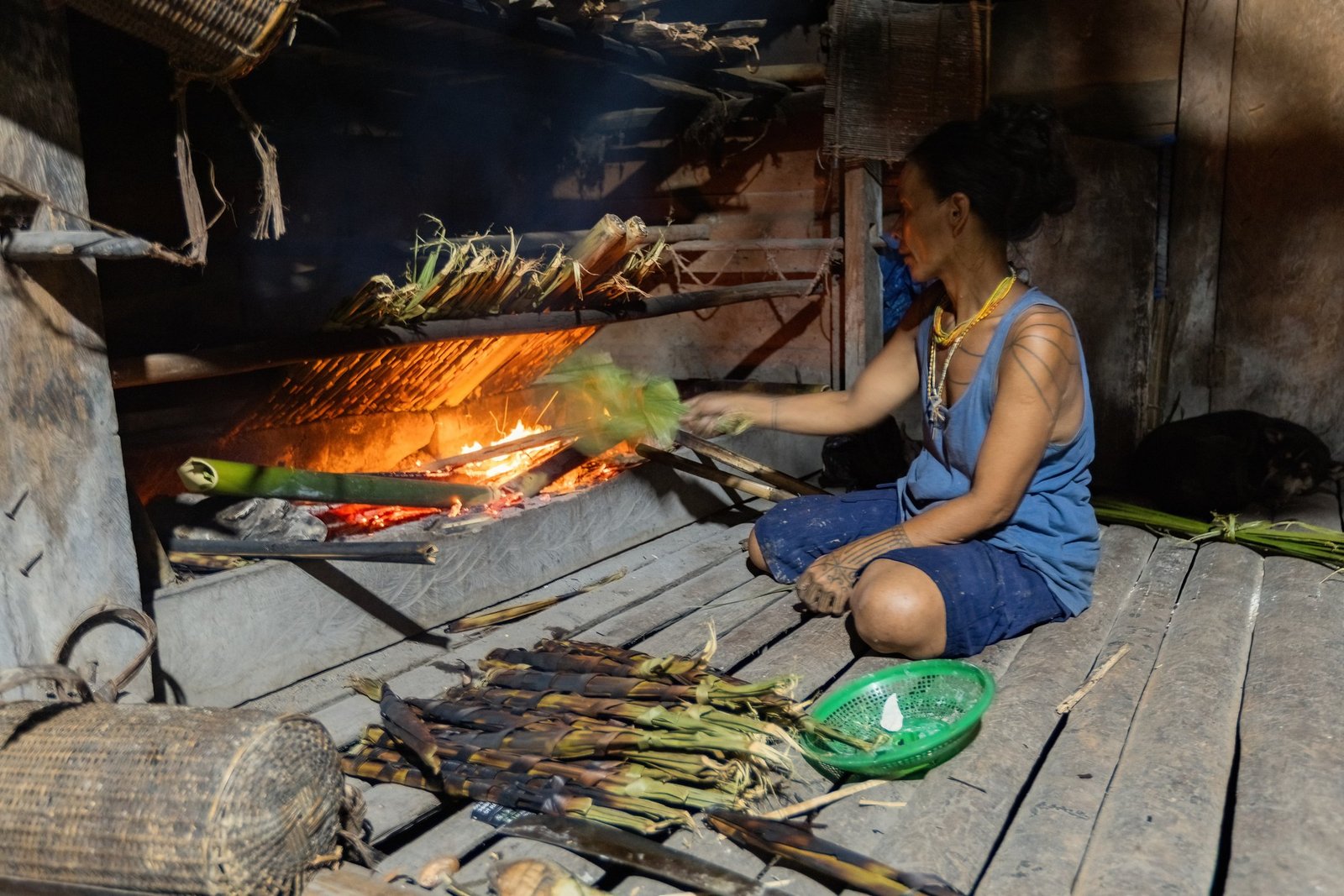
Fessler sees this as an example of a concept that evolutionary psychologists call “ready-made learning”—the idea that evolution doesn’t always give us complete instructions for things, but instead gives us a head start in quickly learning important things. In the case of fire, a natural fascination with fire drives the motivation to master it. Once kids get the hang of it, it no longer has the same powerful appeal.
On the other hand, children whose curiosity about fire never finds a useful outlet may end up spending their adult lives staring at the bonfire for hours on end.
“The idea,” Fessler says, “is that if you don’t have the right development experiences, that motivation doesn’t go away, because you never have enough information in the system to say, ‘Okay, we’ve done our job. Now we can take a step back.'”
However, not all evidence fits neatly into Fessler’s theory. A 2015 study he co-authored evaluated college students in Anchorage, Alaska, a population with varying levels of fire exposure and mastery, and found something unexpected: People who had grown up with more experience with fire actually reported enjoying it more as adults, not less.
Fessler is careful not to overstate the case. “It is possible that even in our Anchorage sample, participants did not have a sufficiently extensive daily experience with fire as a mundane tool during childhood,” he says. “Or our hypothesis could simply be wrong!”
More than a spark
Fessler’s theory is not the only investigation into the role of fire in human history. Research led by Christopher Lynn, an anthropologist at the University of Alabama, has explored a related but separate question: not why we are attracted to fire, but what it actually does to us once we look at it.
In one study, he tracked blood pressure while volunteers watched fire under different conditions and found a measurable drop, particularly when the fire included its natural crackling sound. The effect grew stronger the longer people looked.
Lynn’s research also addresses dissociation, not in the clinical sense, but the same everyday type of “disconnection” you would experience when getting lost in a good book or movie. Fire, their research suggests, could trigger a mild version of that state, where attention narrows and the mind calms.
The research also points to something bigger than personal comfort. Evolutionarily, more tolerant people may have had a real advantage around fire. Calmer group members tend to create less social conflict. They are more cooperative, more willing to share food, and more likely to watch each other’s backs. A fire that helped people relax might have rewarded those who were able to take advantage of that calm, not just in the moment, but in the alliances and solidarity it made possible.
Fessler, for his part, is not surprised by any of this.
“I’m not surprised that we see these relaxation effects,” he says. “Part of it is probably due to the stimulating properties of fire itself, part of it is the emotional attraction to it, and part of it is clearly cultural.”
Related stories from ‘That Moment When’
Fessler admits he’s a little baffled that fireplaces remain a selling point for modern homes, given their relative inefficiency, cost, and environmental impact.
“If you look at real estate listings, what do they describe? The number of bedrooms, the square footage, the number of bathrooms, whether it has a pool, and the number of fireplaces,” he says. “Which is completely absurd.”
Adults may never eliminate the need to look into a fireplace, no matter how irrational it may seem. But there might be a smarter way to handle that same curiosity about fire in kids.
Fessler points to fire safety programs in Germany that skip the usual “stay away” warnings that American children hear growing up. Instead of telling children to avoid fire altogether, the programs teach them how to build and handle it safely. Fessler isn’t sure how the program’s designers arrived at this approach, but he says he follows everything his research suggests.
“Instead of just saying ‘no,'” he says, “they’re saying, ‘this is how to handle fire safely and responsibly.'”
In Ask us anythingPopular Science answers your most outlandish and mind-blowing questions, from the everyday things you’ve always wondered to the strange things you never thought to ask. Do you have something you’ve always wanted to know? ask us.

2025 PopSci Best of what’s new
For more tech updates, stay tuned to our blog.