
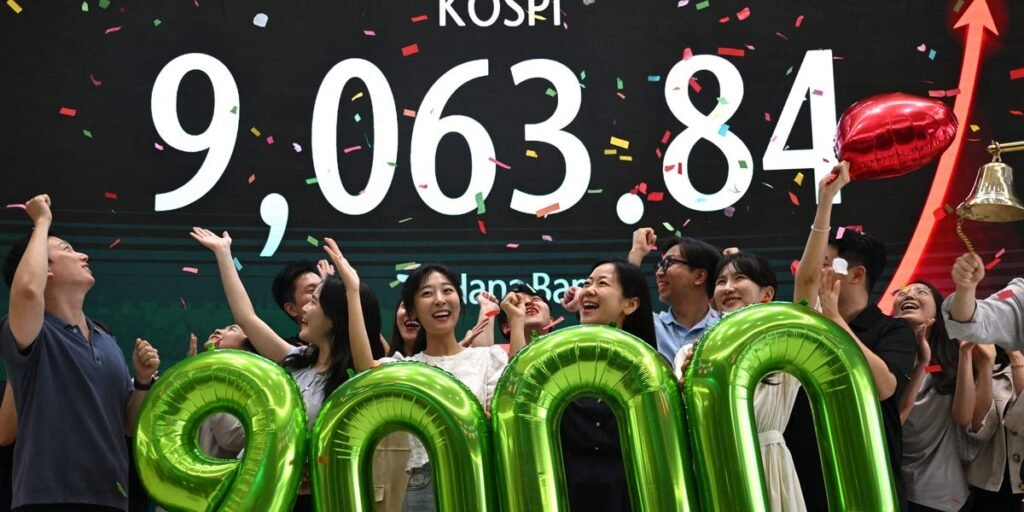
South Korea’s breakneck stock market rally has been rocked by wild swings in recent weeks, but Goldman Sachs says the recent turmoil has not changed its bullish outlook. South Korea was Asia’s best-performing stock market in the first half of 2026, with the benchmark Kospi index nearly doubling. But that rally has come under pressure
South Korea’s breakneck stock market rally has been rocked by wild swings in recent weeks, but Goldman Sachs says the recent turmoil has not changed its bullish outlook.
South Korea was Asia’s best-performing stock market in the first half of 2026, with the benchmark Kospi index nearly doubling. But that rally has come under pressure recently, with wild swings in chip stocks tripping circuit breakers and testing investors’ appetites.
On Monday, the Kospi opened higher before reversing course to trade 2.1% lower at 12:56 a.m. ET.
Despite concerns about concentration risk (as AI-driven gains at Samsung Electronics and SK Hynix drove most of the market’s gains), Goldman expects the rally to broaden beyond trading in AI memory chips in the second half.
“Earnings momentum is increasingly improving in other sectors,” Goldman analysts wrote in a note on Sunday, pointing to energy, materials and industrials.
The change is manifesting itself in the positioning of investors.
“Incremental foreign inflows have already begun to shift toward other AI-related beneficiaries and industries, and we expect this trend to continue as investors seek exposure to the broader AI supply chain and opportunities that are not correlated with AI,” the analysts wrote.
Despite concerns that the rally has become speculative, Goldman said retail positioning does not resemble that of an overheated market.
“Retail activity has increased, but investor exposure remains well below levels typically associated with market excess,” they wrote.
The bank also said the headline margin lending numbers overstate investor risk because much of the growth in ETF leveraged assets reflects rising stock prices rather than new lending.
Domestic households also have to bet on Korean stocks, Goldman added.
“Korean households continue to hold portfolios biased toward property rather than exhibiting full positioning toward domestic stocks,” they wrote.
Because households continue to invest heavily in real estate, cash and foreign stocks (particularly U.S. stocks), domestic investors still have significant ability to increase allocations to Korean stocks if market conditions remain favorable, the analysts wrote.
The bank expects exceptionally strong earnings growth to continue, forecasting profits will rise 320% this year and another 35% in 2027. Valuations outside of Samsung Electronics and SK Hynix remain reasonable relative to regional peers, Goldman said.
Goldman expects the Kospi to reach 12,000 in the next 12 months, implying a rise of more than 20% from current levels, although it warns that the rally is likely to take a “bumpy road.”