AI agents have quickly become Silicon Valley’s latest obsession. Now comes the harder part of figuring out how they’ll make money. The attention comes amid Meta’s recent launch of Muse, which has brought fresh attention to a new generation of AI software designed to shop online, book travel, and complete tasks on users’ behalf. Goldman
Long-term Treasury yields around 5% have made government bonds attractive again, but AI infrastructure still offers a better opportunity, according to a Goldman Sachs executive. “Personally, I think the asymmetric expression is being long compute,” said Anshul Sehgal, Goldman’s global co-head of fixed income, currencies, and commodities. Sehgal said he favors AI infrastructure companies, including
Investors have worried that higher yields would drive foreign buyers out of the US corporate bond market. So far, that hasn’t happened. Despite a sharp rise in Treasury yields this year, foreign demand for US corporate bonds has remained robust, according to Goldman Sachs. Through the end of June, net foreign purchases of US corporate
The emergence of new technology has long inspired humans to shape our environments. The invention of steel permitted the rise of skyscrapers, the automobile inspired highway systems and the internet gave rise to a whole new set of digital spaces. Now, a new force for change is upon us. The pace of improvement in AI
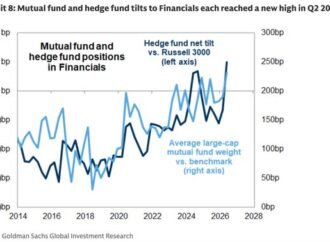
Investors are split on the AI trade, but they’ve converging on one sector of the stock market in particular in recent months: financials. Hedge funds and mutual funds have both poured money into the sector, even as their investing moves diverge when it comes to high-flying areas like AI. In fact, both groups’ buying of
Only about 12% of family-owned businesses make it to a third generation still under family control, according to a new Goldman Sachs playbook aimed at the founders and dynasties the bank counts among its most prized clients. It’s a statistic Goldman itself put in print in “Honoring Legacy and Positioning for the Future,” a paper