On Monday, Decagon CEO Jesse Zhang published a provocative new theory, under the title “Everyone is wrong about open source AI in the enterprise.” The post addresses one of the most interesting contradictions in today’s AI economy: More mature AI deployments are shifting to lighter models, he says, even at his own company. But total
On Monday, Decagon CEO Jesse Zhang published a provocative new theory, under the title “Everyone is wrong about open source AI in the enterprise.” The post addresses one of the most interesting contradictions in today’s AI economy: More mature AI deployments are shifting to lighter models, he says, even at his own company. But total spending on expensive next-generation models has barely changed.
It’s a new way of thinking about the relationship between frontier and open source models. According to Zhang, they are not competitors and the success of open source models does not come at the expense of cutting-edge laboratories. Instead, they are two phases of the same lifecycle, with expensive frontier models used to test use cases that can be ported to cheaper open source alternatives as they mature.
As more mature use cases shift to lighter models, new use cases continue to emerge and overall spending on cutting-edge models barely decreases.
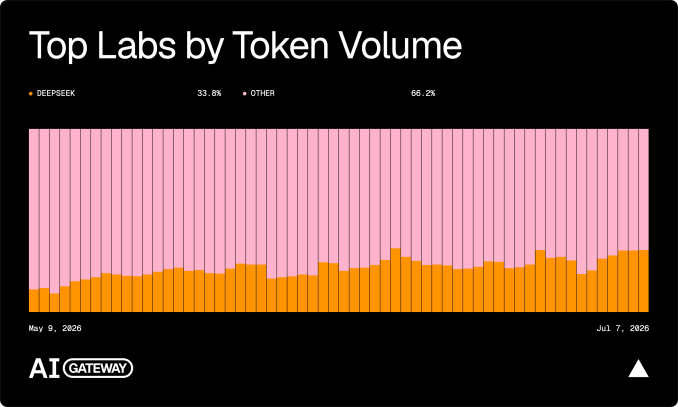
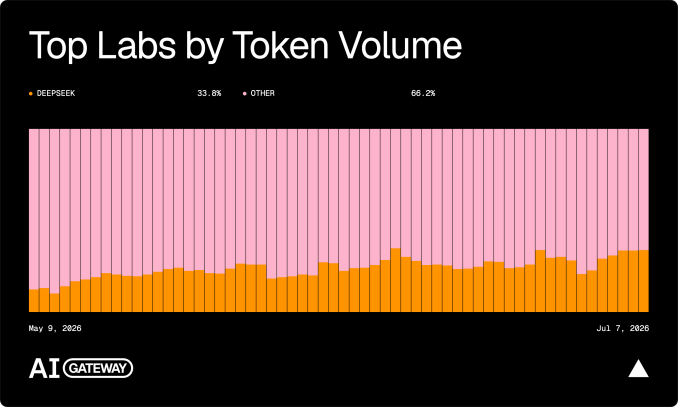
Zhang doesn’t provide much data to support this point, but it’s not hard to find. Vercel’s AI gateway dashboard shows that just last week, DeepSeek has become the leader in token volumes and now processes just over a third of the tokens passing through the company’s infrastructure. Z.ai, the lab behind the popular GLM-5.2 model, jumped to a respectable fourth place during the same period.
But if you scroll down to total token spending, you’ll see that Anthropic still accounts for more than half of the total AI spending on the platform. With much of the recent change coming from rising Anthropic prices, the share has fallen slightly over the past month, but not significantly.
OpenRouter tells a similar story, capturing a much larger (but slightly less enterprise) market segment. Deepseek V4Flash is the top winner in general use, processing 5.3 billion tokens per week. The most popular frontier model, Opus 4.8, manages just over 2 billion. OpenRouter doesn’t rank models by total spend, but records the average token cost for Opus 4.8 as about 23 times higher than V4Flash ($1.37 per million tokens, compared to just 6 cents), which would mean Opus was probably still capturing most of the spend.
Those numbers don’t even capture the newest arrival, Nvidia’s Nemotron, which is poised to jump to the front of the pack by virtue of Nvidia’s strong connections and the model’s extreme adaptability.
Those numbers don’t fully prove Zhang’s point about AI lifecycles, but they do show that cutting-edge labs like Anthropic aren’t suffering too much from the rise of open source, at least not yet. One explanation is that the market for AI addressable tasks is growing so fast that the best models can maintain their position simply by mastering early-stage implementations. As Zhang says: “Frontier labs will continue to own discoveries. Open source will increasingly own production.” Another explanation could be that, even as customers migrate to open source, many use cases are so difficult that they cannot be completely replaced with cheaper alternatives.
Either way, this two-level model economy may become a relatively stable feature of the AI economy.
As recently as last September, I was writing about the possibility that the foundation’s labs could end up selling coffee beans to Starbucks, that is, serving as commodity inputs while the application layer reaped the benefits. Some parts of that prediction came true: vertical AI games shifted to lighter models, for example, and the economics of “GPT wrapper” startups have remained largely stable.
But we are also seeing that, token by token, frontier providers have been able to retain the most desirable part of the market. the price of the premium token. And that doesn’t seem likely to change anytime soon.
When you buy through links in our articles, we may earn a small commission. This does not affect our editorial independence.
Check back often for more exciting news!