A 25-foot fiberglass model of a shark (or at least its back half) adorning the roof of a townhouse in suburban Oxford, England, the Headington Shark is the kind of local curiosity that makes any casual passerby think, “There must be a story there.” And there is: it’s a protest artwork conceived in 1986 by
A 25-foot fiberglass model of a shark (or at least its back half) adorning the roof of a townhouse in suburban Oxford, England, the Headington Shark is the kind of local curiosity that makes any casual passerby think, “There must be a story there.” And there is: it’s a protest artwork conceived in 1986 by sculptor John Buckley and owner Bill Heine as a statement against nuclear war and military airstrikes. Forty years later, however, “Learning to Breathe Underwater” imagines something very different, taking the eccentric work of art as a starting point for a fictional story of grief, healing and home repair, and as the visual cue for its own eccentric style. However, if the real-life shark sculpture was a controversial point of community debate, Rebekah Fortune’s very likeable and sincere tearjerker won’t be so divisive.
Warmly received at Karlovy Vary, where it premiered in the Special Screenings sidebar, “Learning to Breathe Under Water” should continue to please crowds on the festival circuit before being snapped up by independent distributors with an eye for unconventional but crowd-friendly (and indeed, family-friendly) fare. Sympathetic turns from Oscar nominee Maria Bakalova and BAFTA nominee Rory Kinnear will help raise the film’s profile, although its best performance comes from 11-year-old Irish actor Ezra Carlisle (most recently seen in “Hokum”), who is immensely attractive but never cloying as our gravely serious, often accidentally funny protagonist and narrator.
For the purposes of this story, the shark Headington has been relocated to a nondescript family home in a nondescript Irish village, where middle-aged British artist Peter (Kinnear) and his pre-teen son Leo (Carlisle) have lived a quiet, peaceful life together since the deaths of his wife and mother, respectively, a few years ago. Peter installed the peculiar sculpture in the midst of pain, although he is reluctant to explain why to anyone; it’s a curiously attention-seeking act by a man who would prefer to distance himself from society. The bright and curious Leo is more socially engaged, although he keeps his friends at school strictly separate from his home life, where Peter’s ongoing depression dictates their mood and routine together. In his bedroom, where a huge hole has been opened in the ceiling to accommodate the shark, Leo murmurs his secret thoughts into the beast’s synthetic belly; It’s a one-sided therapy, but he feels better for it.
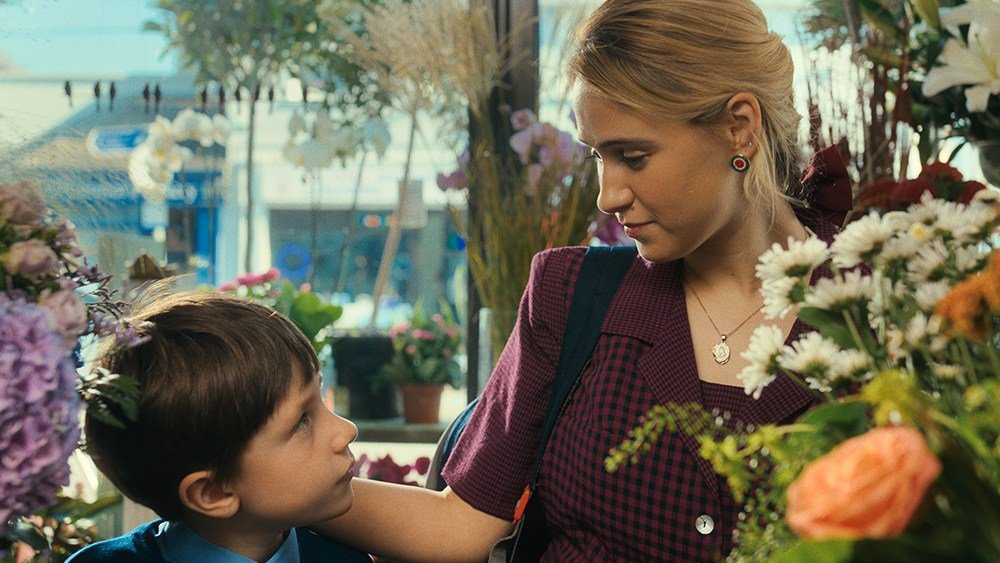
A concerned teacher recommends Anya (Bakalova), a happy-go-lucky Bulgarian au pair who needs a place to stay, and although Peter is initially reluctant to let anyone into this melancholy house of two, he admits that he could use some domestic help. As far as babysitters go, Anya isn’t at Mary Poppins levels of magic, but she’s bubbly and kind-hearted, and that goes a long way. Leo visibly lights up and flourishes under your care; Peter is a tougher nut to crack, but with your support, he takes tentative steps toward rejoining the outside world. Although Richard Brabin’s script has its share of off-kilter humor, it’s pleasantly grounded and believable in terms of the characters’ inner growth: the film mostly uses no drastically transformative arcs or easy solutions, but rather hard-won incremental changes of heart and mind.
Fortune’s previous feature, the 2017 teen drama “Just Charlie,” sensitively examined the gender dysphoria and trans awakening of a teenage soccer prodigy, and once again demonstrates a gentle aptitude for articulating complex emotional struggles from a youthful point of view. Aided by naïve animated intrusions into the frame that illustrate his singular imagination and frequently lateral lines of thought, Leo’s narration is endearingly strange but not overly cheesy, and Carlisle’s excellent, natural performance sells the character’s sincere vulnerability with just a touch of deadpan irony. “People say that, but they don’t laugh,” he responds when Anya says it’s funny; With his tense body language and solemn brow, he inspires as much concern as amusement.
Occasionally, “Learning to Breathe Under Water” takes shortcuts: Fortune and production designer May Davies find visual shorthand for the characters’ psychological state in the ocean blue hues of the home interiors, as dictated by Peter, versus the bright yellows of his wife’s personal effects, hidden in the attic. A third-act shift toward recovery happens too quickly; A heated speech by Anya about the sculpture’s symbolic meaning falls too squarely on the nose. But Fortune’s thoughtful little charmer accomplishes the difficult task of dramatizing trauma and healing in terms accessible to all ages. It doesn’t condescend to its young protagonist by glossing over it, while also identifying those aspects of adult life (why people die, lie, leave, or build sharks on the ceiling) that he won’t understand for a while.
For more tech updates, stay tuned to our blog.