
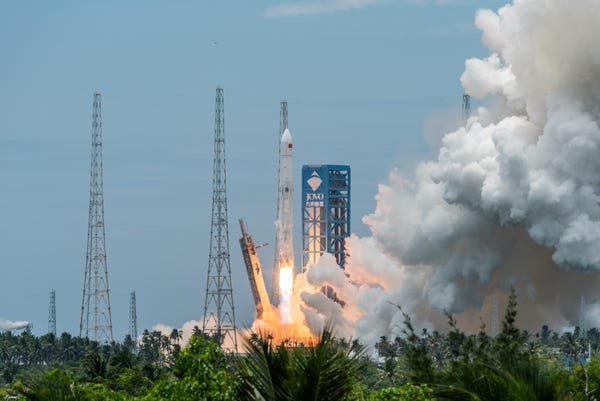
SpaceX is flying high after a record-breaking initial public offering, but China seems determined to bring Elon Musk back to Earth. China successfully landed the booster stage of its reusable Long March-10B rocket on Friday, the first time it has launched and partially returned a reusable orbital rocket safely to Earth. It means China Aerospace
SpaceX is flying high after a record-breaking initial public offering, but China seems determined to bring Elon Musk back to Earth.
China successfully landed the booster stage of its reusable Long March-10B rocket on Friday, the first time it has launched and partially returned a reusable orbital rocket safely to Earth.
It means China Aerospace Science and Technology Corporation, which built the rocket, joins Musk’s SpaceX and Jeff Bezos’ Blue Origin as the only organizations to have successfully landed a booster rocket.
Mao Ning, spokesperson for China’s Ministry of Foreign Affairs, said in an X publication that this is a “big leap toward reusable launch capabilities.”
A historic day in China’s space program!
China’s Long March-10B successfully completed its maiden flight and recovered its first stage via a maritime network. This is the first controlled recovery of a rocket in the country. A big leap towards reusable launch capabilities.… pic.twitter.com/FWuQXLltaD
– Mao Ning 毛宁 (@SpoxCHN_MaoNing) July 10, 2026
Local media reported that the first stage of the Long March rocket landed on a barge about six minutes after launch and was captured by a large net, reportedly the first “network-based recovery” of a rocket in the world.
Landing a first-stage booster, rather than letting it burn up upon reentry, is a key milestone in building reusable rockets, significantly reducing launch costs. SpaceX landed its first booster in 2015 and has since successfully launched and recovered its Falcon 9 rocket hundreds of times.
In 2024, SpaceX captivated the world by snagging the nearly 400-foot-tall super-heavy booster, used to propel its next-generation Starship rocket into orbit, with the toothpick-shaped arms of its “Mechazilla” launch tower.
Blue Origin achieved its first powered landing last November, when the first stage of its towering New Glenn rocket successfully touched down on a platform in the Atlantic Ocean.
Bezos’ rocket company has suffered setbacks since then, with New Glenn exploding on the launch pad in May.
Landing a booster is a significant step toward China’s ambition to catch up with SpaceX, which launches far more material into orbit than any other country or company.

China’s reusable Long March rocket can’t carry as much to orbit as SpaceX’s Falcon 9. Ding Yi/VCG via Getty Images
The Asian superpower is also trying to build a rival to SpaceX’s Starlink satellite internet service, and state-owned SpaceSail has launched around 200 satellites into orbit since 2024.
That’s far behind Starlink, which has about 10,000 satellites in low Earth orbit. China’s Long March rocket also trails SpaceX’s Falcon 9, with a maximum payload capacity of 16 tons compared to 25 tons for the Falcon and more than 100 tons planned for Starship.
However, in a post on
“They have added Starship aspects, such as the use of stainless steel and metalox, to the Falcon 9 architecture, which would allow it to defeat the Falcon 9,” he wrote.
“But starship [is] in another league,” Musk added.