
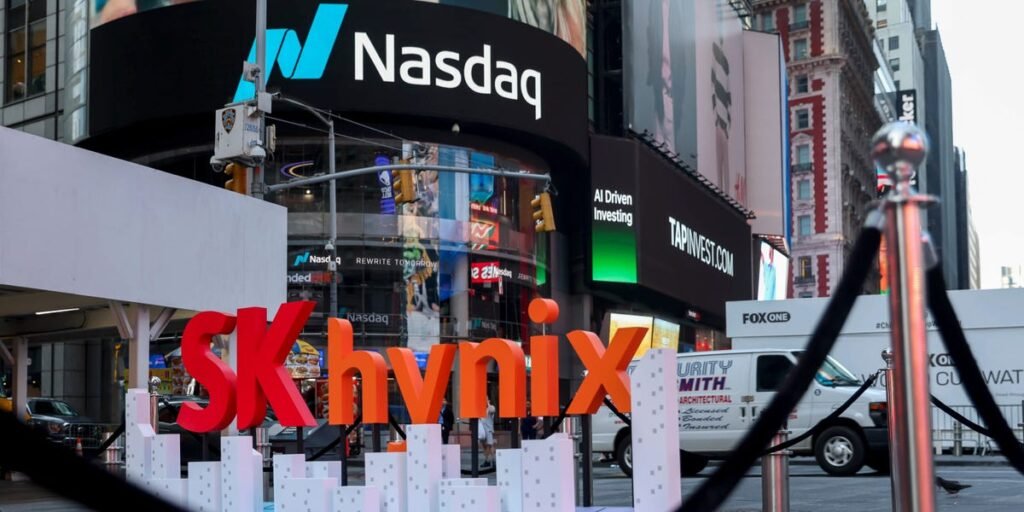
South Korea’s SK Hynix has been on a rollercoaster ride recently, but little has actually changed in its position at the center of the AI boom. On Wednesday, the memory giant’s Seoul-listed shares rose as much as 13% after its Nasdaq-listed American Depositary Receipts rose 27% overnight. The rally followed a sharp sell-off earlier this
South Korea’s SK Hynix has been on a rollercoaster ride recently, but little has actually changed in its position at the center of the AI boom.
On Wednesday, the memory giant’s Seoul-listed shares rose as much as 13% after its Nasdaq-listed American Depositary Receipts rose 27% overnight.
The rally followed a sharp sell-off earlier this week, extending the wild swings that have defined trading since SK Hynix’s successful debut on the Nasdaq on Friday.
The changes have not only been in direction. They have also exposed a widening gap between SK Hynix’s US and Korean listings, with Nasdaq-listed ADRs now trading about 35% higher than their Korean counterparts.
Part of that premium reflects easier access rather than changes in fundamentals.
The Nasdaq listing removed long-standing hurdles for many U.S. investors, including Korean agreements, currency management and restrictions on investment mandates, according to Scott White, an analyst at Singapore-based Yaru Investments.
But it has also created unusual market dynamics, with early trading driven by a combination of “exceptional fundamentals, limited float and saturated positioning in two markets with different investor bases,” White wrote in a Monday note.
Morningstar equity analyst Jing Jie Yu said he expects ADRs to continue to find their feet given their limited trading history. This makes it difficult for investors to determine an appropriate premium on Korean stocks.
Leverage Magnifies Volatility
The ADR premium is not the only technical force influencing the stock.
Trading has also been amplified by individual stock leveraged ETFs linked to SK Hynix. Similar products were launched in the US following SK Hynix’s debut on Nasdaq, adding another layer of momentum-driven trading.
That market dynamic is unlikely to go away anytime soon.
Morningstar’s Yu said he expects “tremendous volatility” in both SK Hynix ADRs and Korean stocks.
He added that unprecedented levels of retail participation and margin borrowing are exacerbating volatility, and that margin calls are likely to amplify selling during sharp pullbacks.
Despite the market turbulence, analysts are generally optimistic about SK Hynix.
South Korea’s KB Securities said the recent weakness reflected growing concerns about a slowdown in AI investment. This comes despite the fact that “neither the long-term growth trajectory of AI nor the fundamentals of memory supply and demand have changed significantly since a month ago,” Jeff Kim, the company’s head of research, wrote on Wednesday.
“Therefore, we believe the recent share price decline reflects sentiment rather than fundamentals,” Kim wrote.