
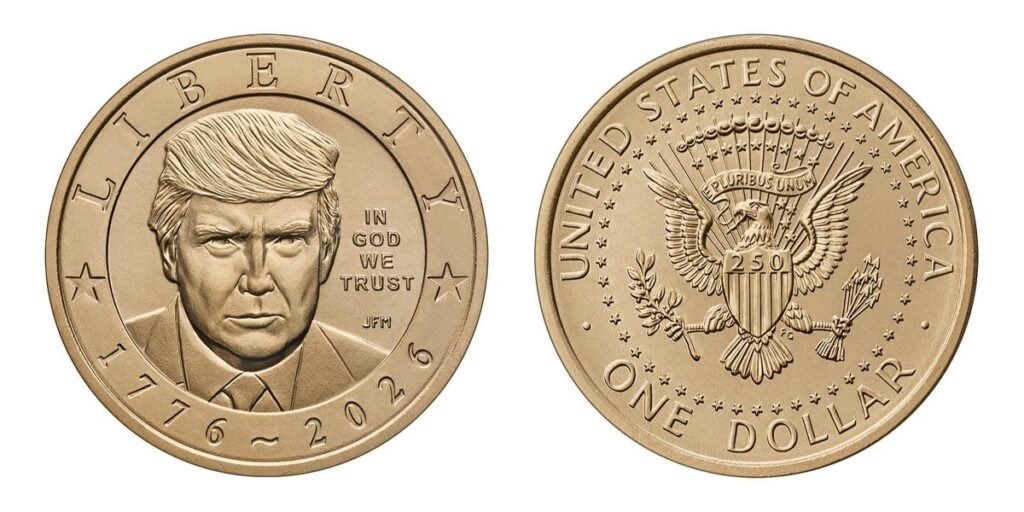
Donald Trump wants to add another government-issued item to the growing list bearing his name or likeness: a commemorative $1 coin. Treasury Secretary Scott Bessent on Wednesday unveiled the design of a new gold-toned $1 coin commemorating the 250th anniversary of the United States. The coin features a portrait of Trump looking forward along with
Donald Trump wants to add another government-issued item to the growing list bearing his name or likeness: a commemorative $1 coin.
Treasury Secretary Scott Bessent on Wednesday unveiled the design of a new gold-toned $1 coin commemorating the 250th anniversary of the United States. The coin features a portrait of Trump looking forward along with the words “In God We Trust” and the inscription “1776-2026.” The initials “JFM” stand for Joseph F. Menna, chief engraver of the US Mint since 2019.
Bessent said in X that the coin “celebrates the strength of American values and the promise of a nation dedicated to preserving freedom for all.”
The design is likely to face legal scrutiny, according to the committees that oversee the coins and medals. A long-standing federal code on “engraving and printing of currency and security documents” says that “only the portrait of a deceased person may appear on the currency and securities of the United States.”
Donald Scarinci, a member of the Citizens Advisory Committee on Coinage, a nonpartisan federal group created by Congress to advise the Secretary of the Treasury on American coin and medal designs, told Business Insider that the Committee has never been asked to review a coin design featuring Trump’s portrait and that production of the coin would be illegal.
“No one but Congress has the power to legislate or enact coin designs in the United States,” Scarinci said. “And Congress has not passed any legislation authorizing this currency.”
“The law Congress passed creating the Citizens Advisory Committee on Coinage requires that every coin produced by the United States Mint be reviewed by both the Citizens Advisory Committee on Coinage and the Commission of Fine Arts,” Scarinci added.
A Treasury spokesperson told Business Insider that the The Circulating Collectible Coinage Redesign Act of 2020 “authorizes the Secretary of the Treasury to issue $1 coins featuring iconic United States Semiquincentennial designs during the one-year period beginning January 1, 2026.”
However, the text of the Act referred to by the Treasury also states that “no head and shoulders portrait or bust of any person, living or dead, nor any portrait of a living person may be included in the design of the reverse of specified coins.”
There will be no gold or other precious metals on the coin, despite its gold finish, the Treasury spokesman said. It will be minted in Philadelphia and available in the fall.
The Treasury move sparked immediate bipartisan opposition.
“Congratulations, we have entered the final stages,” Rep. Thomas Massie, a Republican who represents Kentucky’s 4th Congressional District, posted on X in response to Bessent’s post. “Eliminate the penny, eliminate the nickel, and make some commemorative gold coins that no one can afford.”
“American families are struggling just to make ends meet,” Rep. Brad Schneider of Illinois’ 10th Congressional District wrote in X. “Trump’s gold coin perfectly reflects President Trump’s complete disregard for the burdens his administration is imposing on our citizens.
The coin is the latest example of Trump’s push to leave his mark on federal symbols during his second term. His administration has also launched commemorative passports bearing his image, announced plans for new $100 bills bearing his signature and backed proposals to place his image on other commemorative coins.