
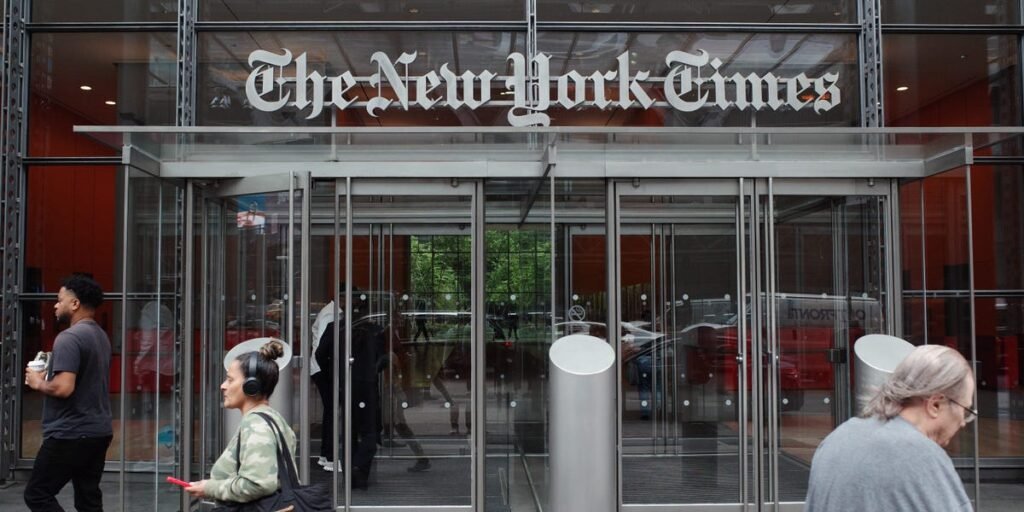
The New York Times on Wednesday asked a federal judge to quash Justice Department subpoenas to journalists who reported on safety failures on President Donald Trump’s new Air Force One plane. David McCraw, the newspaper’s top attorney, called the subpoenas “abusive” and “inappropriate” in a statement. “As we stated in our motion, these subpoenas are
The New York Times on Wednesday asked a federal judge to quash Justice Department subpoenas to journalists who reported on safety failures on President Donald Trump’s new Air Force One plane.
David McCraw, the newspaper’s top attorney, called the subpoenas “abusive” and “inappropriate” in a statement.
“As we stated in our motion, these subpoenas are filed in bad faith to punish the Times for its coverage,” McCraw said. “They violate the constitutional rights of the Times and its journalists. We are going to court to defend the rights of our journalists to freely report on the administration and provide the public with important stories.”
The subpoenas were signed by Jay Clayton, Manhattan’s top federal prosecutor and President Donald Trump’s nominee for director of national intelligence. A spokesperson for Clayton’s office did not immediately respond to a request for comment.
The five Times reporters who were subpoenaed Friday — Julian Barnes, Eric Lipton, Tyler Pager, Eric Schmitt and Adam Goldman — published an investigation the day before about safety concerns with the new Air Force One, which was donated by Qatar. The modified Boeing 747-8 aircraft lacks the same sophisticated missile defense capabilities of the older plane, the Times reported.
The subpoenas require the reporters to testify before a grand jury in Manhattan and initially required them to appear Wednesday, the Times previously reported.
McCraw said he filed the motion to quash under seal because of a court order and is seeking to have the documents unsealed. U.S. District Judge Ronnie Abrams, who heads Manhattan federal court’s media access committee, is assigned to oversee grand jury matters this week.
The subpoenas became an issue during separate hearings on Capitol Hill on Wednesday, when senators on the Intelligence Committee grilled Clayton about what Sen. Ron Wyden called a “blatant attack” on journalists, and a Democratic senator on the Judiciary Committee asked Todd Blanche, Trump’s pick for attorney general, about “attacking journalists.”
At Clayton’s confirmation hearing, Wyden, an Oregon Democrat, asked why he had taken the unusual step of approving subpoenas to journalists. Clayton said they were part of “an ongoing national security investigation.”
“I am pleased to speak with you and this committee about our approach to the First Amendment and our efforts in all cases to limit to the greatest extent possible any intrusion into the functioning of the free press,” Clayton said.
Clayton told Wyden he followed “the process we needed to follow.”
“I operate by asking my team, ‘What do you think?'” Clayton said. “You can be assured that any action in this regard was an exercise in consultation with prosecutors in my office.”
The White House ordered FBI Director Kash Patel to oversee the investigation into the leak of the Times’ reports on Air Force One, according to the Times. During Blanche’s confirmation hearing before the Senate Judiciary Committee, which took place at the same time as Clayton’s, Senator Peter Welch asked her if she supported Patel’s effort to subpoena Times reporters.
Blanche told Welch, a Vermont Democrat, that the Justice Department viewed journalists as “material witnesses, just as reporters would witness a car accident.”
“The question we want to ask you is who provided you with classified national security information, which everyone in this agency should want to protect – I hope so,” Blanche said.
A spokesperson for The New York Times declined to comment on Blanche and Clayton’s comments to the Senate committees.
In an email to the newsroom on Saturday, Times executive editor Joe Kahn called the subpoenas a “retaliatory abuse of prosecutorial power.”
“This is a blatant attempt to intimidate individual journalists and prevent The Times and other independent news outlets from doing important reporting protected by the First Amendment,” he said. “Of course, we will mount a full defense of our staff. We will also fight to ensure that this brazen effort to suppress coverage of a matter clearly of public concern does not in any way impede the accountability of this or any other administration.”
During the Trump administration, the Justice Department took a more aggressive stance toward journalists. Last year, then-Attorney General Pam Bondi made it easier for prosecutors to obtain search warrants and subpoenas for members of the media by eliminating Biden-era policies that required department officials to weigh alternative ways to obtain the information they sought.
This story has been updated.