
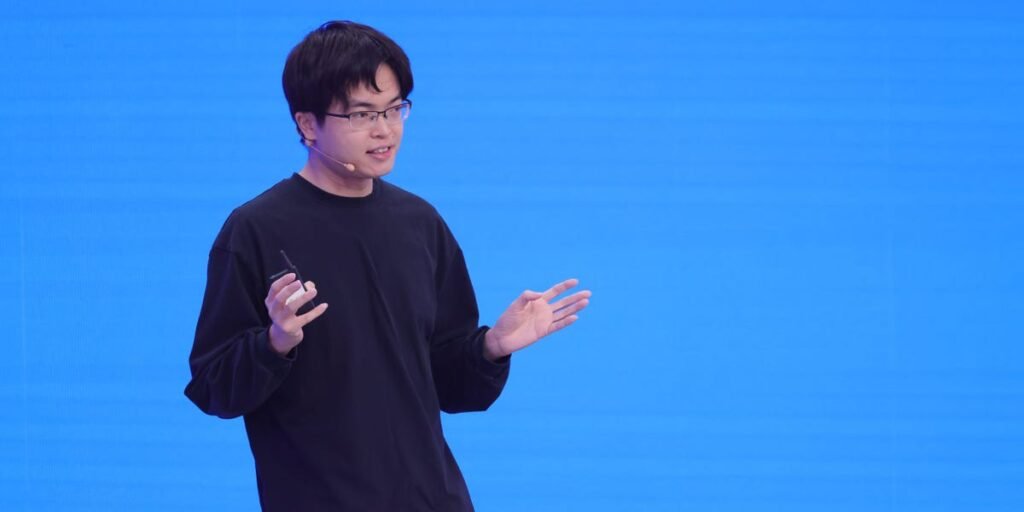
There is one founder making waves in the AI industry who is not an American tech billionaire like Elon Musk, Sam Altman or Dario Amodei. Yang Zhilin is the 34-year-old researcher and entrepreneur behind Chinese company Moonshot AI and its new open-weight Kimi K3 AI model, which caught the attention of Silicon Valley this week.
There is one founder making waves in the AI industry who is not an American tech billionaire like Elon Musk, Sam Altman or Dario Amodei.
Yang Zhilin is the 34-year-old researcher and entrepreneur behind Chinese company Moonshot AI and its new open-weight Kimi K3 AI model, which caught the attention of Silicon Valley this week.
Kimi K3 is China’s latest open weight model. Its coding and agency capabilities rival those of leading American lab models such as OpenAI and Anthropic and come at a much lower cost, marking a new milestone for China in the AI race.
Who is Yang Zhilin?
Yang was born in 1992 in Shantou, a city in China’s Guangdong province. He attended Tsinghua University before earning a Ph.D. at Carnegie Mellon University in Pennsylvania, where he studied with prominent AI researchers Ruslan Salakhutdinov and William Cohen.
“He is absolutely brilliant,” Salakhutdinov said of Yang in a post on X on Friday. In another post, Salakhutdinov said that after graduation, Yang was heavily recruited by Big Tech, but was committed to starting his own company.
While at Carnegie Mellon, Yang interned at Google Brain and Meta. He has also co-authored several research papers on topics ranging from limitations in how language models handle context to quick tuning tips.
Before launching Moonshot AI, Yang returned to China and contributed to several major AI projects, including Huawei’s PanGu model and Beijing Academy of Artificial Intelligence’s Wu Dao, a large-scale multimodal AI model. He also co-founded Recurrent AI, a startup that used artificial intelligence to analyze sales conversations and help companies improve their performance.
One of Yang’s principles in building AI is to lean toward scale.
“If you can solve it with scale, don’t solve it with a new algorithm. The value of the new algorithm is to enable better scale,” he told journalist Xiaojun Zhang in an interview posted on LinkedIn.
He helped start Moonshot AI in early 2023. The team behind the company had developed multiple AI technologies, including Transformer-XL, RoPE, Group Normalization, ShuffleNet, MuonClip, and Mooncake.
Moonshot AI’s first claim to fame was giving its base model Kimi K2 an unusually large context window (a trillion parameters) for processing long documents. Moonshot also has an AI assistant product, Kimi, and has since expanded into coding, research and autonomous AI agents, attracting backing from Alibaba, Tencent and other major Chinese investors.
Kimi K3 has now catapulted both Moonshot AI and its founder onto the global stage.
Vercel CEO Guillermo Rauch said Kimi K3 marked “the first time an open model is ahead of all owners in this comprehensive web engineering benchmark,” in a post on X. While Wharton professor Ethan Mollick called it “the closest to the frontier yet.”
“The ultimate AGI company will eclipse today’s giants: it will double or triple in scale. Not necessarily OpenAI, but such a company will exist,” Yang said in his interview with Zhang.
Why Yan Zhilin left the United States
Some leading tech figures lamented after Kimi K3’s launch this week that Yang would not stay in the United States to work in an American artificial intelligence laboratory. Legendary billionaire investor Vinod Khosla blamed the Trump administration’s restrictive immigration policies.
“An even bigger problem is the brilliant talent we are scaring away from other countries with our immigration policies for great talent,” he said in response to news of Kimi K3’s success.
The Trump administration has taken steps to tighten immigration restrictions, including on student visas. Last year, the government introduced a $100,000 fee for employers who sponsor some new H-1B applications for foreign workers. The ruling was later overturned by a federal judge and remains in litigation.
Then, in May, a memo from U.S. Citizenship and Immigration Services meant that people who previously could apply for a green card from within the U.S. might now have to leave the country while their case is processed.
And this week, the administration introduced a new rule that puts an expiration date on how long people with student visas can initially stay in the United States.
Salakhutdinov, however, said that while the American immigration process can be intimidating and “uncertain,” Yang was always determined to return to China and build his own company.
“I remember him telling me that if he didn’t at least try to start his own company, he would regret it for the rest of his life. I respect him and he was right,” Salakhutdinov wrote in X.