
Mealtime has always been a family affair for the Kochanczyks of Indiana. Dave Kochanczyk loved barbecuing, cooking Polish food, and preparing fresh vegetables from the garden. When he wasn’t in the kitchen, he led an active life, working as an electrical contractor, serving as a volunteer firefighter, and managing the family’s large rural property. Cancer
Mealtime has always been a family affair for the Kochanczyks of Indiana. Dave Kochanczyk loved barbecuing, cooking Polish food, and preparing fresh vegetables from the garden. When he wasn’t in the kitchen, he led an active life, working as an electrical contractor, serving as a volunteer firefighter, and managing the family’s large rural property.

Cancer cachexia candidate participates in first pivotal trial
That all changed after he was diagnosed with pancreatic cancer in 2010. Over the next seven years, as he endured intensive treatment, his love of food remained but his appetite waned. He lost muscle mass and became emaciated. Weakened and fatigued, he could no longer cut wood for the house stove.
Kochanczyk’s struggles were not only a result of the tumor and the treatments fighting each other in his body, but also cachexia, a cancer-related syndrome that causes reduced appetite and muscle atrophy. “It’s very hard to watch,” recalls Dave’s son, Martin Kochanczyk. Since his father’s death in 2017, Martin has become an advocate for cachexia awareness with the Cancer Cachexia Society, a community of scientists, people with the condition, and others who promote research, awareness, and treatment.
As Martin often explains to people with cancer and their families, his father was not an outlier. “Cachexia affects a lot of people,” he says. Between 50% and 80% of people with cancer, depending on the type of tumor and the stage of the disease, experience cachexia.
“I’ve heard people describe it as lying under a thousand-pound blanket,” says sociologist Abigail Newell, senior director of research at the Cancer Support Community in Washington, DC. “Sitting is like running a marathon.” And it’s more than a question of quality of life; Cachexia affects survival. Exhaustion, hopelessness, and other psychological symptoms can make people less willing to follow treatment. Severe cachexia can even make some therapies intolerable or cause some people to be excluded from clinical trials. Ultimately, 20% to 30% of cancer-associated deaths are attributable to cachexia, rather than the cancer itself.

Why do so many young people suffer from cancer? What researchers do and don’t know
Although cachexia was long considered an unavoidable part of cancer progression, it has now become a topic of study in its own right. In 2020, a global research initiative, Cancer Grand Challenges, asked scientists to propose projects on cachexia.
The initiative ended up funding an international team of doctors, scientists and advocates (16 research groups at 14 institutions) to the tune of £20 million ($25 million USD) to study cancer cachexia, its drivers, subtypes and potential treatments. Now in its fifth year, the project, known as CANCAN, has published about 30 papers, which have appeared alongside a growing wave of research from independent efforts.
With the influx of new studies, the very concept of cachexia is changing. Where scientists once saw simple malnutrition, muscle atrophy and weight loss, they now see a syndrome of uncontrolled metabolism throughout the body. Studies reveal how cachexia is more than just physical symptoms; It affects not only appetite and metabolism, but also motivation and behavior. And a handful of companies, including pharmaceutical giant Pfizer, are testing drugs for cachexia (see ‘Fighting cachexia’), raising hopes that a treatment may be on the horizon.
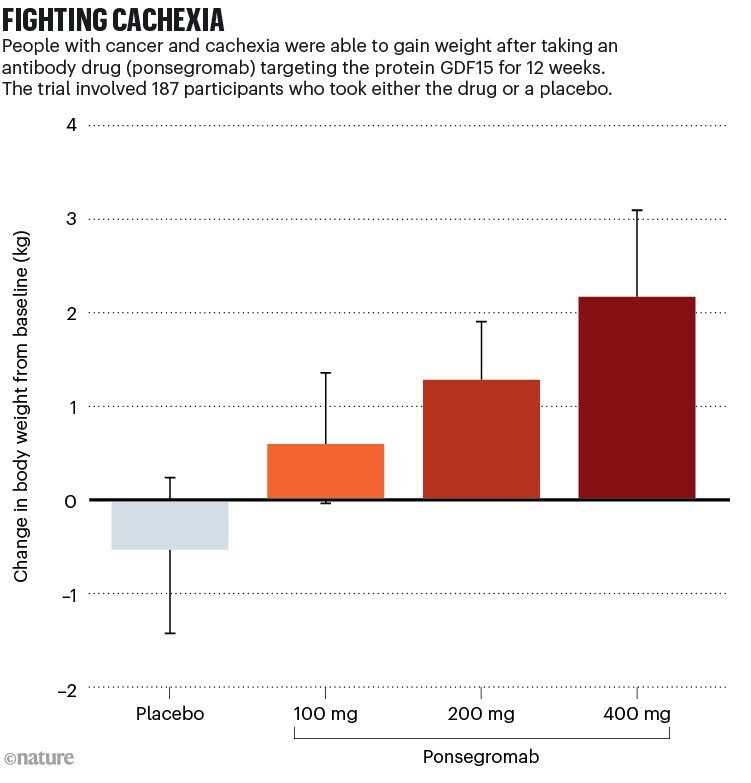
Source: Ref. 10
“It’s still an area of mystery,” says Ryan Schoenfeld, executive director of the Mark Foundation for Cancer Research in New York City, a grant-making organization. But the burst of activity in recent years has made him optimistic. “I’m confident in the future of research here, that we will discover ways to treat cachexia that will make it more reversible than it is today,” he says. “The ideal would be to prevent it.”
Organ crosstalk
Cachexia has long been something of a paradox in cancer: widely prevalent and having an enormous impact on people, yet it existed beyond the gaze of many doctors and scientists. Specialists typically focused on the tumor, thinking that eliminating the cancer would alleviate cachexia, Schoenfeld says. There are no approved medications for cancer cachexia in most of the world. The appetite stimulant anamorelin is available in Japan, but the US Food and Drug Administration and the European Medicines Agency found that the evidence of its benefits was insufficient for approval. Even if people with this condition force themselves to eat more or are fed through a tube, that does not solve the problem.
As more people survive longer with cancer, the need for cachexia treatment is only growing, and funders and scientists have taken notice. “There is a whole ecosystem of cachexia researchers now,” says Tobias Janowitz, a physician-scientist at Cold Spring Harbor Laboratory in New York and CANCAN co-principal investigator. Cachexia, once a specialized topic relegated to specialized conferences, has been on the agenda at the American Association for Cancer Research’s annual meeting for the past few years, says Mariam Jamal-Hanjani, a clinical scientist at University College London and CANCAN co-investigator.
Andrea Bonetto, a muscle physiologist at the University of Colorado Anschutz in Aurora, has been studying cachexia since before the field took off. When it began, the disease was primarily considered a case of muscle atrophy. “What is clear now, compared to 24 years ago, is that cachexia is not a single gene, single tissue disease, but is multifaceted, multitissue and multisystem,” he says. “There is enormous interference between different tissues and organs.” Each region of the body can receive signals that cause it to alter its metabolism or activities, and send signals that influence cachexia pathways elsewhere.
The path begins with cancer. The immune system may respond to the presence of abnormal cells, causing inflammation. But the signaling associated with cachexia is widespread. Bonetto’s group discovered, for example, that tumors that do not originate or infiltrate bone can nevertheless cause cell death and bone degradation.1. Antibodies that block a regulator of bone remodeling and muscle structure called RANKL, which is produced in bones and several types of tumors, minimized bone and muscle loss and preserved strength in a mouse model of ovarian cancer.2. Bisphosphonates used to treat osteoporosis had similar benefits, suggesting that these drugs could also have a role in the treatment of cachexia.
The liver also appears to play a key role in signaling cachexia. For one thing, their secretions appear to worsen muscle and bone breakdown, Bonetto says. A contribution from this organ makes sense, says Mauricio Berriel Díaz, a biologist at the Helmholtz Center in Munich, Germany, because the liver is an important regulator of metabolism. He and his colleagues reported that liver cells respond to cachexia by secreting a handful of specific compounds.3. In laboratory dishes, these compounds cause heart cells to shrink and fat cells to break down fat. Levels of these secretions were also elevated in people with cachexia.3.
Another study, in mouse models of cachexia, linked liver problems to the vagus nerve, which runs between the brain and other organs. Vagus dysfunction caused the liver to alter its metabolism, adopting a pro-inflammatory cachexia-promoting state. Blocking vagal activity minimized weight loss and improved appetite and activity level in these mice4.
A brain disease
Ultimately, the brain becomes a key orchestrator of cachexia, says Adam Kepecs, a neuroscientist at Washington University in St. Louis, Missouri. It is the only place in the body that can integrate the various inflammatory, metabolic and hormonal elements of such a complex condition, Kepecs says. And this is where cachexia becomes not only physical, but also psychological.

Cancer deaths in the United States are falling, but not fast enough
Right now, much of the excitement around cachexia drug development has to do with the action of the stress hormone GDF15 in the brain. GDF15 activates a signaling pathway that decreases appetite and creates a feeling of satiety. If you eat something that doesn’t agree with you, GDF15 sounds the alarm so you don’t eat it again. The hormone contributes well to the loss of appetite seen in cachexia, but scientists do not fully understand where it comes from or how it is involved in the condition.
At the University of Oklahoma in Oklahoma City, cancer biologist Min Li and his colleagues have identified GDF15’s role in a three-way conversation between the tumor, the brain and the immune system. The tumor cells alone don’t cause much cachexia in the mice he and his colleagues used, Li says. But they release signals that cause immune cells to produce GDF15. When GDF15 reaches the brain, it sends signals to tumors, causing them to recruit more immune cells. These then become additional producers of GDF15, creating a vicious cycle. Deleting or blocking GDF15 reduced cachexia in mice5.
Immune signals and the inflammation they cause are well-known contributors to cachexia, but Kepecs and his colleagues found that at least one immune molecule has an influence that goes far beyond affecting appetite and wasting. When researchers conducted behavioral tests on mice with cachexia, they found that the animals were less likely to go the extra mile to obtain food or water, even beyond expectations for mice with poor appetite and reduced energy levels.6. They seemed to have little motivation.
Check back often for more exciting news!