
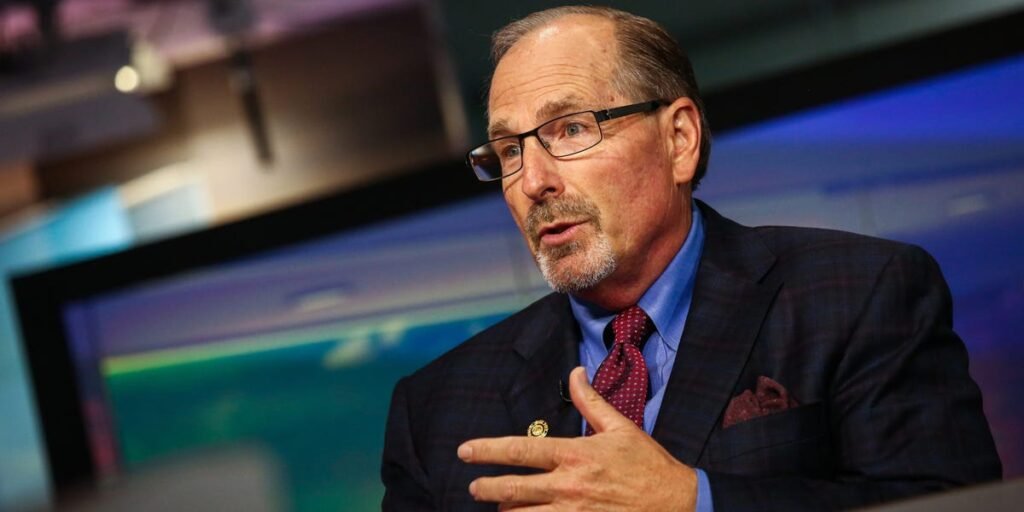
A chorus of market commentators has proclaimed that the Magnificent Seven cohort is dead, and Bill Smead joins the funeral. In an interview with Business Insider on Tuesday, Smead, who manages the Smead Value Fund (SMVLX), which, according to Morningstar data, has outperformed 98% of similar funds over the past 15 years, said Mag 7
A chorus of market commentators has proclaimed that the Magnificent Seven cohort is dead, and Bill Smead joins the funeral.
In an interview with Business Insider on Tuesday, Smead, who manages the Smead Value Fund (SMVLX), which, according to Morningstar data, has outperformed 98% of similar funds over the past 15 years, said Mag 7 stock is now moving off the top of the market.
In 2026 it became clear that the shares of “Mag 7” are no longer moving at the same pace.
Some are spending big on AI (Microsoft, Meta, Amazon, Alphabet), while others are getting a boost from that spending (Nvidia), and some have mostly stayed away from the technology (Apple). Some have risen sharply this year, while others have floundered: As a group, they are almost completely flat for the year, compared to the S&P 500’s gain of about 10%.
The divergence in performance led Citi to say the Mag 7 is obsolete as a gauge of AI and growth trading, but Smead’s view of the group of stocks and its impacts on the broader market is even more dire.
Since the S&P 500 is so concentrated in the market’s largest stocks (the top 10 stocks now make up 40% of the index), he warns that the Mag 7’s decline will drag the index down.
The idea is that if investors suddenly turn angry at AI trading as hyperscalers pour hundreds of billions into capital expenditures to build infrastructure, the index will take a hit, prompting investors to sell it, creating a vicious cycle.
This process may already be underway, as both hyperscalers and chip stocks have stumbled in recent weeks.
“It looks like it’s already broken,” Smead said of the S&P 500. “The value indexes are already outperforming the S&P.”
“The big risk for the index is that every 10 years, the 10 largest capitalization companies in the world change almost completely,” he continued, adding: “We have now started that process.”
He said he expects the S&P 500 to lose value over the next five to 10 years.
The data supports Smead’s view that the market’s biggest stocks often fail to stay on top of the market.
According to a Goldman Sachs report released in July, only six of the top 10 companies since 1990 have managed to remain in the top 10 five years later. Research from the CFA Institute shows that only two of the top 10 stocks from 2009 (Microsoft and Apple) are still in the top 10 today.
History also shows that periods of high concentration like the current one can have dire consequences for index-level returns, according to the CFA Institute.
“Periods of high concentration and relative valuations not only lead to increased volatility, but have also generated disappointing long-term returns commonly known as ‘lost decades,'” the institute said in a 2025 report. “There have been multiple lost decades throughout market history, and most of them occurred after periods of extreme market concentration and relative valuations.”
Smead is positioning his portfolio away from AI trading, betting on energy stocks, homebuilders and regional banks. SMVLX is up 18.6% so far in 2026.