A team of NASA-sponsored scientists and engineers has developed a novel approach to observing high-energy particles in the near-Earth space environment, incorporating miniaturized sensors into a compact, multi-view particle detection instrument like no other before. Built for NASA’s Relativistic Electron Atmospheric Loss (REAL) CubeSat mission, the innovative instrument (also called REAL) enables more comprehensive measurements
A team of NASA-sponsored scientists and engineers has developed a novel approach to observing high-energy particles in the near-Earth space environment, incorporating miniaturized sensors into a compact, multi-view particle detection instrument like no other before. Built for NASA’s Relativistic Electron Atmospheric Loss (REAL) CubeSat mission, the innovative instrument (also called REAL) enables more comprehensive measurements of how energetic particles are transported and lost in Earth’s radiation environment, opening the door to a better understanding of the effects of space weather in low Earth orbit (LEO), while making these unparalleled observations accessible to future small, low-cost spacecraft.
Billions of high-energy charged particles are magnetically trapped around Earth in doughnut-shaped regions called Van Allen radiation belts. These belts typically form two distinct zones: an inner belt dominated by high-energy protons and an outer belt composed primarily of energetic electrons. Together, they represent a persistent danger to satellites throughout Earth’s orbit that modern society depends on, including GPS satellites and satellites that provide telephone and Internet services. The outer belt, in particular, contains so-called killer electrons: particles energetic enough to penetrate the shielding of satellites and cause harmful electrical discharges or operational anomalies.
Because of these risks, scientists have spent decades working to better understand and predict how radiation belts behave. But what complicates that effort is how dynamic they can be, particularly the outer belt, where populations of energetic electrons can build up and then decline rapidly. Sometimes these electrons are lost from the belts, sometimes plunging into Earth’s atmosphere in microbursts that last only 100 milliseconds, and other times in longer events that unfold over minutes or hours.
“Radiation particles can get trapped in the Van Allen belts for long periods, going back and forth along magnetic field lines, but if some interaction directs them more closely along Earth’s magnetic field lines, they sink into the atmosphere,” explained Thomas Sotirelis, a physicist at the Johns Hopkins Applied Physics Laboratory, where the REAL instrument was developed. Sotirelis is the creator of the REAL instrument sensor concept and serves as instrument scientist for the REAL mission.
These loss events, known as energetic electron precipitation (EEP), represent one of the main ways in which electrons are lost from the radiation belts and play an important role in their dynamics. But while researchers have identified plasma waves as likely drivers of these events, the underlying physics (for example, whether electron scattering occurs gradually through diffusion processes or rapidly through nonlinear interactions) is still uncertain.
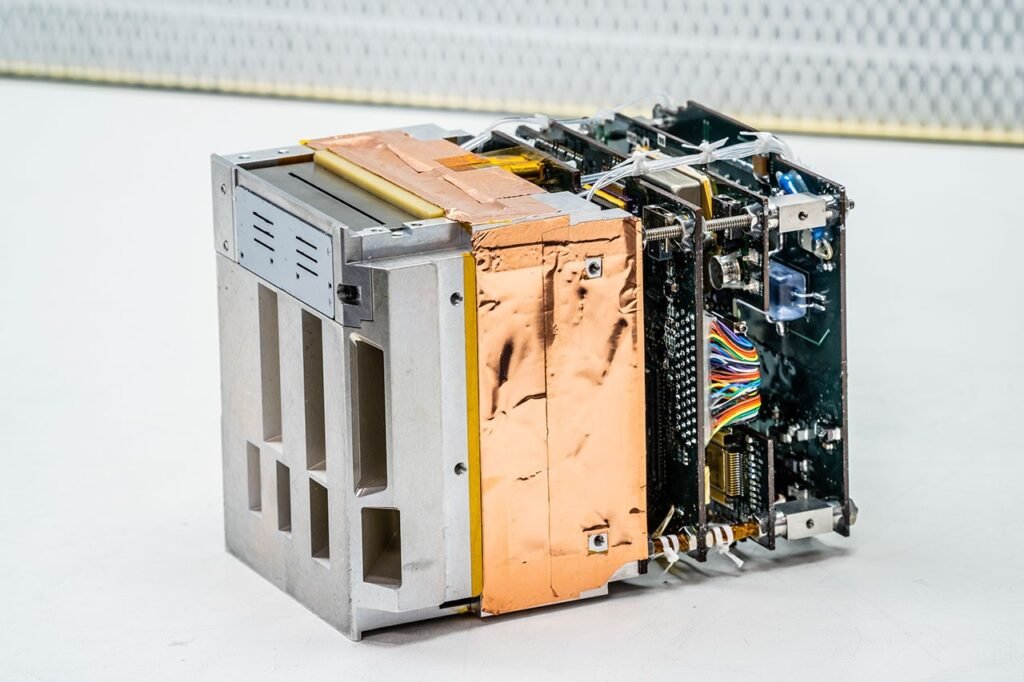
Successfully launched on July 23, 2025, the REAL instrument can distinguish between these potential modes, making it possible to investigate their relative importance and determine which waves, if any, are responsible for the electron shower. Taking advantage of recent advances in sensor miniaturization, the instrument includes three sensor heads (a low-, medium-, and high-energy head with two, five, and four simultaneous gaze directions, respectively) integrated with four electronic boards. Together, they occupy only about half of the REAL CubeSat and use sufficient temporal resolution to resolve electron microbursts with energies ranging from 40 keV to 2 MeV. While its parent 3U CubeSat flies in LEO, REAL points along Earth’s magnetic field and can simultaneously measure the quantity, energy and angle of particles as they fall into the atmosphere – a first-of-its-kind capability.
“Most CubeSats can observe particles from only one direction, so they have to rotate to create a complete image, and that takes a few seconds, too slow to capture microbursts,” said space physicist Robyn Millan of Dartmouth College, who serves as principal investigator for the REAL mission. “With REAL, we’ve managed to place three sensors, each with multiple viewing directions, on top of this 100 by 100 millimeter head, allowing us to capture those measurements all at once. We’re very proud of that.”
The high-energy head consists of a 30-millimeter-thick aluminum collimator with four apertures, each spanning a 20-degree tilt angle. Each aperture connects to an active area in a solid state detector (SSD) in the base. The medium-power head similarly uses an SSD base, but instead employs five active areas that connect to a 22-millimeter-thick aluminum collimator with five apertures, each spanning a 20-degree tilt angle. The low energy head, on the other hand, is a miniature electrostatic analyzer (ESA) consisting of titanium electrodes sandwiched between etched silicon selector slots. These sit on top of a microchannel plate (MCP). The low-energy head uses 36 apertures, two viewing directions (±40 degrees), and 15 channels to measure electrons with lower energies, from 1 keV to 40 keV.
Pitch-angle-resolved measurements from these different viewing directions allow populations of precipitated, quasi-trapped, and trapped electrons to be distinguished from each other on time scales as short as 20 milliseconds, thus more precisely quantifying the rate of electron loss and its impact on Earth’s atmosphere.
Equally important is the fact that this new capability demonstrates that measurements that once required large, resource-intensive missions can now be achieved with compact, cost-effective instruments on small satellites. This shift enables new, more complex mission concepts and technologies and paves the way for CubeSat constellations that could continuously observe Earth’s radiation environment and help us better protect the space systems that modern society depends on.
The three sensor heads on REAL are still nominally functional and continue to collect valuable scientific data. In fact, the REAL team recently fine-tuned the instrument (changing threshold settings, etc.) to improve its sensitivity.
Project leader(s): Dr. Tom Sotirelis, Johns Hopkins Applied Physics Laboratory; Dr. Robyn Millán, Dartmouth College
Sponsoring organization(s): NASA Heliophysics Division Heliophysics Flight Opportunities in Research and Technology (H-FORT) Program
Keep following us for the latest insights.