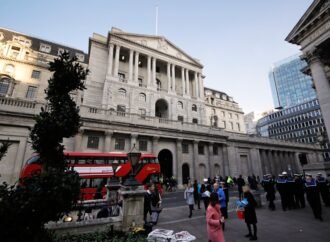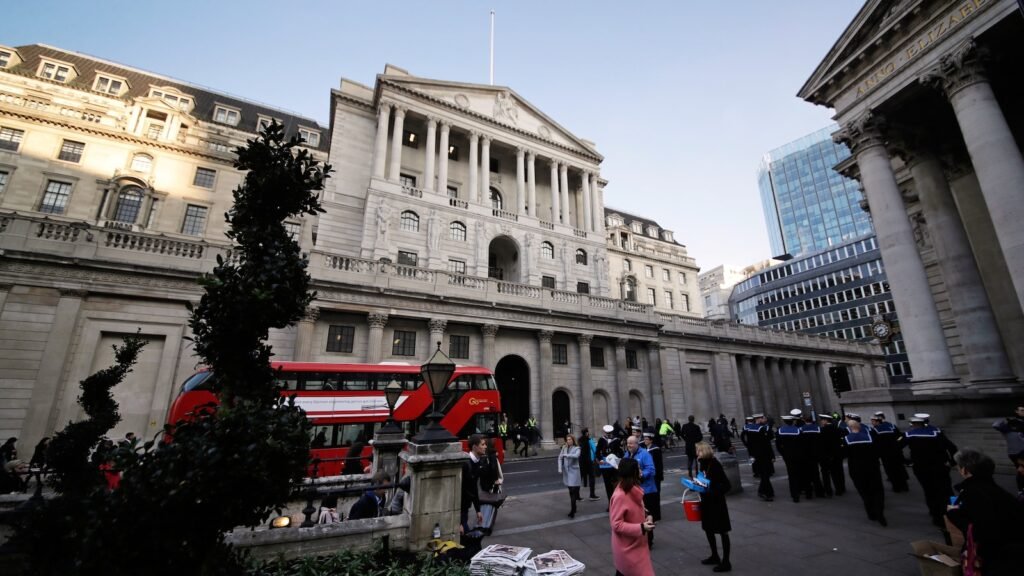
LONDON — Bank of England raises main interest rate a quarter point to 4% as Iran war stokes inflation. THIS IS AN APNewsAlert. Check back for updates. AP’s earlier story is below. The Bank of England is expected to raise interest rates Thursday for the first time in more than three years in order to
LONDON — Bank of England raises main interest rate a quarter point to 4% as Iran war stokes inflation.
THIS IS AN APNewsAlert. Check back for updates. AP’s earlier story is below.
The Bank of England is expected to raise interest rates Thursday for the first time in more than three years in order to tackle the inflation shock caused by the Iran war.
With inflation predicted to rise further over the coming months, economists reckon the nine policymakers on the Monetary Policy Committee have little option but to increase the bank’s key rate to 4% from 3.75%. The anticipated increase would be the first since August 2023.
The pressure on rate-setters has grown steadily over recent months, but the rise in inflation to an 11-month high of 3.5% in September — above their target of 2% — cemented market expectations of a rate hike this month and potentially more in 2027.
The main cause behind the spike in inflation this year has been the sharp rise in fuel costs as a result of the Iran war and the ensuing bottlenecks in the Strait of Hormuz, which have squeezed global oil and gas supplies.
“We imagine that many committee members’ patience with the recent rise in inflation has worn thin,” said Ellie Henderson, an economist at Investec. “The longer energy prices remain elevated, the greater the risk that a temporary price shock becomes more permanent.”
Accompanying the expected rate hike will be the bank’s quarterly economic projections, notably those for inflation and growth. Higher interest rates cool the economy by making it more expensive to borrow, thereby bearing down on spending and inflation, but growth too.
Those projections are highly uncertain though — even more so than usual — because the economic outlook hinges hugely on what happens with regard to the Iran war. The heavy losses suffered by the Republican Party in the U.S. midterm elections have resulted in a sharp fall in energy prices.
If the falls in oil and gas prices are sustained over the coming weeks, then the upcoming peak in inflation will likely be lower, which could temper expectations of further rate hikes, not just by the Bank of England.
Others, including the U.S. Federal Reserve and the European Central Bank, have raised rates recently in response to the higher inflation stoked by the Iran war, and forecasts for their interest rate strategy are largely contingent on what happens to the price of energy.
Interest rates in the U.K. had been trending downward from a 15-year high of 5.25% until the U.S. and Israel attacked Iran on Feb. 28.
Keep following us for the latest insights.