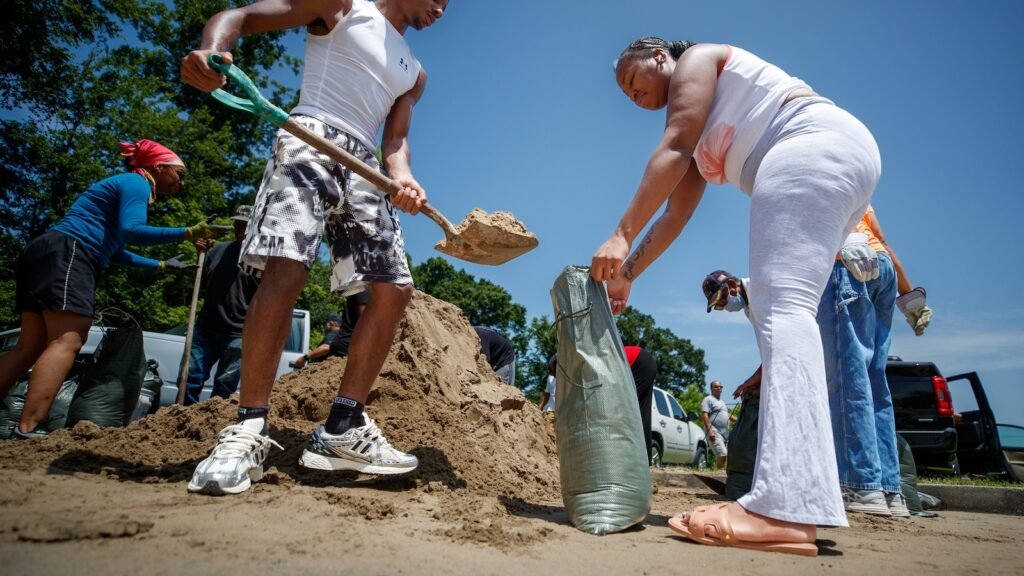
Communities along the U.S. Gulf Coast distributed sandbags and closed beaches as Tropical Storm Bertha threatened to bring flooding and high winds Wednesday from the Florida Panhandle to Louisiana. Bertha was forecast to make landfall Wednesday night in the sparsely populated coastal part of Louisiana southeast of New Orleans, with wind the biggest threat, according
Communities along the U.S. Gulf Coast distributed sandbags and closed beaches as Tropical Storm Bertha threatened to bring flooding and high winds Wednesday from the Florida Panhandle to Louisiana.
Bertha was forecast to make landfall Wednesday night in the sparsely populated coastal part of Louisiana southeast of New Orleans, with wind the biggest threat, according to Michael Buchanan, a meteorologist with the National Weather Service in Louisiana.
Early Wednesday, the center of the storm was about 145 miles (235 kilometers) west-southwest of Panama City, Florida, and 75 miles (120 kilometers) east of the mouth of the Mississippi River. It was moving west at 6 mph (9 kph) with maximum sustained winds of 50 mph (85 kph), the Miami-based National Hurricane Center said.
A tropical storm warning was in effect from Florida’s Bay and Gulf county line west to Morgan City, Louisiana, as well as the New Orleans metropolitan area and Lake Pontchartrain, the hurricane center said.
Storm surges of up to 4 feet (1.2 meters) were possible in Louisiana from the mouth of the Mississippi River to the Alabama-Mississippi state line, with smaller surges in parts of Florida and Alabama, forecasters said.
Rainfall of 2 to 4 inches (5 to 10 centimeters) could fall from western Florida to the southern coast of Louisiana, with higher amounts in scattered areas that could cause flash flooding in urban areas.
Bertha was expected to weaken as it moves toward Texas, forecasters said.
Authorities in Mississippi, Louisiana and Florida opened sites to provide sandbags to residents, while red warning flags were posted at some beaches to warn swimmers of the dangers of high tides. Along the coast, double red flags indicated that the Gulf waters were closed to swimming.
The beaches near Pensacola, Florida, were mostly deserted except for tourists taking photos of the rough surf.
“For locals, this is just another storm,” said Candice Henderson, manager of Crab Trap, a beachside restaurant that was packed Tuesday on Pensacola’s Perdido Key. “When you’re on vacation and it’s raining, you either shop or go out to eat.”
Bertha is the second tropical storm of the Atlantic hurricane season. Tropical Storm Arthur in June brought heavy rain to the southeastern US.
Bertha could bring heavy rain to coastal areas of Mississippi that are still recovering from flooding caused by Arthur that destroyed and damaged homes.
“Because of that, people are definitely paying attention, or at least that’s the hope,” said Jeff Clark, spokesman for Harrison County in Mississippi, where there were six sites open for sandbag distribution.
As of Tuesday, there had been no need to open shelters or order evacuations, Clark said.
The National Oceanic and Atmospheric Administration expects a below-average Atlantic hurricane season this year, although that doesn’t eliminate the chances of a catastrophic storm.
In the eastern Pacific Ocean, Hurricane Fausto moved away from land on Tuesday. The hurricane was about 805 miles (1,295 kilometers) west-southwest of the southern tip of Baja California and was moving west-northwest at 9 mph (15 kph) with maximum sustained winds of 80 mph (130 kph).
It was forecast to gradually strengthen, and the hurricane center warned that ocean surges generated by Fausto could cause life-threatening waves and tides off the coast of Baja California.
___
Associated Press writers Kimberly Chandler in Montgomery, Alabama, Stephen Smith in New Orleans and Haya Panjwani in Washington contributed to this report.
Check back often for more exciting news!