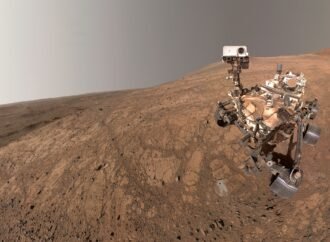
When NASA’s Perseverance rover reached the inner edge of Mars’ Jezero Crater in September 2023, mission scientists were surprised by what they found. Called the “Margin Unit,” the geologic area stretches along the shoreline of an ancient Martian lake, so they expected sedimentary rocks, which would have formed as layers of sand piled on top
Earth and the Martian moon Phobos dance together in a series of images recently acquired by NASA’s Perseverance Mars rover. Earth appears as a point of light in the Martian sky, disappearing behind the crescent of Phobos, the larger of Mars’ two moons. This is the first time humanity has captured from the surface of
NASA’s Perseverance Mars rover has discovered evidence that a 245-foot (75-meter-thick) pile of ancient rock on the rim of Jezero Crater was built by repeated asteroid impacts. This sequence of layered bedrock, dubbed the “Broom Point Member” by the rover’s science team, is likely more than 3.9 billion years old, making it some of the