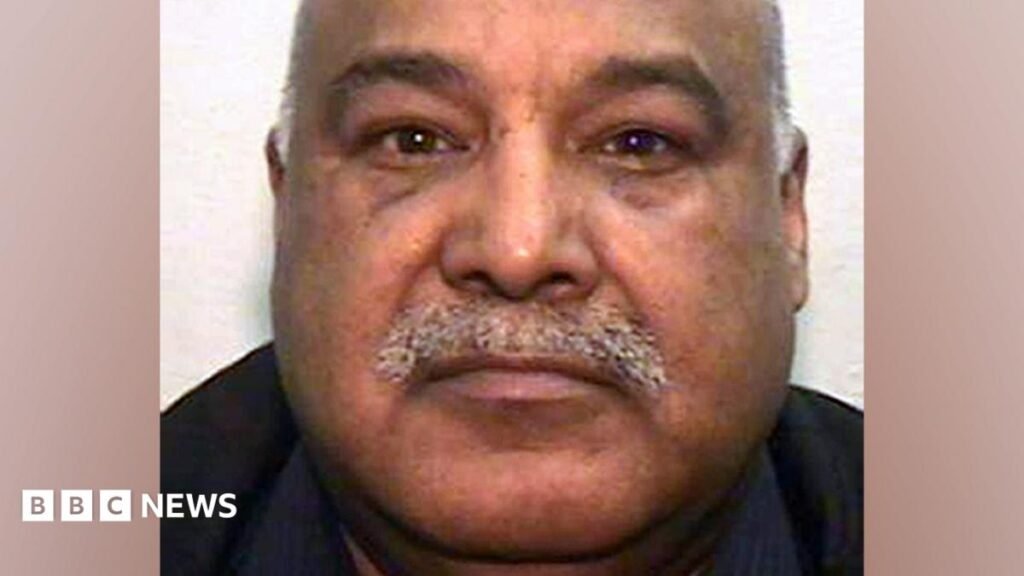
Ahmed, who arrived in the UK in the late 1960s, was one of nine men from Rochdale and Oldham found guilty of exploiting girls as young as 13 in two takeaway restaurants. Andrabi said Ahmed’s “heinous crimes demand serious introspection rather than a search for extraneous causes.” He said: “The matter in question is entirely
Ahmed, who arrived in the UK in the late 1960s, was one of nine men from Rochdale and Oldham found guilty of exploiting girls as young as 13 in two takeaway restaurants.
Andrabi said Ahmed’s “heinous crimes demand serious introspection rather than a search for extraneous causes.”
He said: “The matter in question is entirely an internal UK matter.
“The individual in question is a British citizen who spent his entire adult life in the United Kingdom and was duly convicted by a British court of reprehensible offenses committed on British soil.
“Any decision regarding his release, under control of the usual legal status, falls exclusively within the jurisdiction of the competent British authorities and must be dealt with in accordance with the laws of the United Kingdom.
“Regardless of where you were born, the responsibility lies with where you grew up, where you were raised, where you were cared for and, unfortunately, pampered.”
He added: “The government of Pakistan has no relation to this matter.
“We cannot be associated with any decisions relating to the individual’s release or subsequent treatment under British law.”
Ahmed was jailed for 22 years and released on license this month.
Victims of the gang were told that provisions of the Immigration Act 1971 prohibited the removal of any Commonwealth citizen who arrived in the UK before 1973 and had been in the country for five years.
Under the amendment proposed by the UK government, foreign criminals would no longer benefit from these protections when guilty of some serious crimes.
It would harmonize the law on deportation with the law on loss of citizenship.
Home Secretary Shabana Mahmood said this week that the 1971 Act provided protection for long-term residents of the UK but “should not be used as a barrier against removal in cases such as Shabir Ahmed’s”.
The Home Office has acknowledged that Ahmed’s removal depends on Pakistan accepting him.
Conservative Home Secretary Chris Philp said the government should consider using “very strong measures to essentially force” Pakistan to accept Ahmed’s return.
Speaking to Radio 4’s World At One programme, Philp said ministers had a couple of options: suspending bilateral foreign aid payments completely and, “at the most extreme level”, applying visa sanctions to prevent Pakistani nationals from entering the UK.
Philp said: “If a British citizen commits a crime somewhere else, we would take it back and expect other countries to do the same when the situation is on the other foot.”
After his release from prison, Ahmed was sent to accommodation with 24-hour staff and was fitted with an electronically monitored GPS tag.
While he is in the UK, the government has said he would return to prison if he breaches a series of strict license conditions.
Some of his victims said they were “scared” and felt “unsafe” about his release.
Andy Burnham, who will replace Sir Keir Starmer as prime minister, has described Ahmed as a “vile criminal” who she wants deported.
Keep following us for the latest insights.