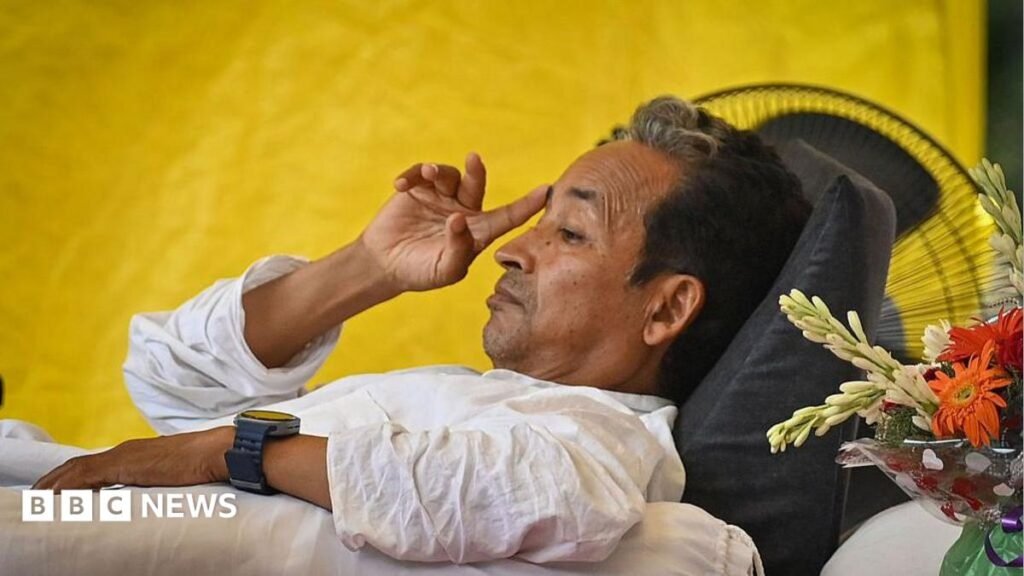
Activist Anna Hazare’s 13-day fast in 2011 gave new impetus to an anti-corruption campaign that briefly captured the national imagination. Irom Sharmila, who was protesting against the draconian Armed Forces (Special Powers) Act in northeast India, refused food for 16 years and survived only because authorities force-fed her through a nasal tube. Medha Patkar, a
Activist Anna Hazare’s 13-day fast in 2011 gave new impetus to an anti-corruption campaign that briefly captured the national imagination. Irom Sharmila, who was protesting against the draconian Armed Forces (Special Powers) Act in northeast India, refused food for 16 years and survived only because authorities force-fed her through a nasal tube. Medha Patkar, a prominent social activist, has gone on repeated prolonged hunger strikes to demand fair compensation and rehabilitation for people displaced by the large dam projects.
“Hunger strikes are a global form of protest, not exclusively Indian,” says Sayantan Saha Roy, an anthropologist at the University of Connecticut whose recent research explores the politics of fasting.
Indeed, across the British Empire, the hunger strike emerged as a shared language of democratic and anti-colonial resistance, adopted by suffragettes in Britain and nationalists in Ireland and India.
“But in India, where governments can become deeply insensitive, protesters often see fasting as the only way to force those in power to act,” says Saha Roy.
India, he says, has a particularly rich tradition of the hunger strike because Gandhi transformed it into an enduring moral and political act. “In a world of selfish politics, they stand out as acts of self-sacrifice. As the protester’s body weakens, the moral and political pressure on those in power grows.”
That pressure, however, depends on the audience. “Hunger strikes have to be performative to be persuasive. They are not directed only at the state, but at the public, whose indignation can put pressure on those in power,” says Saha Roy.
He points to the Irish hunger strikes of the 1970s and 1980s as an example. “These protesters [Irish republicans demanding to be treated as political prisoners instead of criminals] They were attempting to mobilize the Irish public by vividly demonstrating their suffering and accepting their death. The body of the hunger striker then becomes a demonstration of the cruelty of the State.
“But there is no guarantee that the public will respond, which is what makes hunger strikes such a precarious form of protest.”
Keep following us for the latest insights.