
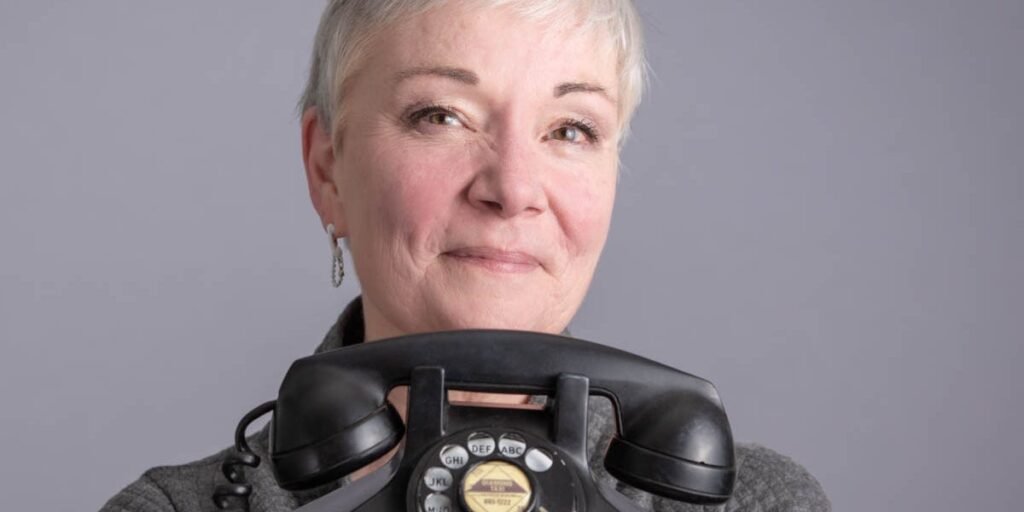
This As Told Essay is based on a conversation with Mary Jane Copps, a communications coach known as “The Telephone Lady.” Copps has spent two decades training people in the workplace how to be better communicators. The essay has been edited for length and clarity. I have been “The Phone Lady” for 20 years. When
This As Told Essay is based on a conversation with Mary Jane Copps, a communications coach known as “The Telephone Lady.” Copps has spent two decades training people in the workplace how to be better communicators. The essay has been edited for length and clarity.
I have been “The Phone Lady” for 20 years.
When I started my company, phone anxiety wasn’t something my clients talked about. Companies hired me to help their teams have better conversations, and for the first 12 years, those conversations occurred primarily over the phone.
About eight or ten years ago, that changed.
Today I coach people of all generations who struggle with real-time conversations. I see it most often among younger employees entering the workforce, and the issue is more complicated than it seems.
The hardest part is the uncertainty.
The reasons for phone anxiety can be deeply personal.
I worked with a man who grew up in a family that had financial difficulties. Every time the phone rang, his mother refused to answer because it was usually someone who was owed money. He learned early that answering the phone meant trouble.
That’s something I hear over and over again. People are not afraid to speak. They are afraid of not knowing what will happen after saying hello.
One of the main reasons we no longer practice uncertainty management is that our phones are no longer phones: they are computers.
When you send a text message or email, you can think about it, edit it, and respond when you’re ready. In a telephone conversation you have to improvise. You have to think quickly. Once you’ve said something, you can’t take it back.
Older generations developed that skill naturally because they grew up with a phone hanging on the kitchen wall, but the younger generation did not.
With the rise of social media, we are isolated. We don’t all watch the same news program at night. We have less in common when we meet a stranger. That prevents us from having conversations.
So speaking became a skill rather than something we assumed everyone knew how to do.
The conversation gap
Every year, I survey executives about workplace communication.
Last year, 98% of senior executives told me that the ability to have real-time conversations is vital to business success. Only 11% believed their organizations were doing this effectively.
I call that the conversation gap.
I’ve also found that many tech companies want employees with strong communication skills, but aren’t interested in training them. Instead, they hope to hire people who already have those skills.
This is a problem because communication is often dismissed as a “soft skill.” The term actually comes from the military in the 1960s, where organizational skills, writing, and speaking were considered “soft,” while operating machinery was considered “hard.”
Unfortunately, etiquette makes communication seem optional when it is actually essential.
Leaders set the tone. If executives don’t model good conversations and encourage real-time communication, their teams won’t either. Organizations should make it clear that these skills are important and that employees will be supported if they need help developing them.
how to practice
The good news is that conversation is a skill and skills can be learned.
Start with people you already know. Call your grandmother. Call your sister. If you’re used to texting your friends, spend a weekend calling them. You may want to let them know first so they actually respond.
When you’re with friends, put your phone away. Focus on the conversation instead of constantly checking your screen.
Then start practicing small talk.
Many people don’t like it, but when you start a new job, attend a conference, or walk into a meeting, small talk is everywhere. Keep a few simple topics in your back pocket (vacations, movies, the weather) so you can practice having conversations without worrying about achieving a specific outcome.
A young salesman I later trained told me that he began using the techniques I had taught his wife at home. They began asking each other more open questions over dinner, and he said it improved their marriage.
This is because conversation not only makes us better employees. It makes us better partners, friends and family.
I don’t think we should point the finger at the younger generations. Technology has changed us all. We are overwhelmed, overscheduled, and constantly distracted. We even schedule phone calls with close friends and family because everyone is so busy.
If we want better relationships (at work and at home), we have to spend time practicing talking to each other again.