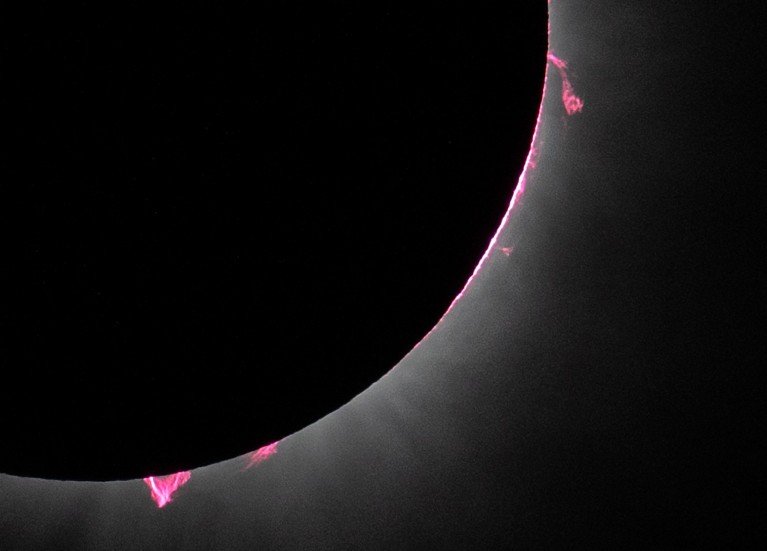
Solar prominences protruding from the Sun’s corona during a total solar eclipse in Dallas in 2024.Credit: NASA/Keegan Barber When the Moon blocks the Sun over Greenland, Iceland and Spain on 12 August, researchers will get roughly two minutes to study the solar corona, the Sun’s outermost layer, which is only visible to the naked eye
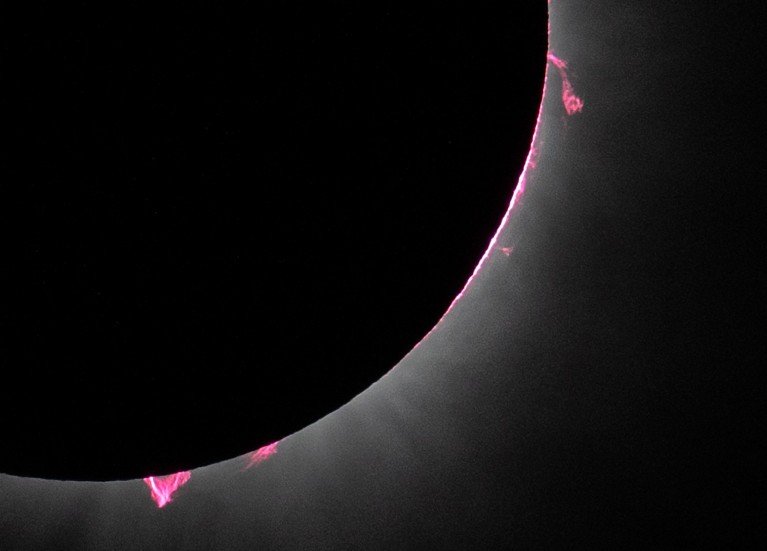
Solar prominences protruding from the Sun’s corona during a total solar eclipse in Dallas in 2024.Credit: NASA/Keegan Barber
When the Moon blocks the Sun over Greenland, Iceland and Spain on 12 August, researchers will get roughly two minutes to study the solar corona, the Sun’s outermost layer, which is only visible to the naked eye during total eclipses.
Despite centuries of observations, physicists still don’t know why the corona is hundreds of times hotter than the Sun’s surface below it. To try to answer this question, several research teams will travel to Spain and Iceland, hoping to gather data that space-based instruments cannot. This will be the first of two total eclipses in successive years (the eclipse in 2027 will be on 2 August) — a rare opportunity that scientists are eager to seize. They hope that understanding the solar corona will help them to better predict space weather, which can affect satellites and power grids on Earth.
“We want to address this age-old question: where does the [Sun’s magnetic] energy come from and how does it get transported to get the corona to be a thousand times hotter than the surface underneath?” says Amir Caspi, an astrophysicist at Southwest Research Institute in Boulder, Colorado, and leader of one of the expeditions.
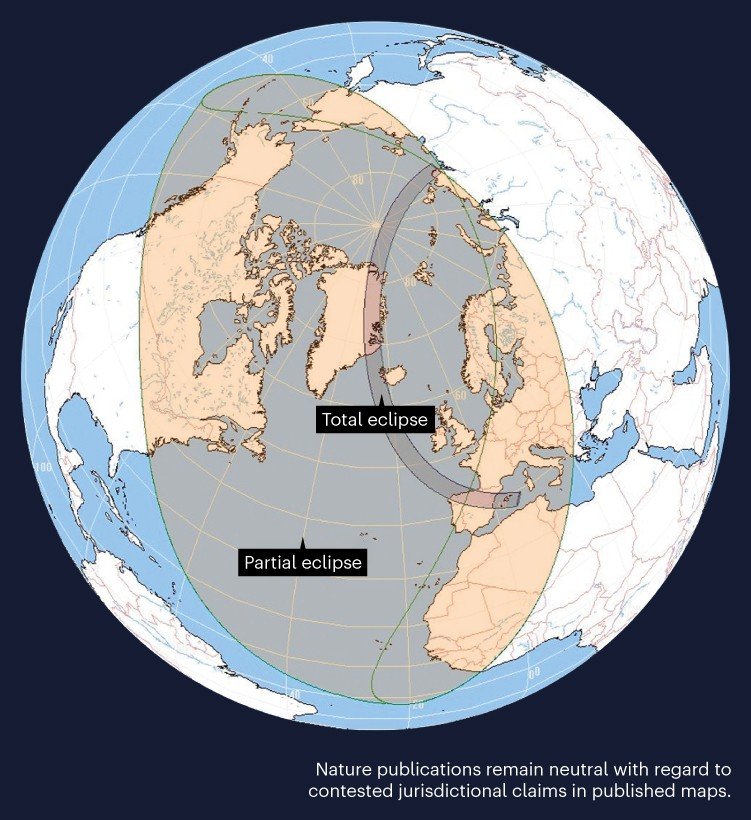
Total solar eclipse 12 August 2026.Source: ESA
A rare window
The solar corona, the Sun’s outer atmosphere, is made of extremely hot plasma — a mixture of free electrons and charged atoms that can reach 1,000,000 °C. Compared with the rest of the Sun, the light from the corona is very dim, making it invisible under normal conditions. But during total eclipses the Moon obscures the Sun’s surface, revealing the corona. “The eclipse basically lets us see the Sun at night,” explains Caspi.
Although there are ways of artificially blocking the Sun’s light, both in space and on the ground, total eclipses offer the opportunity to record the sharpest images, owing to reducing problems associated with light scattering and diffraction. “There’s nothing else that gives you this continuous coverage, so close to the Sun and so far away,” says Shadia Habbal, an astronomer at the University of Hawaii in Manoa who will also travel to Europe to study the eclipse.
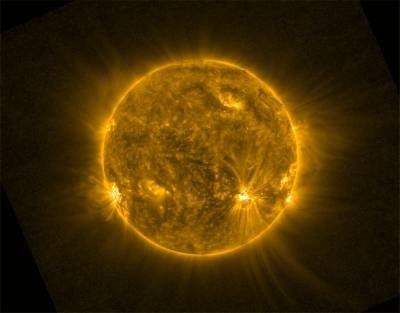
Staring at the Sun — close-up images from space rewrite solar science
For Habbal, this will be her 20th expedition to observe a total eclipse since 1995. Her team will set up five observing sites — two in Iceland and three in Spain — to maximize the chances of obtaining information, even if clouds prevent some observations. The researchers will use a spectrometer and high-resolution cameras equipped with special filters to capture light emitted from the corona at specific wavelengths. Such measurements allow scientists to infer the presence of chemical elements and their ionization state. Habbal’s team is particularly interested in analysing ionized forms of iron, which provide information about the corona’s temperature and structure.
Researchers hope that the observations will help to create more accurate predictions of geomagnetic storms and other forms of space weather, which disrupt satellite operations and induce electrical currents leading to power blackouts. In 1989, for example, a geomagnetic storm caused a power grid to collapse and left six million people in Canada in the dark.
Currently, scientists can predict a few days in advance if coronal plasma released after coronal mass ejections from the Sun is heading towards Earth, but they can only determine if it poses a risk when it passes a monitoring satellite that measures its magnetic field — tens of minutes before it hits. Understanding the processes taking place in the corona could help researchers to estimate the magnetic properties of the plasma earlier and improve forecast systems.
Keep following us for the latest insights.