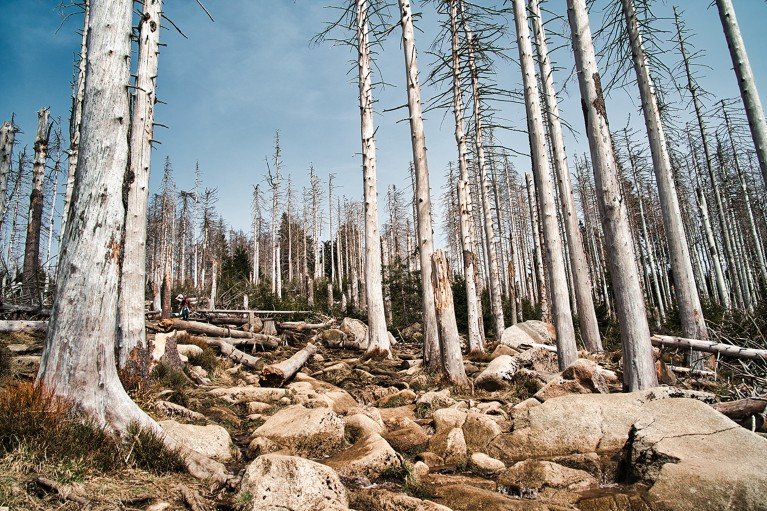
Satellite data shows a browning trend across the planet since around the turn of the century. Credit: ezypix/Getty Around 56 million years ago, a sharp rise in carbon dioxide in the atmosphere led to severe global warming that transformed the planet’s surface. A detailed reconstruction of an ancient ecosystem suggests that this transformation included a
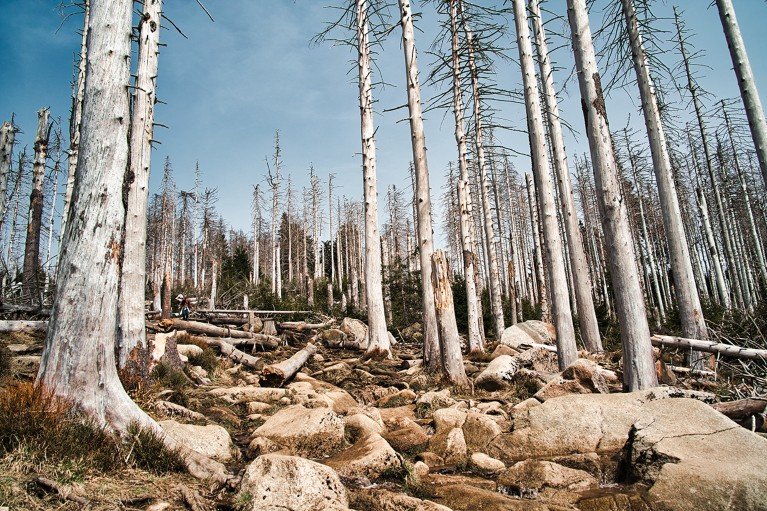
Satellite data shows a browning trend across the planet since around the turn of the century. Credit: ezypix/Getty
Around 56 million years ago, a sharp rise in carbon dioxide in the atmosphere led to severe global warming that transformed the planet’s surface. A detailed reconstruction of an ancient ecosystem suggests that this transformation included a widespread decline in forest cover. The study1, published in Science on 13 August, has parallels for what could happen as a result of human-driven climate change, say the authors.
“We’re seeing that now all over the world. Many forests are in states of decline,” says co-author Regan Dunn, a palaeoclimatogist at the Natural History Museum of Los Angeles County in California.
This sudden warming event, called the Paleocene–Eocene Thermal Maximum (PETM), was one of the most notable climatic upheavals in Earth’s history. The volume of CO2 released during that period is thought to be roughly equivalent to total human emissions that would be released by the end of the twenty-first century under a pessimistic scenario. The ancient surge of CO2 raised global average temperatures by between 5 and 9 °C, changing the climate for more than 150,000 years.
Using fossils, sediments and other geochemical evidence preserved from this time, researchers have begun to piece together a picture of abrupt changes to Earth’s ecosystems that took place in response to this warming. The make-up of forests changed, with broad-leafed trees in the mid-latitudes giving way to landscapes dominated by ferns. Rivers supercharged by a water-logged atmosphere carried away more sediment. Soils stored less carbon.
Dunn and her colleagues sought to get a clearer view of how these shifts changed the structure of forest canopies. This can reveal information about changes in carbon storage in ecosystems, says Dunn. “It’s really telling you something about how the forest is functioning.”
The ancient analysis was aimed at shedding light on a question ecologists have today: how will Earth’s ecosystems respond to rising levels of CO2? Higher concentrations of the greenhouse gas trap more heat, boosting temperatures and shifting patterns of precipitation in ways that can stress plants. However, more CO2 also acts to fertilize plants, and there’s wide uncertainty about how these opposing forces will affect forests of the future.
Reading the leaves
To work out the structure of ancient forests, the team analysed the shape of fossilized leaf cells in sediment cores from the Hanna Basin in Wyoming. Because of the way plants grow and stretch towards light, the shape of these cells offers a measure of how much of the canopy was shaded versus how much was exposed to sunlight. “There’s this difference between sun leaves and shade leaves, even on the same plant,” says Dunn.
They used the fossil leaves to estimate how canopies changed at the Wyoming site across the PETM, as CO2 rose and temperature changed. The ‘greenness’ of the forestwas described by a metric called the leaf area index.
The forest didn’t fare well, they found. After an initial rise in canopy coverage at the start of the PETM, the leaf area saw a steep drop of 61% over the next few thousand years. Then, canopy cover remained 35% lower for tens of thousands of years until the end of the PETM.
The researchers say this pattern suggests that an initial pulse of CO2 — probably from a large volcanic eruption in carbon-rich sediments in the north Atlantic — boosted forest growth. But then, this fertilization effect was overwhelmed by hotter temperatures. “Too much carbon dioxide raises temperatures beyond the limits that plants can function,” says Dunn.
Check back often for more exciting news!