
728 x 90

I visited Dataland, the ‘world’s first AI art museum’ in Los Angeles: photos

I visited Dataland, the ‘world’s first AI art museum’ in Los Angeles: photos

I rode the elevator down into a sprawling AI rainforest, where digital images of green and gold, vaguely resembling trees, flickered on each wall, while the floor and ceiling featured an ever-evolving, root-like web of blue that lit up in response to my footsteps. The sounds of an orchestra could be heard, punctuated by the

I rode the elevator down into a sprawling AI rainforest, where digital images of green and gold, vaguely resembling trees, flickered on each wall, while the floor and ceiling featured an ever-evolving, root-like web of blue that lit up in response to my footsteps. The sounds of an orchestra could be heard, punctuated by the chirping of crickets. I was hit with a familiar aroma, herbaceous and spicy, like cutting into a fresh jalapeño.

I walked into Dataland, billed as “the world’s first AI arts museum,” which opened last month in downtown Los Angeles.

I was there to see the inaugural exhibition, “Machine Dreams: Rainforest,” which features five galleries of multi-sensory art generated by AI trained on data from the natural world.


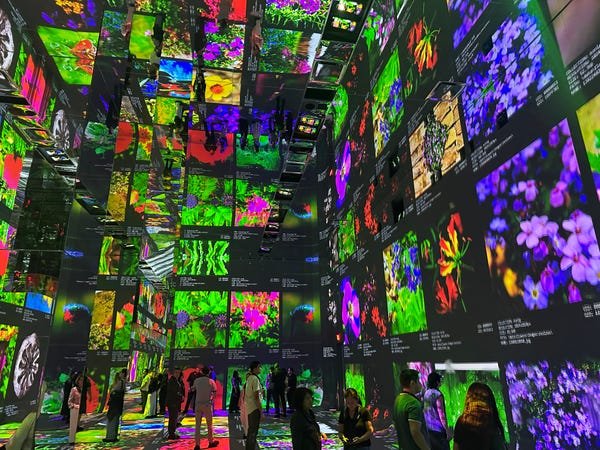
Visitors find themselves inside an immersive room filled with colorful flowers and nature images on the walls and ceiling.

The AI ​​used in Dataland is based on data about the natural world.

Kelsey Vlamis

Dataland was founded by multimedia artist Refik Anadol and his partner, artist Efsun Erkiliç.

Dataland collaborator Google says the museum uses Google Cloud tools to create generative soundscapes, sense visitors’ emotions, adjust smells “algorithmically,” and respond to human movements.

At a time when the use of AI in art remains controversial, Dataland is its highest adoption.

The art was often beautiful and interactive.


Author's selfie at the entrance to Dataland.

Dataland includes sights, scents, sounds and interactive experiences.

Kelsey Vlamis

My ticket for the weekday afternoon was $59, and after a group of about 20 people formed, we were let into the first of five galleries.


Three AI digital art screens.

The museum has five galleries of different AI art.

Kelsey Vlamis

“You are inside a work of art that is still developing,” said a recorded voice. “Your presence shapes the world you are about to enter.”


A bracelet and a neck device.

Dataland visitors receive two wearable devices for the experience.

Kelsey Vlamis

We were given two wearable devices: a watch-like bracelet that tracked movement, temperature and pulse, and a U-shaped device worn around the neck that emitted aromas. Instead of filling rooms with a single scent, each person would be exposed to different scents on their individual devices.


A photo of a bracelet and a screen in the background.

I could see my movements, labeled M4, projected on a screen.

Kelsey Vlamis

The images were often mind-blowing, ranging from abstract, like a wave of colored balls that looked like Dippin’ Dots, to more literal, like fantastical flower shapes or pink and blue birds fluttering across the screen.


Colorful holographic patterns in the form of green and rainbow circuits cover a dark reflective surface in a gallery.

The art mixed images that looked like nature and technology.

Kelsey Vlamis

At times, the images looked more like the inside of a computer than nature, highlighting the combination of technology and environment upon which the entire premise was built.


The interactive digital screen displays a deep blue bird of paradise flower and a Thinking Brush drawing interface.

There were interactive displays for visitors to create their own AI art.

Kelsey Vlamis

In one gallery, visitors could create their own art with artificial intelligence on small interactive screens. I made strokes and watched as the image on the big screen in front of me transformed into an abstract bird-of-paradise flower that vaguely matched the shape of my drawing.

Being Tracked Through a Museum Might Surprise Some People


Visitors move through a dark, immersive installation with glowing blue-white floor projections and mirror panels.

At one point, the floor illuminated, forming a circle around each visitor’s feet.

Kelsey Vlamis

Visitors interacted with the space, watching their footsteps and waving their hands to see how the art responded. At one point, the screens went dark and circles of light appeared around each of our feet, showing our pulse and temperature.

According to the museum, the bracelets track the “electricity of the skin” to “capture its response to the artwork within.” It also tracks your movements through space, and on one screen, I could see myself, labeled M4 according to my assigned wristband, walking.


The feet lie on a blue digital projection that displays a circular temperature gauge.

The circle around me showed data from my bracelet.

Kelsey Vlamis

A screen showed how each person in the room reacted to the space; I could see the line for me, M4, on graphs showing changes in my “emotional temperature” and “heartbeat” during my visit.

It was a little interesting to see my avatar on the screen and realize how much time I had spent in each room, but I wasn’t entirely sure what to do with the data and I was wondering if some people might feel a little weird about being monitored.

I wasn’t sure how to feel about it.


Visitors find themselves inside an immersive room filled with vivid blue and magenta digital light projections.

The art in Dataland often filled the entire room.

Kelsey Vlamis

I spent about 90 minutes wandering around Dataland. From time to time I was delighted by some of the images. I felt a spark of curiosity when I was randomly hit with a new scent: “Is it more woody or smoky?” – and the sounds often matched the hypnotizing movements of the images in an interesting way.

It was impossible not to think about the fact that the art had been created by AI. I tend to ask myself two questions when I see a work of art: How does it make me feel? What is the artist trying to say?


Two silhouetted visitors view a large illuminated digital floral artwork in a dark gallery space.

Dataland says its art responds to its visitors.

Kelsey Vlamis

Without the sense that the art was the direct result of a thinking and feeling human being, it was difficult for me to connect with much of it.

For me, the most moving part of the experience was not AI-generated at all: it was a real recording of a now-extinct Hawaiian bird asking for a mate and getting no response.


The author takes a mirror selfie inside a colorful immersive light installation with reflective walls and digital projections.

The mirrors added to the mind-blowing perspectives in Dataland.

Kelsey Vlamis

I spent much of my time in Dataland reflecting on a simple question: What is art? And can it really come from AI?

While the visuals were often stunning and I enjoyed some parts more than I expected, I came away with a lingering uncertainty about whether I had seen art, technology, or some strange new combination of the two.