Betelhem, 10, lies on a bed next to her father at Ayder Referral Hospital in Mekelle, Ethiopia, on October 6, 2026. She was injured during heavy artillery shelling in Alamata. Fighting broke out between the rebel Tigray People’s Liberation Front and federal forces on September 23, sparking fears of a return to the civil war
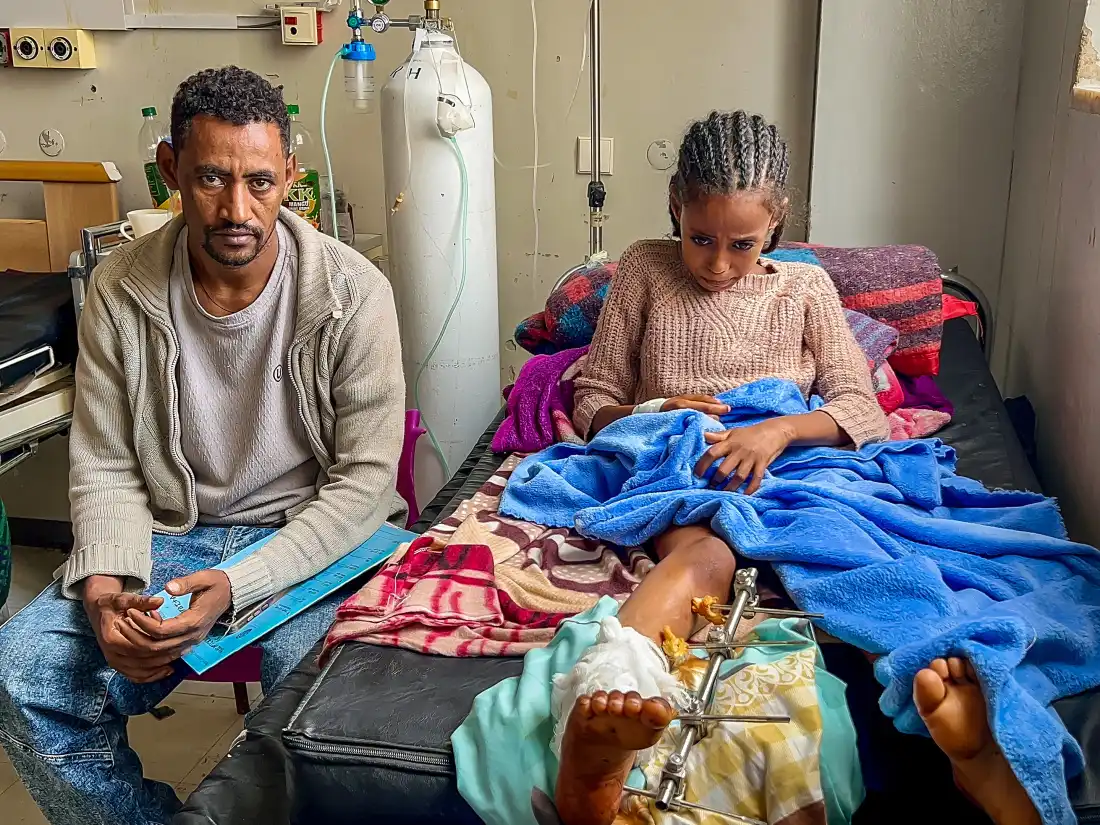
Betelhem, 10, lies on a bed next to her father at Ayder Referral Hospital in Mekelle, Ethiopia, on October 6, 2026. She was injured during heavy artillery shelling in Alamata. Fighting broke out between the rebel Tigray People’s Liberation Front and federal forces on September 23, sparking fears of a return to the civil war of 2020-2022 and putting tremendous strain on the healthcare system.
AFP/via Getty Images
hide caption
AFP/via Getty Images
“It was a mess, it was chaos, and that continued for almost seven, eight days. Without (cell) network, without electricity,” recalls a surgeon in Ethiopia.
On September 24, a two-year ceasefire between rebels and the Ethiopian government began to collapse. As injured people streamed in from the countryside, this surgeon and his colleagues treated as many as they could at a hospital in Mekele, the capital city of Ethiopia’s northern Tigray region. Fearing repercussions for treating rebel fighters, the surgeon asked NPR not to publish his name.
“The whole emergency (room) was flooded with war trauma patients,” he recalls. “The floors were all filled up, there was no place to step.”
For the past several weeks, the violence has continued at a steady pace, raising concerns that Ethiopia could again face a civil war. The Ethiopian military has accused Sudan, Egypt and Eritrea of backing Tigrayan militants, who have aligned themselves with seven rebel groups in Ethiopia with the goal of ousting Prime Minister Abiy Ahmed.
After drone strikes in late October killed at least 15 people, including children, the director-general of the World Health Organization, Tedros Adhanom Ghebreyesus, posted on X that the violence in northern Ethiopia “is pushing an already fragile health system closer to collapse.”
During the initial outbreak of violence in September, the surgeon in Tigray says he spent days operating on victims of gunfire, drone attacks, and mortar shells. Some were clearly civilians, but others were fighters in uniform. Complicating matters, he recalls, there was no way to know how many patients were coming because cell service and the internet were cut.
“We don’t know where they’re from — you just go ahead and do whatever you can, you know?” he told NPR.
There had been signs that the war between Ethiopia’s federal government and rebel groups could reopen. In May, Tigrayan rebels ousted regional leaders and installed their own. In response, Ethiopia’s federal government cut funds to Tigray — including to hospitals run by the regional administration. Doctors, he says, haven’t been paid in months.
“It’s an open wound, which was never closed, you know. Left for healing and never healed,” he says. “I guess now it’s infected.”
For Tedros of WHO, the situation is deeply personal. He is Tigrayan and previously served as Ethiopia’s minister of health. In his social media post, he wrote that hospitals are facing shortages of workers, medicine and ambulances, and that WHO and the U.N. are working to deliver medical supplies to the affected regions.
“As fighting continues, more people are likely to lose access to essential healthcare … civilians must be protected,” Tedros wrote. “The most courageous choose peace.”
A worldwide worry
Public health experts say targeted attacks on healthcare —– generally considered a war crime —– have become a growing concern in conflict zones around the world.
So far in 2026, attacks on health care facilities and workers in 19 countries led to more than 960 deaths, according to data collected by WHO. While the largest mass casualty event occurred in a Pakistani airstrike on a drug rehabilitation center in Afghanistan, hundreds of people have died in attacks on healthcare settings in Sudan, Lebanon, and Ukraine.
Complicating matters are funding cuts to global health initiatives, including the dismantling of USAID shortly after Donald Trump took office in 2025.
“The continual attack against healthcare is eroding the norm of healthcare being a protected part of conflict,” says Lindsey Green, a researcher focused on Ethiopia for the U.S. nonprofit Physicians for Human Rights.
The Tigray war lasted two years, killing an estimated 600,000 people. The majority of Tigray’s health facilities were only partially functional, as the Ethiopian government imposed an aid blockade on the region — home to more than 7 million people.
Attacks continued, despite a peace agreement
The government struck a peace agreement with Tigrayan rebels in 2022, ending most hostilities, but attacks on healthcare continued. In August of this year, Physicians for Human Rights worked with the Organization for Justice and Accountability in the Horn of Africa to publish a report detailing these attacks.
Of more than 600 health workers surveyed across three regions of northern Ethiopia, 63% reported attacks on ambulances, some as they tried to reach injured patients, and 57% reported witnessing an armed takeover of their clinic or hospital between 2020 and 2024. One health worker in Mekele recalled Ethiopian forces occupying a hospital and placing the uniforms of Tigrayan rebels on the floor and forcing staff to step on them. “Nonsense stuff,” he said.
“Armed groups were occupying facilities to take resources or to destroy resources, to destroy machines and equipment, really with the goal of making healthcare harder to access,” Green says.
In the report, researchers confirmed targeted attacks on health care workers perpetrated by both rebels and government forces – often as retribution for a community’s perceived alliances or against doctors who treated an enemy. But there has been no way for victims to seek justice from either party.
“It’s very clear that this ongoing pattern of attacks on healthcare links back to impunity for these violations,” Green says.
NPR reached out to Ethiopia’s Foreign Ministry and Office of the Prime Minister, but did not receive a response.
Doctors in northern Ethiopia say the one-two punch of a war that specifically targeted healthcare, followed by foreign aid cuts, have left the region without a chance to recover.
A health worker in Tigray counted more than 100 women who died in childbirth over the past year. He attributed their deaths to the dire state of the health system. He spoke to NPR on condition of anonymity, due to fear of being targeted for speaking out.
“They died during delivery because of a lack of medicine, lack of health care providers, a lack of fuel. So the ambulances are not functional,” he said.
An independent review of birth data during the Tigray war from 2020 – 2022 showed that the maternal mortality rate per 100,000 live births increased fivefold, compared to prewar data. Researchers in 2022 found that 83% of clinics and hospitals were no longer able to serve pregnant women. Additionally, systemic rape and sexual violence were regularly used as a weapon of war.
“They told us, the people should be punished, because we are supporters of the TPLF (Tigrayan rebels),” the health worker says.
Ayoda Werede, a California-based physician with the nonprofit, Health Professionals for Tigray, says that since the latest outbreak of violence, the Ethiopian military has not targeted health centers. But other unidentified groups have stolen supplies, “including medication, equipment, even mattresses off of patient’s beds,” Werede says. “This was just the opportunistic vacuum space that was created because of this conflict.”
Her fear is that Ethiopia’s healthcare system is already stretched beyond its capacity — and as the conflict reignites, injured people will have nowhere to go. The surgeon in Mekele has similar concerns. Many of Tigray’s doctors, he says, have already left the country.
“We’ve lost our sense of being secure,” he says. “It’s a repeat of what’s happened in the past.”
For stories about life in our changing world, subscribe to NPR’s Global Health newsletter.
{For more tech updates, stay tuned to our blog.|Keep following us for the latest insights.|Check back often for more exciting news!}