SPOILER ALERT: This article contains spoilers for the Season 3 finale of “House of the Dragon,” now streaming on HBO Max. HBO’s “House of the Dragon” ended its third season Sunday with a bang, then a whimper. Following a slew of casualties (including James Norton’s Ormund Hightower) during a massive battle between the Blacks and the
SPOILER ALERT: This article contains spoilers for the Season 3 finale of “House of the Dragon,” now streaming on HBO Max.
HBO’s “House of the Dragon” ended its third season Sunday with a bang, then a whimper.
Following a slew of casualties (including James Norton’s Ormund Hightower) during a massive battle between the Blacks and the Greens at Tumbleton, Helaena Targaryen (Phia Saban) jumps to her death off screen in King’s Landing.
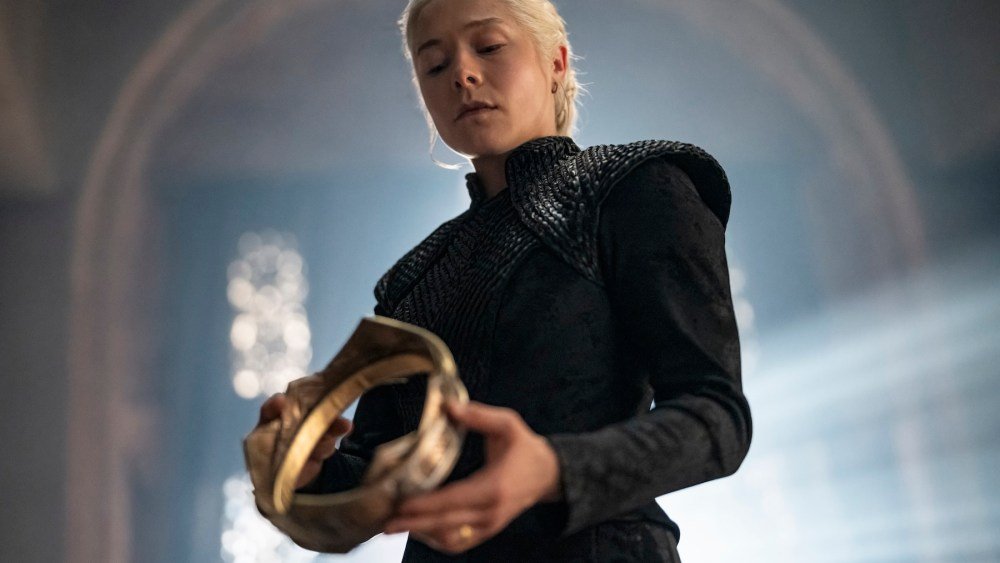
While players on both sides of the battle for the Iron Throne are to blame for the carnage, Season 3 of the “Game of Thrones” prequel has put forward the quickly unraveling Queen Rhaenyra Targaryen (Emma D’Arcy) as the one most responsible for the fire and blood. And “House of the Dragon” co-creator and showrunner Ryan Condal is prepared for Rhaenyra’s heel turn to be compared to that of her descendant Daenerys Targaryen (played by Emilia Clarke) in 2019’s “Game of Thrones” series finale.
“I think that’s wonderful if people draw parallels between this and the original series,” Condal said during a press conference Friday. “For sure, there’s going to be mirroring and echoes and reflections across the two series, and people will see things that are either intentional or subliminal. And I will just say that I think this is a one of those existential themes that goes across this entire universe, which is the draw of the Iron Throne — what it does to a person in its thrall, or the people that are trying to get to it.”
Condal notes the “big difference” here is that “Daenerys only got to the Iron Throne at the very end, after she had destroyed the city,” while “Rhaenyra goes through this experience of having the throne, trying to hold it and being, in a way, turned and changed by it — altered by the experience.”
“They’re very different things, but I think the parallels do call to the greater themes of the ‘A Song of Ice and Fire’ universe, which is pride and power, and how power corrupts, and how far it corrupts. And it can change good people into corrupted people,” Condal says. “It can take corrupted people and make them real villains, and other people, like Viserys, it can simply just destroy.”
It seems the Iron Throne is doing a mixture of both to Rhaenyra by the end of the third season of “House of the Dragon.” She’s been pricked and bloodied by it, and is now making the choice to turn violent herself, becoming responsible (directly or inadvertently) for more than one death in the finale.
“I really wanted to make sure that that journey was a legible one,” D’Arcy says. “I think, broadly, if we’re to be more practiced at protecting democracy, which seems increasingly fragile at times, we have to be smarter about understanding the behaviors of dictatorial leaders. I think Ryan and I both, this was an opportunity to attempt to try and make a certain type of behavior at least understood by an audience. And from an acting perspective, it felt much more playable to think about empathy and the sort of empathetic machine and how that gets damaged and affected by events, than it did to sort of solely think about her relationship with authoritarianism or something.”
Rhaenyra orders Daemon (Matt Smith) to take Tumbleton, and kill every Hightower he can while leaving its people as unharmed as possible. Daemon brings troops and his dragon Caraxes, but holds out on laying siege for as long as possible, especially as Ormund has stationed children on the battlements and in front of the gates to the city. Eventually, Daemon uses Caraxes to burn down the entrance so that the Blacks can storm the town in search of Ormund and his Rhaenyra’s latest rival, Daeron (Benjamin Evan Ainsworth). The plan is to take those Hightowers out before turning to the matter of a revived Aegon (Tom Glynn-Carney) and his dragon Sunfyre.
By the end, many of Rhaenyra’s supporters, including Northmen Roddy the Ruin (Tommy Flanagan), have been killed by a traitorous Ulf (Tom Bennett) and his dragon Silverwing — but so has Ormund, who went up in flames when Ulf double-crossed him, too.
Daemon, Corlys (Steve Toussaint) and Hugh (Kieran Bew) make it out alive, and the last we see of Ulf, he is being chased by Daemon on Caraxes and Hugh on Vermithor. Back in the burnt Tumbleton, Gwayne Hightower (Freddie Fox) is barely left standing, while the fate of Daeron and his dragon Tessarion are unknown.
“All season long, we’re setting up this classic medieval siege, which is really where we wanted to get to, and the fun of that, the concept of that battle was that Ormund had basically done all he could to blunt the threat of Rhaenyra’s greatest power — which is that she has, or had, six dragons, under her command at that point,” Condal says. “So how do I take the dragons off the board and make this an even fight, man-to-man? And he sees his army as better trained and better suited than the rivermen that are coming to attack. He knows the ground, he’s inside the city, they have to come over the walls, sacrifice a bunch of their men. It was a very, very, very complex thing to fold all together, but we wanted to do a classic Medieval siege. That was the elevator pitch for the finale.”
Back in King’s Landing, Rhaenyra is making moves she thinks will keep her firmly on the Iron Throne as long as Daemon and his team pull through. She kicks Mysaria out of the Red Keep, and has a captive, pregnant Helaena forcefed to keep her alive. Rhaenyra dons some Joan of Arc-esque armor, and has Alyn (Abubakar Salim) escort her and her young son and new heir Joffrey (Oscar Eskinazi) to the sept, where she demands to be annointed as the queen in front of all her people. When the High Septon refuses this request yet again, in favor of supporting Aegon’s return, she orders his execution.
Then Rhaenyra takes to the streets, and tells the people of King’s Landing the prophecy her father, Viserys, entrusted to her: Aegon the Conqueror’s “A Song of Ice and Fire” vision of the Targaryens and their dragons being the only ones who can defeat the whitewalkers in the future. She tells the crowd (which Mysaria is hiding in) that she is the “prince that was promised,” and they look on in shock, confusion and fear.
It’s a big moment for fans who will recall the importance of this prophecy to the original “Game of Thrones” series, and how “House of the Dragon” has incorporated it into its own mythology in a break from its source material, George R.R. Martin’s “Fire & Blood.”
“It’s not in the book, and it’s not in the history, but there is a bunch of talk about how Rhaenyra became very despotic, and became a tyrant at the end, and was very unpopular with the people,” Condal says. “So we saw it as, this could just be something that happened, and there was disagreement over exactly, what it was, so it didn’t make the historical record. My glib toss-off from the historians is, ‘Oh, well, Targaryens say crazy shit all the time.’ But so much of their existence is this self-aggrandizement. And for the stonemasons standing there in the crowd just looking up at this, it could just sound like somebody trying to make something of themselves, because they have no idea of all the quote-unquote real history that went into Rhaenyra making that speech.”
Condal says the scene was written into the “House of the Dragon” storyline because the writers wanted “a real seismic change, a sea change in Rhaenyra’s relationship to her people” leading into the final season.
“She’s seen to the death of their religious leaders, she’s standing outside of the church of the faith of most of the people standing there, as a member of a totally different faith, this old Valyrian faith of dragons and fire gods and blood magic,” Condal says. “And [she’s] pronouncing herself this chosen one, the leader that is going to take them through the fire and out of the darkness.”
When Rhaenyra returns to the Red Keep, she receives the terrible news that Helaena has jumped to her death. (Read Variety‘s interview with Phia Saban here.) In Helaena’s room, Rhaenyra finds a tapestry Helaena had just finished sewing that predicts a dark and fiery end for Rhaenyra in the future. Now, she’s left to wonder how the people — including Helaena’s traveling mother, Alicent (Olivia Cooke), her childhood best friend — will react when they learn of Helaena’s death. And who they will blame.
The “House of the Dragon” team has already broken the “superstructure” story for the final season, and Condal has handed in a draft of the first episode to HBO, but there’s no timeline for when Season 4 will air just yet. Condal says he has been on a break throughout the airing of Season 3.
“No, I’ve actually taken time off,” Condal says. “I needed to step away from all of this. But we have an incredible season coming. As crazy and big as Season 3 was, I think Season 4 is going to be even bigger.”
Condal adds: “It’s a great privilege to be able to tell a story, and to be able to control and write the ending, and to control when and where that happens. This is not a given in making television, certainly. So, we’re very excited to get back in, and we have new characters, and new dragons and new locations all to come, that I think are gonna make it a very worthy, final season.”
For more of Variety’s “House of the Dragon” finale coverage, read this interview with Phia Saban, who plays Helaena Targaryen and this interview with James Norton, who plays Ormund Hightower. This interview has been edited and condensed.
Check back often for more exciting news!