Jon Gambrell and Nasser Karimi Updated July 5, 2026 — 11:09 a.m.,first published July 4, 2026 – 12:09 p.m. Save You have reached your maximum number of saved items. Remove items from your saved list to add more. TOTOTO Tehran: Tens of thousands of Iranians gathered Saturday at a vast open-air prayer complex in Tehran
Jon Gambrell and Nasser Karimi
Updated ,first published
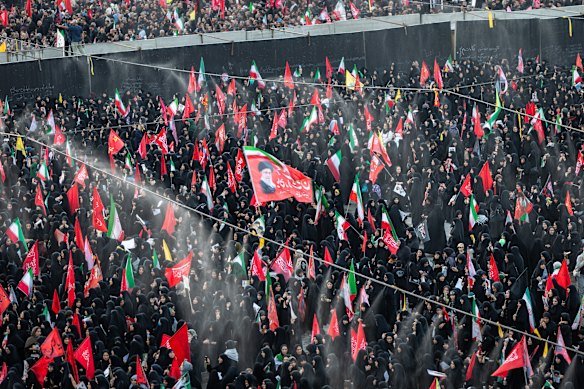
Tehran: Tens of thousands of Iranians gathered Saturday at a vast open-air prayer complex in Tehran to view the coffins of Ayatollah Ali Khamenei, the 86-year-old supreme leader killed at the start of the US-Israel war against Iran, and his family.
Dressed in black and draped in the red, white and green flags of the Islamic Republic of Iran, mourners held portraits of Khamenei and his son and successor, Mojtaba.
In a show of public devotion to the theocratic state and revolutionary zeal of the Islamic Republic, Iran is organizing a week of mass funeral processions for the supreme leader killed in February by the first airstrikes of the war.
After a day indoors for top Iranian leaders and foreign officials to visit, Khamenei’s coffin was displayed under glass outdoors, along with those of his daughter, son-in-law, daughter-in-law and 14-month-old granddaughter.
No image has yet been publicly seen or released of his son, the new leader, who is said to have been wounded in the same attack.
Mourners filed into Imam Khomeini’s vast Grand Mosalla courtyard, beating their chests, crying and waving banners of the Islamic Republic. Women dressed in black chadors wore white visors or held umbrellas to protect themselves from the hot mid-morning sun.
“Let’s cry!” A presenter encouraged the crowd through a loudspeaker. Chants of “Death to America” echoed in the enormous prayer room.
blood feud
“Everyone here has come to avenge the blood of their supreme leader,” Arash Rahimi, 40, said in the crowd. “As our leader has said, we have a blood feud with the United States. Our relations with the United States will never be good.”
The funeral comes at a critical time for Iran, with its clerical rulers, backed by the military, buoyed by having survived the attack with their system of government intact.
The war has been paused to achieve a ceasefire under a deal with Washington that Iranian officials say will ultimately bring huge economic benefits, in line with what they describe as a victory over a superpower.
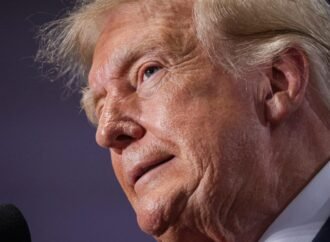
The news website Axios quoted US President Donald Trump as saying that peace talks had been paused for a week due to events surrounding the funeral.
With the assistance of all of Iran’s leaders, Washington could eliminate them all in “one fell swoop,” he quoted Trump as saying: “But we’re not going to do that because then we wouldn’t have anyone to negotiate with.”
Trump also told the news outlet that he was surprised to see some Iranians crying at the funeral and said he thought people hated Khamenei. “Maybe they’re fake tears,” she said.
Iran’s embassy in Armenia reacted to Trump’s comments in a post on X: “You don’t understand these things because you have no civilization, no history, no honor.”
Inside Iran, beyond displays of solidarity with leaders, it remains impossible to assess how deep public loyalty runs in a country of 90 million people.
Weeks before the war, hundreds of thousands of Iranians demonstrated against the government in protests that were quelled by a violent crackdown in which thousands of people died. But there have been few if any public signs of such dissent since the US and Israeli attacks began.
During the war, more than 3,000 people were killed, including many of Iran’s most senior politicians and military commanders. Military bases and large infrastructure projects were destroyed, causing billions of dollars in damage.
But Iran successfully attacked US bases in the region, inflicted pain on the Gulf Arab countries that host them and asserted its control of the Strait of Hormuz, causing a surge in global energy prices, which Trump says led him to push faster for peace.
The interim deal reached last month includes the unfreezing of billions of dollars in Iranian assets abroad and waivers of financial sanctions that had brought Iran’s economy to its knees.
Shia martyrdom
In Iran’s theocratic system, Khamenei was not only head of state and leader of a revolutionary movement, but also the earthly representative of the last imam of Shiite Islam, a sacred figure who disappeared in the 9th century.
His death in an enemy attack plays into a long tradition of martyrdom and ritual mourning, dating back to the 7th-century death in battle of the Prophet Muhammad’s grandson Hussein, which split Islam into its Shiite and Sunni branches.
In Islam, burials must take place within a day of death, but due to the risks of holding a large funeral during war, this was postponed until after last month’s provisional truce deal was agreed.
Khamenei’s coffin was unveiled on Thursday night. On Friday he was placed in the large prayer hall built in honor of his predecessor, Ayatollah Ruhollah Khomeini, where he will remain until Sunday evening.
After what authorities announced as a mass procession in central Tehran on Monday, the remains will be taken to the seminary city of Qom, the center of Iran’s Shiite hierarchy, for ceremonies on Tuesday.
From there, the body will be flown to Iraq for ceremonies in the two Shiite shrine cities of Najaf and Karbala on Wednesday. The body will return to Iran on Thursday for another procession in Mashhad, to be buried near the tomb of another of the medieval Shiite imams.
Authorities plan to mobilize millions of people for large processions in the coming days, offering transportation, food and accommodation.
Reuters
Get a note directly from our foreigner correspondents about what’s making headlines around the world. Subscribe to our weekly What in the World newsletter.
From our partners
Keep following us for the latest insights.