One of the things I love about movies is how layered they are. When a film connects on a deep level, saying what it’s truly “about” may not be as simple as it sounds. Chasing down a movie’s inner meaning can lead you into the mystery of things. A great movie can be “about” more
One of the things I love about movies is how layered they are. When a film connects on a deep level, saying what it’s truly “about” may not be as simple as it sounds. Chasing down a movie’s inner meaning can lead you into the mystery of things. A great movie can be “about” more than it seems.
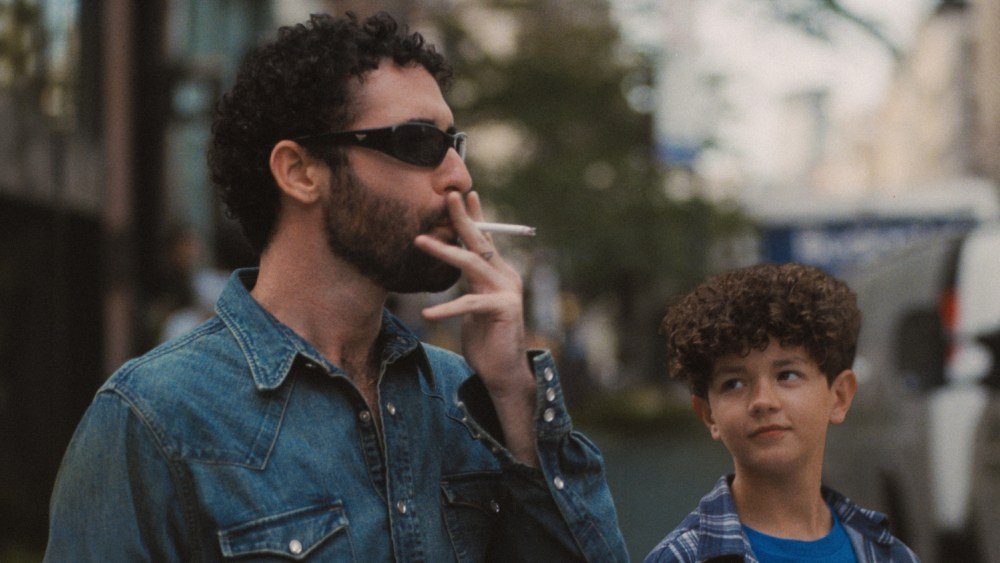
Take “Club Kid.” Jordan Firstman’s ebullient and moving first feature tells a story that couldn’t be more straightforward — or, in a way, more traditional. Firstman, who gives a fantastic performance, plays Peter, a queer New York party promoter (a few decades ago we would have called him “downtown,” now he’s Brooklyn) who learns that he has a 9-year-old son, whom he fathered in a random three-way sexual encounter at one of his 4:00 a.m. club bacchanals. The kid, Arlo (Reggie Absolom), is sweet and curly-haired and British (he arrives with a chaperone from London); his mother, who raised him, recently committed suicide. The responsibility to take care of Arlo has suddenly dropped on Peter like a load of bricks. It’s something he doesn’t want and, for the time being, doesn’t have much choice about. But as he and the kid start to hang out, a tentative relationship forms, and the two begin to figure out what they might mean to each other.
What “Club Kid” is “about” is how Peter, a charming dissolute man-child, living an existence of unhinged hedonism, discovers that he wants to grow up and take care of someone besides himself. On that score, the drama is authentic and fully felt. In outline, though, it’s something we’ve seen many times before, in films from “About a Boy” to “Big Daddy.” Yet what makes “Club Kid” singular is that it’s about something larger than that.
As a filmmaker, Firstman plunges you into the world of queer club culture with a fervor and tumult and personality and lived-in detail that takes your breath away. He plunks the audience down in the middle of the shade-throwing nightbloom revels, the cocaine and ketamine binges, so that we experience the cathartic rush of drugged-out insolence, of heightened erotic excitement, of gender-flipping transgression. From the earliest days of gay liberation, the party scene was a core expression of queer freedom, and still is. What we call disco started in the underground gay clubs of the early ’70s, and part of Peter’s cachet as a promoter is that what’s he organizing is now a business, but it’s still underground. The staging of these scenes, and the acting in them, is extraordinary. Jordan Firstman makes us feel the life of the party.
And yet…he’s not merely celebrating it. Far from it. As authentic and scene-specific as they are, the party sequences in “Club Kid” signify as more than just a portrayal of the New York queer club scene. They’re also a larger snapshot of what party culture, out there in the world, has become: an arena of liberation that’s rooted in a place of physical and spiritual abandon that contains the seeds of destruction.
If you wanted to encapsulate the history of the last six decades in one sentence, you could do worse than this: Ever since the late ’60s, the party has never stopped. There are countless versions of the party, and we’ve all been to our own preferred versions. It might have been the singles bars of the disco age, or the frat-house benders that came to rule in the late ’70s — and have only grown more frenzied and predatory ever since. It might have been the industrial dance clubs of the ’80s or the raves of the ’90s. It might have been the suburban saturnalia of “Jersey Shore,” or the more contempo versions of that. It might have been the punk mosh pits, or the revels of Studio 54, or the back-to-the-underground scene of Basement. The music, the drugs, the alcohol, the hooking up, the vibe of orgiastic excess — for 60 years now, we’ve been a culture on the prowl.
In “Club Kid,” it’s not just Peter who starts to question the party culture that has fueled him. The film itself is questioning it. It’s asking, “Is this how we should be living?” And yet, because the movie dares to pose that question, there has been a backlash against it, with a chorus of voices damning the movie by branding it “conservative.” A certain number of people are looking at “Club Kid,” with its tale of a queer man who turns his back on his own personal decadence to embrace the call of family, as if it were a movie Nancy Reagan could love.
What I think the “conservative” slur misses is that Jordan Firstman, who came out of this scene, is not questioning it in a puritanical or moralistic way. He captures the honest vibrance of party culture. Yet he also captures — and this is what I think is brilliant about “Club Kid” — that whatever version of it floats your boat, the party that never stops, while rooted in a certain vibe of community, may be rooted even more deeply in the enticement we feel from getting high on ourselves. That’s the hidden seduction of party culture, the thrill and the beauty of it, and maybe the lie of it. The party doesn’t need to stop. But it might be time that we stopped seeing it as an uncut salvation without ever pausing to ask, as “Club Kid” does, what it’s doing to us.
Check back often for more exciting news!