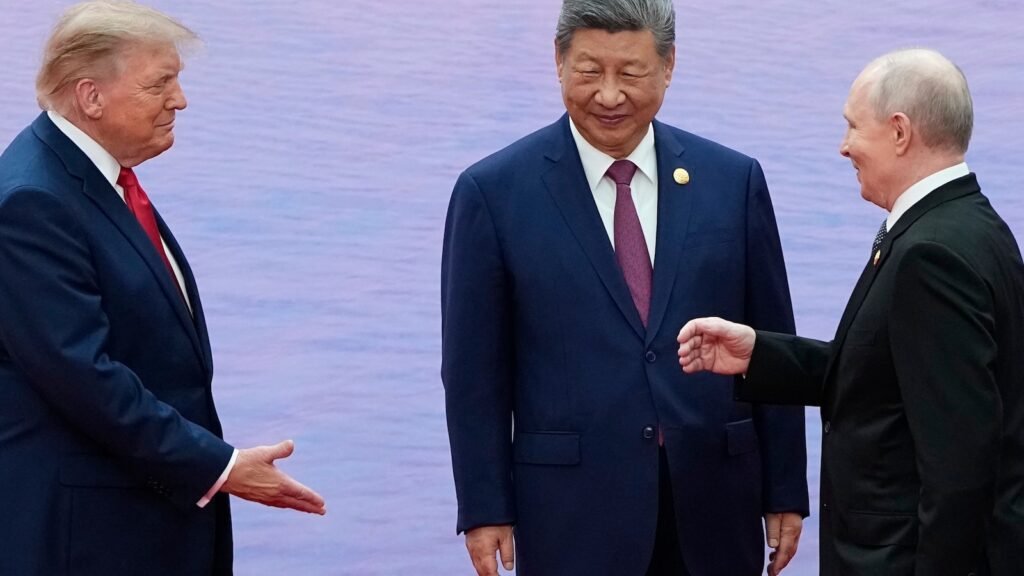
President Donald Trump landed in China on Wednesday, seeking to reinforce the United States’ status as the world’s leading technology power, but a distressing series of technical outages back home has left the administration scrambling to calm the American public. The issues put the administration on the defensive at a moment when the president wants
President Donald Trump landed in China on Wednesday, seeking to reinforce the United States’ status as the world’s leading technology power, but a distressing series of technical outages back home has left the administration scrambling to calm the American public. The issues put the administration on the defensive at a moment when the president wants to project strength and certainty ahead of a potentially complicated trilateral meeting with the presidents of China and Russia, Xi Jinping and Vladimir Putin.
Trump on Wednesday reunited with longtime friend Imelda Marcos, the widow of an ousted dictator and mother of the incumbent Philippine president, who is known for her vast shoe collection. The brief meeting took place in the Philippine capital, Manila, at the Malacañang Presidential Palace, where Trump held a bilateral meeting with President Ferdinand Marcos Jr., who received him with a red-carpet welcome and full military honors, said Philippine Ambassador to Washington Jose Manuel Romualdez.
Homeland Security Secretary Markwayne Mullin is set to appear Wednesday at a congressional hearing about threats facing the U.S. at a time of looming questions over cyber infrastructure, the future of immigration enforcement and his decision to fly to the LSU-Texas college football game as travelers across the country were still stuck at airports after the nationwide grounding of flights.
Here’s the latest:
The Trump administration’s director of national intelligence, Jay Clayton, says recent computer systems service disruptions in the government and private sector are “not a coordinated or state-sponsored attack.”
Clayton told the House Homeland Security Committee the outages instead appear to be separate and “associated with maintenance and technical changes.”
The testimony was the latest effort by the Trump administration to offer reassurances after technical outages that have affected everything from Microsoft to the Federal Aviation Administration, the banking industry to United Airlines and a classified internal communications network at the National Security Agency.
Clayton said in interviews Tuesday that the outages appeared to be connected to recent efforts to upgrade systems and patch vulnerabilities.
The Homeland Security Secretary offered a new defense Wednesday for his weekend flight to the LSU-Texas college football game, saying canceling the trip could have sent a confusing message.
Markwayne Mullin, speaking at the House Homeland Security Committee’s worldwide threats hearing, said the trip had been planned for weeks so that he could take his nieces to the game and there was discussion beforehand about whether to forgo it.
“If we canceled something with the airspace completely open, it could bring confusion because I was meeting the governor there. I was meeting other people there that would show maybe distrust that we’re not even willing to fly,” Mullin said.
Mullin said Tuesday and reiterated Wednesday that he is required to fly on government planes and that he personally paid for the trip.
His comments, delivered in a forceful tone, came after Democratic Rep. Bennie Thompson faulted him for the trip while others were stranded because of the nationwide ground stop, which had been lifted before his flight.
Homeland Security Secretary Markwayne Mullin said that when the FAA ordered the ground stop, the entire cabinet worked together.
“The whole of government went to work — every aspect of it,” he said.
More than 4,000 planes landed safely and the response was a great success, Mullin added.
Mullin said the government was able to get planes back in the air safely within a matter of hours.
The top ranking Democrat on the House Homeland Security Committee criticized Homeland Security Secretary Markwayne Mullin for taking a government flight to a college football game shortly after a nationwide ground stop.
Rep. Bennie Thompson, speaking during a committee hearing on worldwide threats, addressed Mullin’s weekend travel at the start of the meeting.
“While Americans were stranded in airports across the country, with many sleeping on the floor at their gates, the secretary boarded a luxury jet, flew to a college football game and visited the private suite of a company that DHS had awarded a $2.2 billion contract for the secretary of Homeland Security,” Thompson said.
Thompson said the Trump administration was failing to take responsibility for that and other recent technological disruptions.
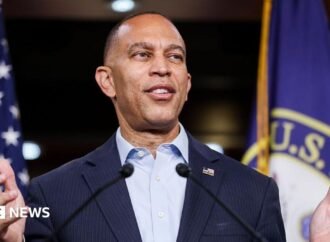
Democrats nominated Hakeem Jeffries on Wednesday to be speaker of the House, as he brushed past skeptics and was on track to make history as the nation’s first Black American with the gavel.
Jeffries, of New York, secured the nod during closed-door voting, ahead of a full House vote when the new Congress convenes in January.
He ran unopposed but faces a restive party eager for a change after voters ousted Republicans in a rebuke of President Donald Trump and the party in power. Jeffries is part of a leadership trio with Rep. Katherine Clark of Massachusetts and Rep. Pete Aguilar of California, who would all be historic firsts — Clark as the first female majority leader and Aguilar as the first Latino to serve as the majority whip. They also ran unopposed.
Jeffries will face a separate roll call of the whole House to become speaker when the new Congress convenes on Jan. 3, 2027.
Rep. Andrew Garbarino, a New York Republican and chairperson of the House Homeland Security Committee, said the panel had made repeated efforts to line up FBI Director Kash Patel’s appearance at Wednesday’s worldwide threats hearing but that he made it clear “he had no intention” of being present.
Garbarino said Patel’s absence marked a significant departure from committee precedent. He said the committee has been clear about its expectation that the FBI director appear in person to testify.
The committee’s top Democrat, Rep. Bennie Thompson, also joined in the criticism.
The FBI sent Deputy Director Christopher Raia in Patel’s place.
Also testifying were Homeland Security Secretary Markwayne Mullin and Jay Clayton, the Trump administration’s director of national intelligence.
Sen. Bill Cassidy, who chairs the Senate health committee, said they would not consider Jim O’Neill, the White House’s pick to lead the science organization.
Cassidy said O’Neill “did not do enough to stand up for science” during his time as acting director of the Centers for Disease Control and Prevention, raising concerns about how he might lead the National Science Foundation.
It’s not yet clear why the vote did not happen. In an email, the White House confirmed it has not pulled O’Neill’s nomination.
O’Neill does not have an advanced science degree or research experience.
Earlier this year, around 50 scientific institutions and groups signed an open letter urging the Senate to hold a confirmation hearing for O’Neill so they could learn more about his vision for NSF prior to a vote.
The science foundation’s staff has been gutted over the past year, and more than $1 billion of its allotted funding sat unused when the fiscal year ended last month.
Democrats are voting in a closed-door meeting nominating Jeffries to become the House speaker when the new Congress convenes.
If nominated by his colleagues, Jeffries would face a vote of the whole House on Jan. 3, 2027.
The New York Times said that Vice President JD Vance has canceled his scheduled Wednesday appearance at the news organization’s DealBook Summit.
Vance’s office declined to directly address his decision to skip the event and instead referred to DealBook’s “tweets on the matter.”
The Times reported Vance has been called to stay in Washington to take part in meetings to address tech outages that have impacted airlines and banks.
Five Democrats essentially representing all corners of the caucus will nominate Hakeem Jeffries for House speaker.
Among them is Rep. James Clyburn, the legendary lawmaker from South Carolina.
Democrats are meeting to elect their leaders for the new Congress in January.
A congressional hearing on worldwide threats is underway in Washington, with Homeland Security Secretary Markwayne Mullin set to testify.
The hearing before the House Homeland Security Committee is aimed at assessing threats 25 years after the Sept. 11 attacks.
It also comes amid disruptive technological outages, including a rare nationwide ground stop of flights last week.
Also appearing are FBI deputy director Christopher Raia and Director of National Intelligence Jay Clayton.
Mullin, along with Transportation Secretary Sean Duffy, took the lead briefing the public after the outage, which the Trump administration has said likely is not the result of an attack.
Mullin has also been in the news because he took a government flight — which he said he personally paid for — to an LSU-Texas college football match Saturday, hours after the upheaval at airports.
House Democrats are gathering behind closed doors to nominate the House speaker and choose other top leadership positions.
Leader Hakeem Jeffries faces a key test on his path to becoming House speaker, and is expected to easily clear the majority threshold from Democrats during the private caucus election. He and the other top leaders are running unopposed.
In first voting, Rep. Ted Lieu of California has been elected the caucus chairman.
The House elects its speaker when the new Congress convenes on Jan. 3, 2027. Jeffries would make history as the nation’s first Black American to become speaker of the House.
Trump plans to meet separately with Russian President Vladimir Putin on Thursday in China, in addition to his already scheduled three-way meeting with Chinese President Xi Jinping, a U.S. official confirmed.
Trump’s meeting with Putin would be the first time the pair have sat down since they met in 2025 in Alaska, conducting talks that failed to broker a deal to ease Russia’s war in Ukraine.
The distressing series of technical outages back home has put the Trump administration on the defensive at a moment when the president wants to project strength and certainty ahead of a potentially complicated trilateral meeting on Thursday with Xi and Putin.
Trump on Wednesday reunited with longtime friend Imelda Marcos, the widow of an ousted dictator and mother of the incumbent Philippine president, who is known for her vast shoe collection.
The brief meeting took place in the Philippine capital, Manila, at the Malacañang presidential palace, where Trump held a bilateral meeting with President Ferdinand Marcos Jr., who received him with a red-carpet welcome and full military honors, Philippine Ambassador to Washington Jose Manuel Romualdez said.
Trump arrived in Manila on Tuesday night to join leaders of the Association of Southeast Asian Nations in their annual summit meetings with major Asian and Western counterparts. In a speech before ASEAN and other Asian leaders over dinner Tuesday, Trump praised Marcos and his parents.
“I just don’t wanna date myself, but I knew your parents very well,” Trump said, addressing the Philippine president. “They were great. I believe in genetics, and they did a good job.”
▶ Read more
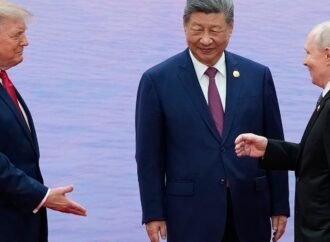
Before leaders got into position for the traditional summit family photo, Russian President Vladimir Putin approached President Donald Trump, and they shook hands and exchanged greetings.
Trump had said before departing Washington that he was open to a formal one-on-one meeting with Putin, but it appeared that it might not come to pass while both are in China.
Instead, Trump, Putin and Xi will meet as a group on Thursday on the summit sidelines.
Marcos said he sent Trump a Jollibee delivery so he could have a “taste of Manila” during his short stay in the capital.
Marcos said it was intended as a pick-me-up of sorts for a president who works hard.
“Jollibee … is a very, very popular chain. And one of their main products is fried chicken. And we are very proud to say that we have surpassed KFC in the United States in terms of popularity,” Marcos said at their palace meeting.
“Oh wow,” Trump said upon hearing the claim. “Fantastic.”
“You have been working very hard, Mr. President, so just think of it as providing extra energy for all the work that you have to do that you have done and continue to do, and that is in front of you,” Marcos said.
Trump, who enjoys McDonald’s, didn’t say whether he had tried the chicken. Neither did the White House.
Trump was led by Philippine President Ferdinand Marcos Jr. on a rather lengthy red-carpet stroll around the lush grounds of the Malacañang presidential palace after they reviewed the troops.
They stopped at one point to listen as musicians using bamboo instruments played Elvis Presley’s “It’s Now or Never” and a Filipino folk song.
For a few seconds, Trump moved his forearms from side to side in a windshield-wiper-type motion.
Once seated inside the sprawling palace for their meeting, Trump told Marcos their countries’ people have a lot in common and stressed “architectural tastes.”
“I love what you’ve done here,” Trump said, referring to the palace. “You’ve done a fantastic job.”
Trump is a former real estate developer and builder who has been putting those skills to work on numerous renovations at the White House.
Canadian Prime Minister Mark Carney on Wednesday said that Canada ’s growing trade relations with China are not a top priority for Trump, pointing out that Canada primarily exports commodities to China rather than sensitive technologies such as advanced semiconductors.
“In my conversation with the president, he’s tried to understand where we are with China, where we’re going with China,” said Carney during a news conference in Shenzhen, ahead of the Asia-Pacific Economic Cooperation leaders’ summit. “I shouldn’t speak for him, but in his hierarchy of issues, it’s not the top issue at all.”
Carney’s comments came amid criticism from White House trade adviser Peter Navarro over Canada’s willingness to pursue closer economic relations with Beijing, including potentially bringing Chinese automakers to Canada.
Canada and the U.S. have one of the world’s largest trading relationships, but Trump’s tariffs have strained ties and pushed Ottawa to seek other markets. After negotiations collapsed in August, Washington imposed 50% tariffs on about $20 billion in Canadian goods, prompting retaliation from Ottawa.
▶ Read more
The Asia-Pacific must pursue more open trade and equitable growth if it is to remain stable and dynamic, Chinese President Xi Jinping told business executives gathered Wednesday in the southern Chinese technology and financial hub of Shenzhen, on the sidelines of the annual Asia-Pacific Economic Cooperation summit.
Trump’s “America First” approach of tariff hikes and other moves runs counter to APEC’s aim of eventually forming a Pacific Rim free trade zone. U.S. limits on Chinese access to leading-edge American technology, such as the Nvidia computer chips that help to power artificial intelligence, are a constant source of strain with Beijing.
Xi and other APEC leaders called for a more open approach, without directly criticizing the U.S. shift toward protecting its own markets.
Xi faces pressure at home from slowing growth as retail spending and investment have dragged as China endures a prolonged property market slump.
Still, Trump’s emphasis on friendly relations with Xi may lead to an extension of the trade truce reached last year after a series of tariff escalations.
▶ Read more
Chinese President Xi Jinping welcomed Trump to Shenzhen at an airport, a rare courtesy for Xi that highlights the importance Beijing attaches to its relationship with Washington.
During Xi’s state visit to Washington in September, Trump had also taken the unusual step of greeting Xi on the tarmac.
Chinese official news agency Xinhua reported that Xi recalled Trump’s gesture and said: “China is a nation of etiquette, with a tradition of reciprocating courtesy.”
Xi and Trump greeted each other at the foot of the airplane’s stairs and shared a brief hug as an ensemble of young people chanted, “Welcome! Welcome! Warmly welcome!”
Xi said he looked forward to talking with Trump on major issues concerning China-U.S. relations, Asia-Pacific cooperation and the global landscape to advance “strategic stability,” Xinhua said.
President Donald Trump landed in China on Wednesday, seeking to reinforce the U.S. status as the world’s leading technology power, but a distressing series of technical outages back home has left the administration scrambling to calm the American public.
The issues put the administration on the defensive at a moment when the president wants to project strength and certainty ahead of a potentially complicated trilateral meeting on Thursday with the presidents of China and Russia, Xi Jinping and Vladimir Putin.
As he began his trip to Asia, Trump initially had been nonchalant about the outages that left people in the United States worried about accessing their email, checking their bank accounts or safely flying on an airplane.
But then the outages involving Microsoft, the Federal Aviation Administration, JPMorgan Chase and the National Security Agency’s communications network began to overshadow Trump’s visit. They raised the specter that artificial intelligence can disrupt daily life, as new cyber vulnerabilities identified require software to be constantly upgraded to fix flaws or other security holes, known as patching, which is supposed to improve how the technology runs.
▶ Read more
For more tech updates, stay tuned to our blog.