
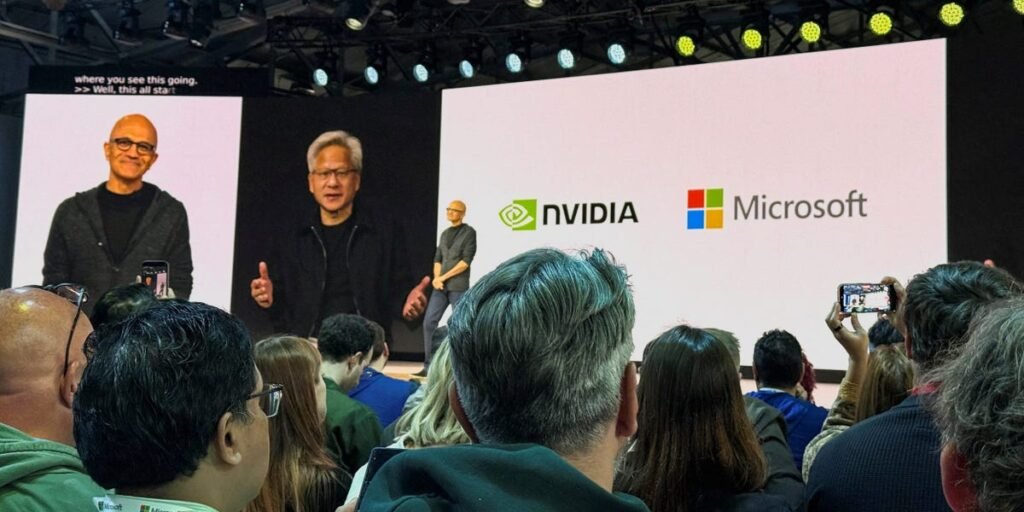
In his first post on “AI will transform every industry, power every company, and be built by every country,” Huang wrote in X. “Open models strengthen security and cybersecurity, accelerate innovation and diffusion, and enable sovereignty.” On Friday, Nvidia, Microsoft, Meta, Mistral and others signed an open letter urging US policymakers not to crack down
In his first post on
“AI will transform every industry, power every company, and be built by every country,” Huang wrote in X. “Open models strengthen security and cybersecurity, accelerate innovation and diffusion, and enable sovereignty.”
On Friday, Nvidia, Microsoft, Meta, Mistral and others signed an open letter urging US policymakers not to crack down on open-weight AI models.
His statement amounts to a full endorsement of open-weight AI models at a time when senior Trump administration officials have suggested they could take action against Moonshot AI, the creator of the Kimi K3, the world’s most powerful open-weight AI model.
“Our leadership in AI will not be judged by a frontier AI model, but by whether the United States builds a strong, open ecosystem that spreads across all sectors,” the signatories wrote in the letter.
The two biggest absences from the list are OpenAI and Anthropic, widely regarded as the world leaders in the frontier AI modeling race. Unlike Anthropic’s Fable 5 and OpenAI’s GPT-5.6-Sol, Kimi K3 as an open source model will soon be available for download and customization. Both companies would benefit if the US government directly blocks or significantly impedes China-based open model makers like Moonshot AI. Google also did not sign the letter.
OpenAI CEO Sam Altman later said he was “glad to see” support for open weight models.
“I want the United States to win in AI in both open source and proprietary models,” Altman wrote in X.
While SpaceX is not listed as a signatory, Elon Musk later expressed his support for the message.
“This has my full support,” Musk wrote on X, quoting Huang’s tweet. “Jensen is right.”
While the letter does not specifically mention Moonshot, its authors describe the broader development of open AI models as similar to how open software revolutionized computing in the 1980s.
“Open source did more than reduce the cost of software; it created a shared knowledge base upon which generations of American engineers and entrepreneurs built their institutional sovereignty,” they wrote.
Until now, China has dominated the development of open-source AI models, despite the United States’ legendary reputation for creating open source software. Two of the biggest modern names in open software, Mozilla and the Linux Foundation, also signed the letter.
In the US, Nvidia’s Nemotron model is one of the largest open models, although its performance pales in comparison to rivals like the Kimi K3. Alexandr Wang, Chief AI Officer at Meta, has said his Meta Superintelligence Labs team remains committed to open models and is developing an open variant of its Muse Spark model. Reflection AI, a startup founded by former Google DeepMind researchers, is also preparing its own open model.
On Wednesday, Michael Kratsios, director of the White House Office of Science and Technology Policy, publicly accused Moonshot of developing Kimi K3 by distilling Anthropic’s Fable 5 model. Distillation, the process of training a less powerful model with the results of a more powerful one, is a controversial but commonly used practice in AI development. At the same time, companies like Anthropic have accused their Chinese counterparts of abusing the distillation process to the point of essentially ripping off their intellectual property.
Earlier this week, Treasury Secretary Scott Bessent suggested that the United States could sanction companies that engage in such distillation, which he likened to theft.
The letter defends the distillation process more broadly, but opens the door to the possibility of companies like Nvidia, Microsoft and Meta supporting a crackdown on those who have proven themselves to be bad actors.
“Illegal efforts to extract value from closed models raise legitimate concerns,” they wrote. “Those concerns should be addressed through specific legal and commercial frameworks rather than sweeping restrictions on techniques that play an important role in AI innovation.”
In total, a combination of 25 companies, organizations and platforms signed the letter. These are American Innovators Network, Andreessen Horowitz, Arcee AI, Arena, Black Forest Labs, Box, CrowdStrike, Dell Technologies, Emergence Capital, Hugging Face, IBM, The Linux Foundation, Mariana Minerals, Meta, Microsoft, Mistral, Mozilla, Nvidia, Palantir, Perplexity, Reflection, Replit, ServiceNow, Telnyx and Y Combinator.