“Midday Meal” isn’t necessarily about the art of cooking, but it is in part about the rituals of food, rituals which become more precious with scarcity. But more than that, the new film from director Majid Majidi — best known for his 1997 drama “Children of Heaven”, the first Iranian production ever nominated for the
“Midday Meal” isn’t necessarily about the art of cooking, but it is in part about the rituals of food, rituals which become more precious with scarcity. But more than that, the new film from director Majid Majidi — best known for his 1997 drama “Children of Heaven”, the first Iranian production ever nominated for the Best International Feature Oscar — is about the right to have food, a punishing struggle to find and provide it in the absence of governmental care.
Set in the Iranian village of Goorankesh, housed in an incredibly arid and seemingly inhospitable region, the film follows schoolteacher Davoud Soulan (Mohammad Rahimi), whose job lies on precarious foundations. His livelihood is mostly privately funded — though his salary is from the ministry of education, he’s only a contractor — and his benefactor has passed away. Worse still, the dead man’s heirs don’t wish to continue the investment that allows him to provide lunches for his students. This pause in food supply imperils the entire school due to a domino effect: With no lunch, the kids will stop showing up, which would shut the school down after an estimated two weeks.
The teacher accepts the semi-transactional nature of his relationship with his students: It’s hard to fault a child for being hungry, and it’s difficult not to be moved by the desperate measures that Soulan takes to keep his school open. He lives in the building to save on rent (which then goes to food), and moonlights smuggling and selling fuel to keep the school running. (Here, smuggling is a pastime than many engage in, children included.)
But it’s not so simple as Soulan choosing and continuing to do the right thing. His determination to keep the school open comes with some moral compromises — and this is what makes “Midday Meal” more interesting, and more fraught, than expected.
The conflict between pragmatism and generosity begins at a small scale and incrementally escalates. At first, it’s seen in Soulan’s hesitation at accepting children from other villages to his class — then in his rage at his mother for feeding guests at the potential expense of the children’s meals. Between Rahimi’s performance and Majidi’s patient exploration of his reactions, it comes off as very human rather than as an idealistic cipher for how the director wishes the world was. Desperation shifts Soulan’s actions into more dubious territory, especially as one character even calls into question how much of what he does is charity and how much is pursuit of a guaranteed salary.
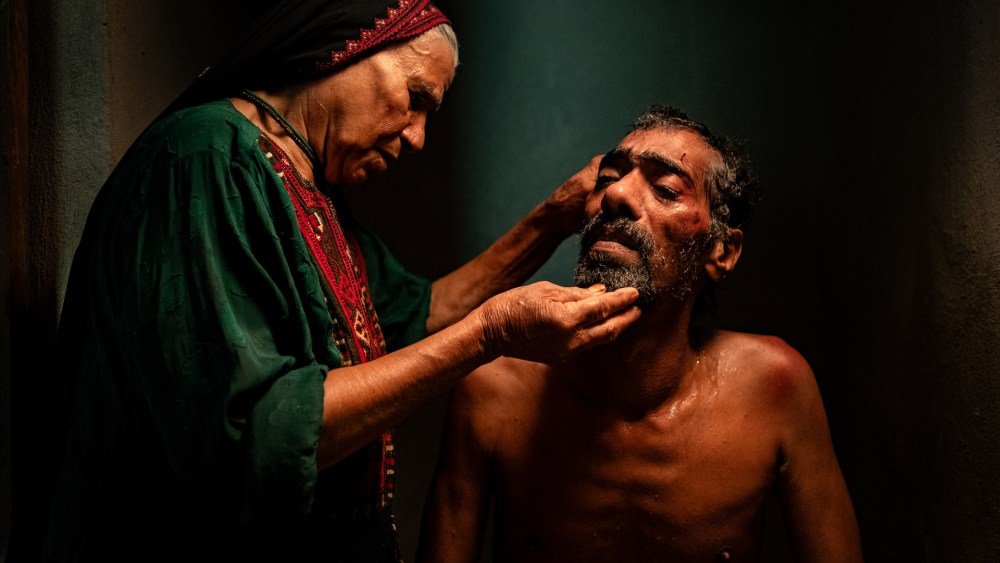
Either way, Rahimi balances the character’s clear vulnerability with just enough ambiguity about his plans for the school, accentuated through Majidi’s restrained and naturalistic approach. The director’s deliberate obfuscation of Soulan’s immediate intentions — beyond his desire to keep the school open — make for a fascinating character study. Rahimi plays him as a mostly sincere but deeply conflicted man, and most importantly a desperate one, capable of some rather unexpected deceptions. One of these is effectively kept hidden from scene to scene, especially once a sick old man falls into Soulan’s care.
At one point, Soulan points out that the crime of fuel-smuggling is minor compared to the barons profiting off the very same — and shouldn’t the motivation, the practical outcome of the act, count for something? Majidi tests the limits of this sentiment throughout “Midday Meal,” often to great effect. The film starts from a point of frustration about a lack of governmental care, and a community falling apart from the stressors of being left with no support. The few encounters with representatives of the law are exasperating — an officer chastises Soulan for being a bad role model for his students — though not necessarily cut and dried. Meanwhile, a member of the education department treats his organization and financing with suspicion, despite having already left him to his own devices.
This is where the anger of “Midday Meal” comes in, an innate frustration at how so many institutions continually fail to make the simplest decision in the world: to provide for people. Majidi’s matter-of-fact style of shooting underlines the cold reality that Soulan tries to navigate, and strips away any semblance of potential didacticism. For every good deed he does, there’s an underside of pragmatism to it, which can seem a little ruthless.
But some good deeds do seem to come back around, in moments of grace that keep “Midday Meal” from being a punishingly bleak affair. Despite his seeming sternness and the board’s outright negligence, the inspector sees Soulan’s charity and decides to help how he can — even if the scene of the inspection itself is incredibly stressful. In a film that, at the outset, seems like it could be open-and-shut in terms of moral simplicity, there are ultimately no easy answers.
Check back often for more exciting news!