Auroras have been beguiling humans for centuries, creating colorful, otherworldly shapes that ripple and dance across the night sky. Earth-bound observers most often see them at high northern latitudes, where they’re known as the aurora borealis, or northern lights. But these auroras can also appear in the Southern Hemisphere, where they’re called the aurora australis,
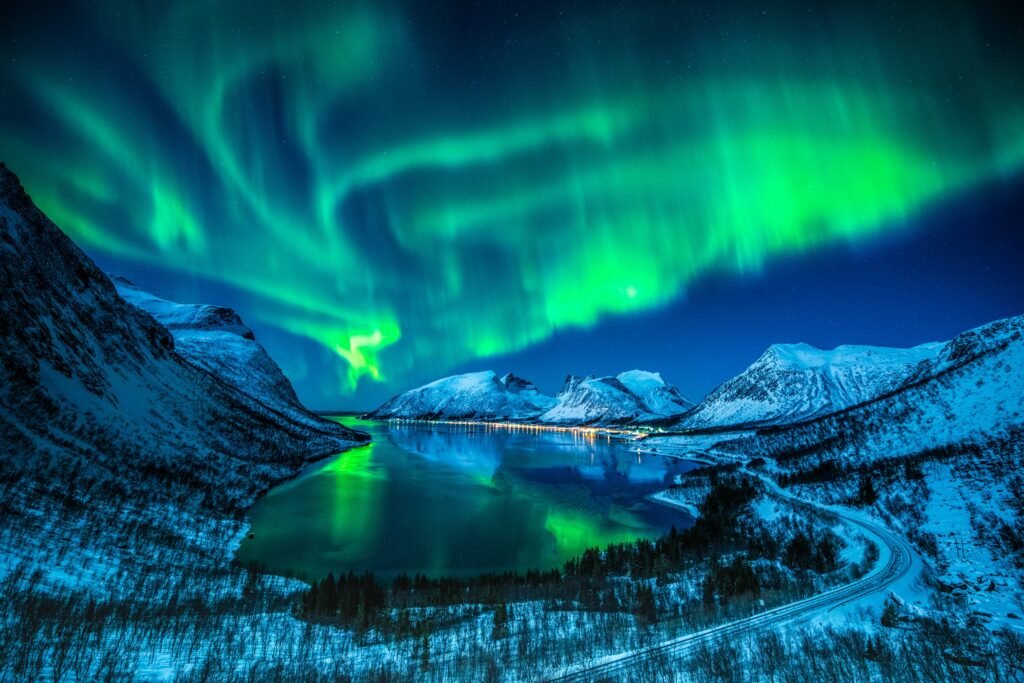
Auroras have been beguiling humans for centuries, creating colorful, otherworldly shapes that ripple and dance across the night sky. Earth-bound observers most often see them at high northern latitudes, where they’re known as the aurora borealis, or northern lights. But these auroras can also appear in the Southern Hemisphere, where they’re called the aurora australis, or southern lights. Earth’s auroras are also visible from space, routinely putting on a show for astronauts aboard the International Space Station.
Of course, Earth is far from the only celestial body in the universe. So, do other planets have auroras, too? The short answer is yes—but they’re not necessarily the same as the dazzling displays we see here on Earth.
What makes an aurora?
Auroras typically involve three main ingredients: energetic particles, an atmosphere, and a magnetic field. These are “not unique to the Earth,” says Tom Kerss, an astronomer and author who serves as the chief aurora chaser for Hurtigruten, a Norwegian cruise line and coastal ferry operator that’s been sailing Norway’s coast since 1893. “We just have a long history of studying auroras on the Earth because people have been seeing them for a very long time.”
Earth’s auroras start with the sun, which sends a constant stream of electrically charged particles into space, a phenomenon known as solar wind. When some of these particles reach Earth, our planet’s magnetic field funnels them toward the polar regions.
There, the particles collide with gases in the upper atmosphere, transferring some of their energy. As the gases return to their normal state, they release that extra energy as light, creating the shimmering ribbons, arcs, bands, and curtains we know as auroras.

Auroras get weird on other worlds
Aurora formation on other worlds is surprisingly diverse, Kerss says. Before they were able to detect them, many scientists assumed that all extraterrestrial auroras would be similar to those on Earth.
“But actually, every planet has some kind of unique feature about it, and so it’s the Earth that is almost uniquely strange itself,” says Kerss. “We’re just used to Earth’s auroras. There’s no reason to think this is normal, and everywhere else has it weird.” So, in order of coolest to slightly less cool, here’s what we know—so far—about auroras on other planets.
Jupiter’s auroras are big, bright, and powerful
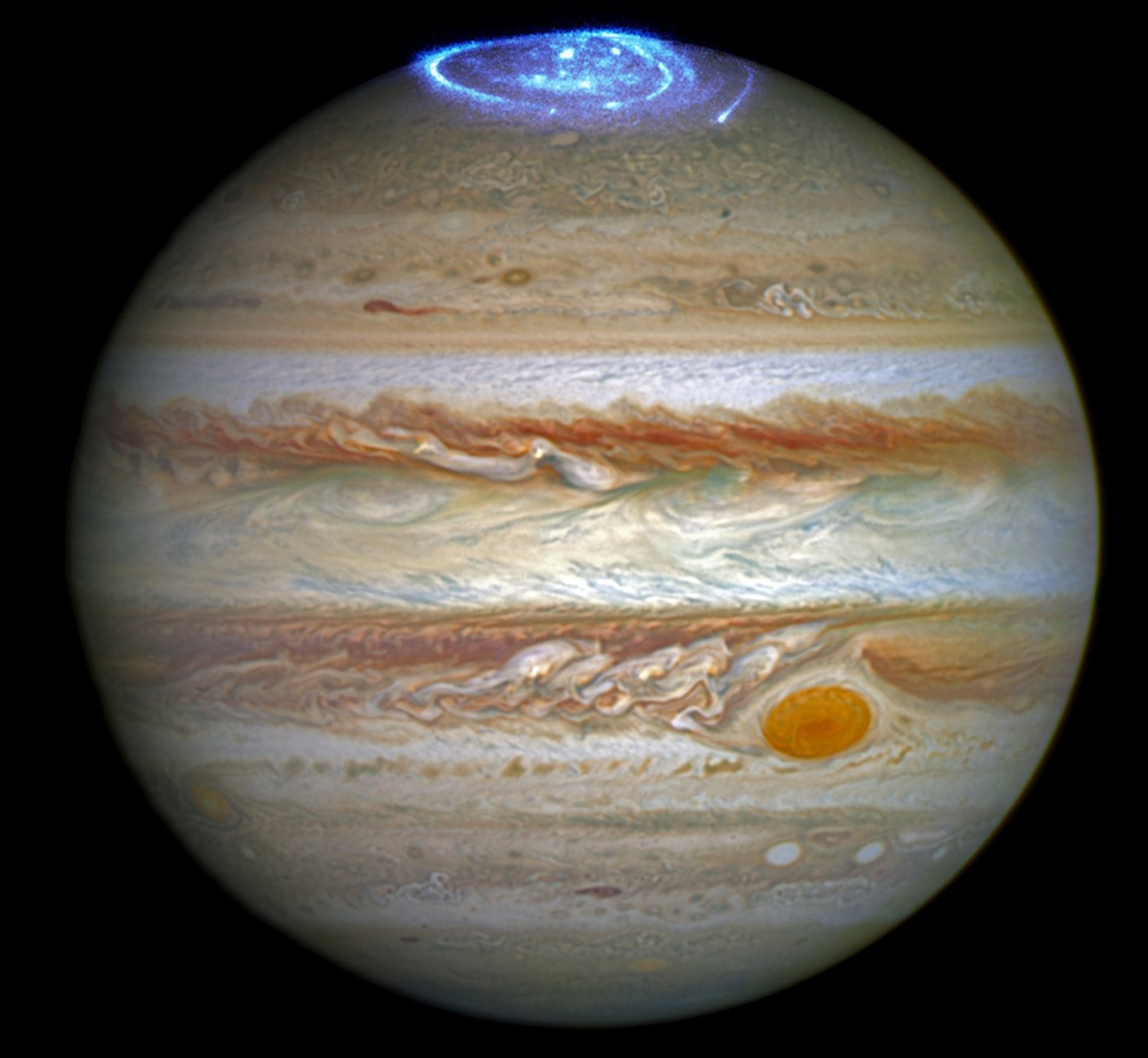
Jupiter’s auroras, first detected in 1979 by NASA’s Voyager 1 spacecraft, form and behave very differently than Earth’s. The massive planet has such a powerful magnetic field that its magnetosphere—the massive, protective magnetic bubble surrounding it—deflects nearly all of the solar wind that reaches it. So, instead of coming from the sun, much of the plasma, or superheated, electrically charged gas, that fuels Jupiter’s auroras comes from its innermost moon, Io.
Io is covered in volcanoes that release huge amounts of material into space. That material becomes ionized and trapped in Jupiter’s magnetic field. These charged particles then “ride the rails” of Jupiter’s magnetic field toward the planet’s poles, says Kerss.
Jupiter’s auroras are larger, more energetic, and brighter than Earth’s northern and southern lights, and they’re especially prominent at wavelengths of light that are invisible to human eyes, including ultraviolet and infrared.
“Io powers a good 85 to 90 percent of all the auroral emissions on Jupiter,” he says. “Not just auroras, but the strongest auroras anywhere in the solar system—auroras so strong that if you could float around in the clouds of Jupiter, you would see every color of the rainbow with extraordinary brightness,” says Kerss.
“Jupiter, the king of the planets, is also the king of auroras. There’s no question of that.”
Mars has patchy, localized auroras
Mars has auroras, too, but they’re “rather strange,” says Kerss. The Red Planet lost its global magnetic field billions of years ago and it has an extremely thin atmosphere, yet it still produces several different kinds of auroras.
When charged particles from the sun stream toward Mars, they funnel into patches of intensely magnetized crust—left over from its days as a magnetically active world—and produce localized light shows known as discrete auroras. These look similar to Earth’s auroras, but they can occur all over the planet, rather than being concentrated only near the poles.
Mars also has proton auroras. As the name suggests, protons, rather than electrons, produce these auroras. These protons come from solar wind interacting with Mars’ atmospheric gases. The result is a diffuse ultraviolet glow across the planet’s entire dayside.
Scientists have also observed solar energetic particle auroras, which occur when bursts of high-energy particles from the sun slam into the Martian atmosphere, producing ultraviolet and visible green light across the night sky.
Neptune’s auroras glow at mid-latitudes and Saturn’s can last for days
On the somewhat less dramatic side are Saturn’s and Neptune’s auroras.
Neptune’s auroras, which the James Webb Space Telescope’s near-infrared spectrograph only officially confirmed last year, are located at its geographic mid-latitudes—not its northern and southern poles—thanks to the planet’s tilted magnetic field.

Meanwhile, Saturn’s auroras are fairly similar to Earth’s, in that they’re fed largely by solar wind and concentrated near its poles. But they can last for days, rather than mere minutes or hours, and they glow mostly in ultraviolet and infrared light.
Comets and “failed stars” have auroras, too
Scientists have also detected auroras on 67P/Churyumov-Gerasimenko, the first comet that a robotic spacecraft from Earth has orbited and landed on. Though the comet lacks an intrinsic magnetic field, an envelope of gas known as a coma surrounds 67P/Churyumov-Gerasimenko. When electrons in the solar wind interact with molecules in this coma, they break them apart, producing excited atoms that give off an ultraviolet glow.
Some brown dwarfs—large, distant, substellar objects sometimes referred to as “failed stars”—also generate auroras. But unlike planets in our solar system, brown dwarfs don’t have gusts of solar wind blowing past them, so scientists aren’t yet sure what powers these strange objects’ auroras.
What auroras can tell us about other celestial bodies
Auroras are more than just pretty lights, says Kerss. They’re also windows into otherwise invisible forces, giving scientists clues about magnetic fields, atmospheres, and even hidden oceans.
For instance, the Hubble Space Telescope’s observations of ultraviolet auroras helped scientists confirm their hunch that Ganymede—Jupiter’s biggest moon and the largest moon in the solar system—has a massive saltwater ocean lurking beneath its surface. Scientists were able to infer the ocean’s presence because Ganymede’s auroral belts wobble as the moon interacts with Jupiter’s magnetic field. The amount of wobbling depends in part on the strength of Ganymede’s magnetic environment, which the electrically conductive ocean beneath its surface influences.
Moving forward, auroras could play an important role in the search for life beyond our solar system, Kerss says. Scientists may be able to use auroras as a kind of cosmic filter, helping them zero in on the most promising exoplanets for further study.
“We can start to use auroras to reverse-engineer the circumstances of other worlds,” says Kerss. “If we’re looking for a very Earth-like atmosphere, then looking for Earth-like auroras is a good way to narrow it down.”
He adds: “We’re in the infancy of a situation where aurora detection has added a new instrument to the Swiss army knife of planet exploration. Maybe one day in the far-flung future, we’ll know of a habitable world, we’ll know of alien life there, and perhaps one of the reasons we’ll know is the aurora.”
In Ask Us Anything, Popular Science answers your most outlandish, mind-burning questions, from the everyday things you’ve always wondered to the bizarre things you never thought to ask. Have something you’ve always wanted to know? Ask us.
Related ‘Ask Us Anything’ Stories

2026 Popular Science Home of the Future Awards
Check back often for more exciting news!