Paul Smith has never been afraid of color. In fact, he’s surrounded by it. “Welcome to my room!” the cheery 80-year-old says over a Zoom call as he moves his laptop like a toy airplane around his office headquarters in central London. Smith’s signature is whimsy: For him, fashion is about play. The suits he
Paul Smith has never been afraid of color. In fact, he’s surrounded by it.
“Welcome to my room!” the cheery 80-year-old says over a Zoom call as he moves his laptop like a toy airplane around his office headquarters in central London.
Smith’s signature is whimsy: For him, fashion is about play. The suits he sells are lined with polka dots; the socks are vividly striped; boxer briefs are covered in hearts; cuff links take the shape of pencils or Big Ben. His office is a testament to his curiosity. Take the stacks of books, which call to mind the famous Bodleian Library at Oxford. “This is all photography,” he says as he points to a pile that reaches the ceiling. “And then we have graphic design. And then we have a lot of industrial design.” He pulls open a drawer to reveal a collection of vintage Rolex watches. “Look here!” he says as he discovers an old fabric badge from Studio 54 that somehow survived. “I was there with my wife. Do you see it?”
Perhaps because he’s not one to sit still, Smith keeps 22 bicycles in his five-floor office; they’re gifts from avid racers who know his love of the sport. (In addition to animals, bicycles are another motif in his collections, appearing on everything from bags to T-shirts.) His cluttered workspace is a resting place for all the fan mail he receives — including presents from a mysterious admirer who, over the decades, has sent him the following: “A skateboard, a hat, a goose, a red dog, a dinosaur,” Smith says, relishing every object.
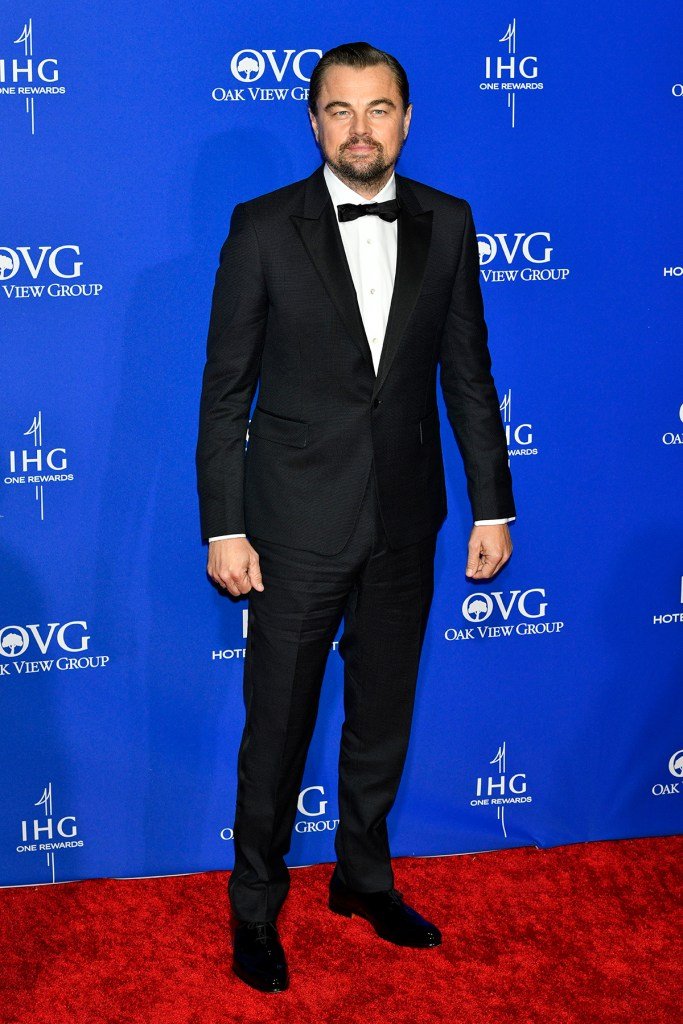
Smith has been a staple in fashion since he and his wife, Pauline Denyer, who studied couture at London’s Royal College of Art, decided to get into the business as a lark. In 1976, he showed his first collection not during fashion week, but at a friend’s apartment in Paris. Only 35 people attended, but a buyer from Barneys New York was there, and that was enough. These days, Smith’s client list includes Leonardo DiCaprio, Daniel Day-Lewis, Harrison Ford, Andrew Scott and Tom Holland. His brand is known for elegant looks that have “a sense of humor,” Smith says. “It’s really subtle. A lot of designers are what I call attention-seeking — extreme shapes or too many pockets. Our clothes are very wearable.”

Leonardo DiCaprio in Paul Smith at the 2024 Palm Springs International Film Festival Awards
FilmMagic
And in this fantastical setting, Smith is not letting something as inconsequential as age slow him down. For example, today he got to work at 5 a.m. to take a call from New Zealand as guest artistic director of a traveling Picasso exhibit that’s made stops in Paris, Shanghai and Tokyo. He recently published his memoir, “Threads: My Life in Style” (with an audiobook narrated by the actor Bill Nighy, his friend and doppelgänger). In his book, Smith writes candidly about how COVID lockdowns nearly destroyed his privately owned business, but he refused to sell — and now he’s back on the path to profitability. He’s opening a second New York store on Madison Avenue this month. (Although he’s known for his menswear, he also sells women’s attire and special-edition home furnishings that range from candy-colored rugs to lamps to cutlery). “I’d really recommend anyone to visit it,” Smith says of his new store. “The interior is based on my house in Notting Hill. It’s going to be so quirky.”
We’d expect nothing less. During our hourlong chat, Smith answered our questions while regularly interrupting himself for a show-and-tell of his favorite keepsakes.
I’m talking to you from Los Angeles, where the sun is rising, but it’s the afternoon in London. I want to start by wishing you a happy 80th birthday, which you celebrated in July.
Believe it or not, I’m older than I was earlier in the year. Oh, dear! If these pests [he’s referring to his colleagues, but he says it with love] hadn’t reminded me, I wouldn’t have a thought about being 80. I’m blessed with a lot of enthusiasm and energy and travels. It hasn’t meant anything to me.
You’re sitting next to a plastic dinosaur, and dinosaurs are a common theme in your work as a designer. What is it that you love about them?
I think it’s because they’re no longer here, and the scale of them is so incredible. They’re just so full of mystery, and kids love dinosaurs. I suppose it has to do with pleasing children. I like dinosaurs a lot. I’ve got three that walk.
There’s something about your brand that brings me back to my own childhood. I’m sure many of your customers feel the same way. I own your dinosaur and dog cuff links, and for years I took my Paul Smith turquoise luggage to film festivals. Can you talk about what inspires you?
I think one of the things my entire life has always had in it is humor. My father was a very humorous man. When I first started designing, I realized I wasn’t a great designer. I could do nice things, but I wondered why people would buy them. Then I realized if I could just make a different-colored buttonhole, or make the inside of the jacket patterned, maybe people would buy it. And then it got coined as “classic with a twist” or “classic with the unexpected.” At the beginning of my career, most men were classically dressed. A cuff link or tie was a good way of showing they had a sense of humor or they were more artistic without blowing the job with the boss because they looked too frivolous.
You’re known for your patterned socks. How many socks do you own?
I would say 200, probably. My wife is always complaining: “You only use the top layer. Why do you have so many?” I have no idea. Oddly, I only have six ties. I love ties. Most of them are woven in Como, Italy. The machinery is absolutely amazing, with this very fine needle and very fine thread. So you can do so much detail. To me, they’re really like art pieces.
What is your favorite sock pattern?
Blue, today. [He pulls up his pant leg to reveal a light blue sock.] And often they’re burgundy-and-blue-striped or two shades of blue. But recently, I’ve been wearing lemon-colored socks, and it’s caused a stir without me realizing it. We have mint green on my desk. I might be coloring them later with a felt tip.
Barneys gave you one of your early big breaks as a young designer. What happened after they saw your first show?
I got to know Gene Pressman because I was working as a freelancer in a shop in London. I went into Claridge’s to see him. I thought I was going to see him in the lounge, and he said come up. He and Michael, his buyer, were doing situps on the floor. I showed the shirts to them as they were going up and down. And they ordered 350, which was an enormous number for me at the time.
Do you remember what they retailed for?
I think they were about 12 pounds, so about $15. They were 4 pounds 50 wholesale. I remember that.
When you first came to New York, your store here didn’t have a security system. Burglars broke through the glass.
It was the first night. I was having dinner. They just pushed the glass out — and stole the knitwear! The very first shop we opened in London was on Oct. 9, 1970. The managers were a dog — Homer the Afghan hound — and me. We both had long hair and big noses. We looked identical. It was quite a nice shop to go into.
You have a story in your book about one of your first big sales: Paul McCartney spending 5,000 pounds on suits.
Paul’s stylist said he wanted some new clothes. I decided I would coordinate 10 looks, hoping that he might buy more than one. And actually, it wasn’t in the store — I took them to the Hammersmith Odeon, which is a big theater in West London. He was doing a sound check, and so I took advantage and laid all the outfits on the floor in this big rehearsal room. And he came back off, and I said, “How are you? I put outfits together for you. Do you want to try anything on?” He said, “No, that’ll be fine. Do you want a sandwich?” He made me a cheese sandwich and a cup of tea. It was the quickest sale I’d ever done.
Paul Smith and John Legend in Los Angeles
Getty Images for Paul Smith
Who are some of your other favorite clients?
Let’s see. [He holds up a series of picture frames.] Jimmy Page. Led Zeppelin. John Legend. Orlando Bloom was an assistant in my jean shop in Covent Garden. Jack Nicholson. Harrison Ford was an early customer. He loves custom — especially tuxedos and navy blue cashmere blazers that we do. Daniel Day-Lewis became a very close friend. I always liked the way he put things together: He had a denim shirt with a bespoke, custom suit and motorbike boots and a yellow Triumph hat. The combination was fabulous!
I read in your book that you helped Day-Lewis prepare for his role as a tailor in “Phantom Thread.”
Yeah, exactly. He was calling things “scissors.” I said, “You can’t say ‘scissors’! They’re shears.” I had to teach him about a particular needle which is for buttonholes. He hung out for a week in our cutting room, and we worked together. He always went into character, of course. For “My Left Foot,” he would ring me up, and there was such a strong accent, I’d think, “It’s not him!” I’d say, “Is your mom down in Sloane Street?” That’s where his house was. He’d say, “Oh, yeah, she’s there.” That’s how I knew it was him. Otherwise, he was so in character, I didn’t believe it was him.
Bill Nighy is the narrator for your audiobook. When did you first meet him?
Do you know he often gets mistaken for me? He was in the L.A. shop, and a customer said to him, “It’s so nice to see you working in your store. Can I have a photo?” Bill said, “Yeah, sure.” And I was walking in Mayfair three Saturdays ago, and this man came up to me and said, “I love all your movies. Can I have a photo?” I said, “Yeah, sure.”
He could play you in the biopic of your book.
Yeah, sure. We had a few people suggest we do that. We’ve had quite a couple of serious offers. The problem is in today’s world, the movies always want to sensationalize it. That’s not me. I’m a very normal guy. My life has been blessed with normal, calm days. There’s never, ever big dramas. My career was built slowly and gently.
You write in your book about COVID and how you navigated store closures during the lockdown. That period was the biggest challenge you’ve faced at Paul Smith.
We’re still getting over it. For 16 weeks, none of my stores were open. As an independent company, that was tough. We were losing $1 million a day. We were running out of cash. But luckily, we hung in there. Business is actually really good, especially in the U.S. And we are very big in Japan. We have 140 shops in Japan.
I know you have to go. Finally, I want to ask you about your Paul Smith collaborations for the home — everything from lamps to hand-knitted rugs.
We worked with an American company called Maharam. They make fabric for rugs. And I’m quite famous for my colors. They have somebody in Nepal who is called “the color doctor”: “The color doctor is waiting for Paul Smith colors!” It seemed like a natural progression.
[He spots a toy dog and tilts his laptop down to share more of his favorite possessions.] I’m not sure if I introduced you to Snoopy earlier. And this guy from Norway sends me matchboxes. These are the fish sent to me from Japan. [He picks up a card.] This is from Patti Smith. I met her at an airport in Barcelona, and we became friends. I’m not sure if you can see it — it says, “To P.S. from P.S.”
Keep following us for the latest insights.