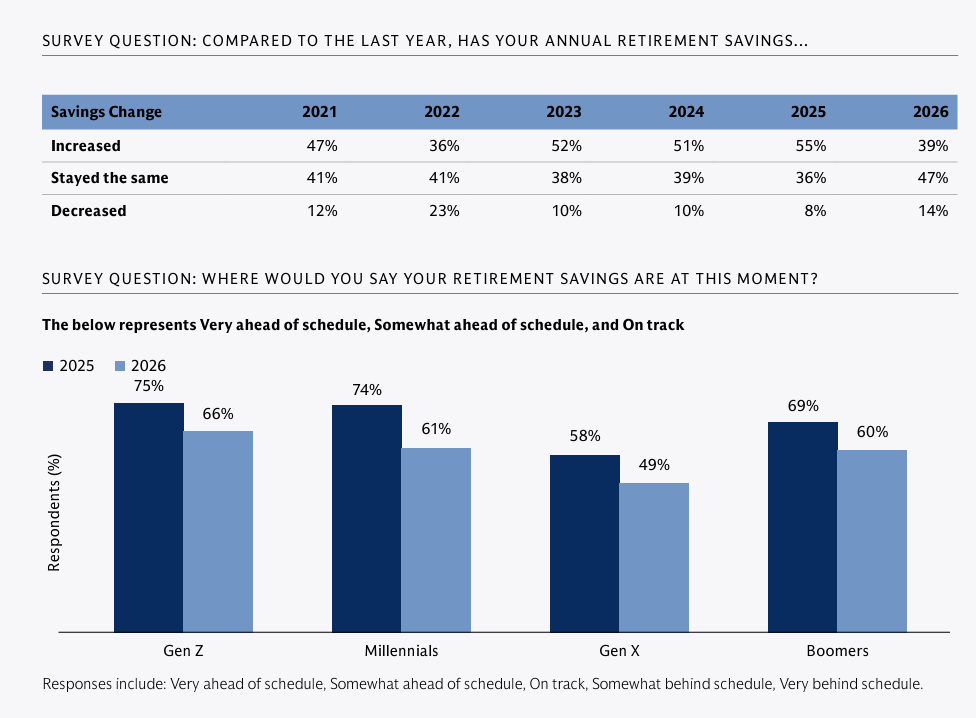
Thirty-two years after Reality Bites turned Gen X slackerdom into a movie poster, the generation’s retirement math has caught up with the title. Just 49% of Gen X savers say they’re on track or ahead for retirement, down from 58% a year ago, according to the 2026 Goldman Sachs Asset Management Retirement Survey & Insights
Thirty-two years after Reality Bites turned Gen X slackerdom into a movie poster, the generation’s retirement math has caught up with the title.
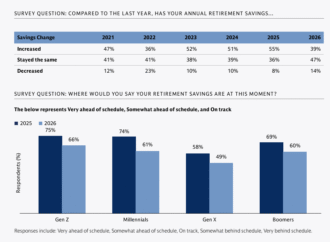
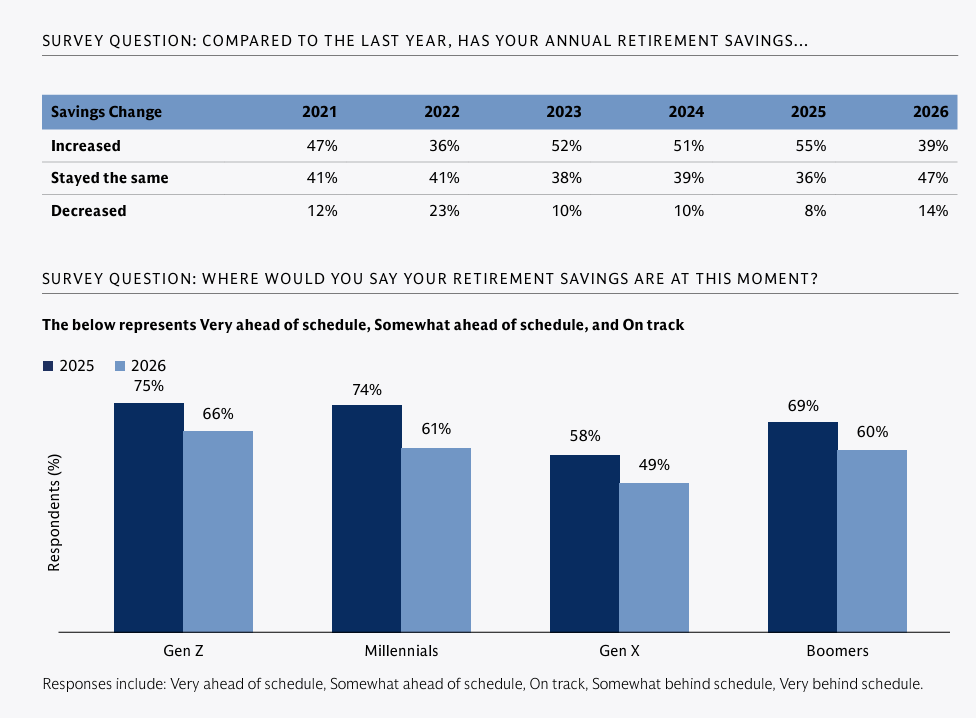
Just 49% of Gen X savers say they’re on track or ahead for retirement, down from 58% a year ago, according to the 2026 Goldman Sachs Asset Management Retirement Survey & Insights Report, released Sept. 30. That makes Gen X the only generation in the survey where fewer than half feel on track. Gen Z sits at 66%, millennials at 61% and boomers at 60%.
Other generations also lost ground this year, but they started higher. Millennials actually fell furthest, 13 points, from 74%. Gen X, however, started lower than the rest and fell further behind.
The survey of 5,106 people, fielded in July, describes a generation that is working more and feeling less secure about it. Only 57% of Gen X respondents describe their primary job as financially stable, the lowest of the four generations. Millennials are at 71%. And 57% of Gen Xers have taken on work outside their main job, and 72% of them said they needed the income.
“While workers may look financially stable externally, underneath, they’re working more, delaying major goals, and supplementing their income,” Greg Wilson, head of retirement and co-head of Americas third-party wealth at Goldman Sachs Asset Management, said in a release accompanying the survey.
Goldman’s report singles out Gen X directly. The generation “in the heart of their career and earning years,” it says, is “the least likely to report that their job provides long-term financial security.”
Goldman’s report calls the Gen X job-security number “a striking result.” Another 33% of Gen Xers said their job covers current expenses but makes it hard to get ahead, and 11% said they struggle to stay financially secure despite working consistently. “Gen X sits primarily in the second half of their career and a critical time for accumulation just before retirement,” the report says. “Confidence in one’s earning power should be at its peak.”
Gen X’s squeeze shows up at the grocery store. Housing was the top savings obstacle for Gen Z (38%) and millennials (36%). For Gen X, it was everyday expenses, at 37%, the highest share of any generation. Some 65% of Gen Xers said they had delayed a major financial goal.
“Deferring these goals postpones stability and compounds the savings problem,” said Chris Ceder, senior retirement strategist at Goldman Sachs Asset Management. “Emergency savings is especially important as one unexpected expense can trigger debt and crowd out the savings that a household has already delayed.”
The experiment generation
Gen X was the first generation to build a whole career on the 401(k) instead of the pension. They were the test case, and the results are coming due soon, with the oldest Gen Xers now in their early 60s.
Goldman’s survey found the whole market turning defensive. The share of workers who increased their retirement savings fell to 39%, down more than 16 points, which Ceder called the largest decline the survey has recorded in six years.
“Savers are taking less action, and the actions they are taking are more defensive in nature, suggesting that they may have concerns over persistent inflation and market volatility,” he said.
The share of workers who cut their savings rose to 14% from 8%. Two-thirds of Gen Z, millennial and Gen X respondents expect to delay retirement.
Wilson summed up the old deal in one sentence: “For generations, the retirement security formula was straightforward: work consistently, save diligently, and security would follow.”
But work isn’t always consistent either. Among retirees in the survey, 44% stopped working earlier than they planned. Of those, 12% said it was because their job was no longer available, and 14% left to care for a family member.
The insecurity is spilling into the office. Some 53% of Gen Xers said financial concerns make it hard to focus at work at least sometimes, and 27% have missed work in the past year because of a financial challenge. About a third, 32%, said they’re likely to look for a new job in the next 12 months mainly to improve their finances.
Jonathan Barber, head of compensation and benefits solutions at Goldman Sachs Ayco, said that gives employers “a unique opportunity and clear incentive to provide innovative support tools beyond traditional retirement plans.”
A plan helps, if you have one
The one bright spot in the data: Savers with a personalized retirement plan were far more likely to feel on track, 72% versus 33% without one, and 46% of them increased their savings in the past year, compared with 26% of those without a plan.
But for a generation that spent the 1990s being told it was too cynical to care, 49% might be the most Gen X number possible. It’s a quiet slide, and nobody’s making a TikTok about it.
For more tech updates, stay tuned to our blog.