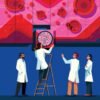
Credit: Peter Greenwood/Folio In the past three decades, the field of regenerative medicine has advanced rapidly, driven by breakthroughs in areas such as cell therapy, in which specific cell types are transferred into a patient to treat or prevent disease, and tissue engineering, which uses various methods to grow or repair damaged human tissues. Nature
The cells in Daolin Tang’s Petri dishes were dead. Signs of life had dropped off a cliff; they weren’t reproducing. They were goners. And that was good; the cell biologist had been looking for chemicals that would poison cancer cells. These secret battles between your body’s cells might just save your life But Tang and
Over two days in June, Emily Aguilar-Pine drove 2,500 kilometres from Bozeman, Montana, to Austin, Texas, with one of microbiology’s most coveted organisms in the back of her mother’s SUV. Inside some protective packaging, labelled ‘hopes and dreams’, was a small bottle containing about 30 millilitres of what looked like clear liquid, but that in
A migrating breast cancer cell.Credit: Christoph Burgstedt/SPL Choosing the most effective treatment for people with triple-negative breast cancer (TNBC) is often challenging because the tumours can behave very differently at the molecular level. Now, researchers have developed an artificial-intelligence-based ‘virtual cell model’ that can help in choosing the best treatment for this aggressive form of
When a fertilized mammalian egg divides, it yields two seemingly identical daughter cells. Some of their descendants generate the diverse organ systems of the embryo, while others form extra-embryonic tissues that sustain the developmental process. In 2025, researchers used a cutting-edge technique known as single-cell proteomics (SCP) to show that even in the two first-generation
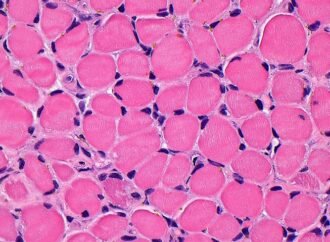
Grafts of muscle cells lead to cognitive and physical improvements in mice.Credit: Ziad M. El-Zaatari/Science Photo Library Researchers have created contracting muscle implants that can mimic some of the benefits of exercise, including improving muscle mass, strength and bone density while also slowing age-related muscle changes1. The research, published in Nature Aging on 26 August,