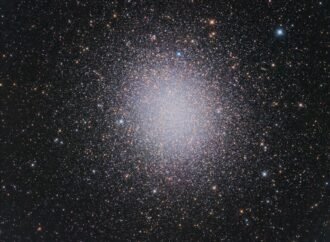
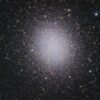
Explanation: Globular star cluster Omega Centauri packs about 10 million stars much older than the Sun into a volume some 150 light-years in diameter. Also known as NGC 5139, at a distance of 15,000 light-years it’s the largest and brightest of 200 or so known globular clusters that roam the halo of our Milky Way
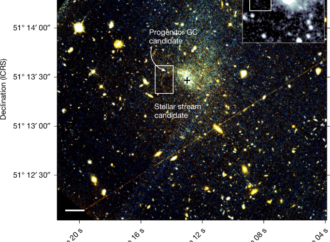
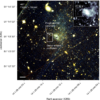
Data The HST Advanced Camera for Surveys (ACS) images use the Wide Field Channel (WFC) in the F555W and F814W filters, have an angular resolution of 0.1″ and reach exposure times of 2,406 s and 2,439 s, respectively. The observations were carried out in September 2022 under HST programme ID 16890 (ref. 52) and the resulting images of
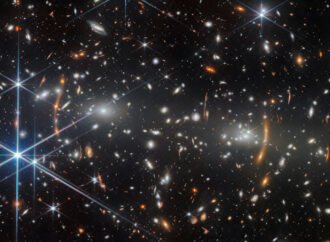
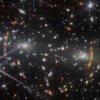
NASA’s James Webb Space Telescope takes us 4.4 billion years into the past with this July 3, 2026 image of a young galaxy cluster, MACS J0553.4-3342. The group is composed of two actively merging subgroups that have approximately the same mass. Each subcluster is anchored by an immensely bright and massive elliptical galaxy, easily identifiable
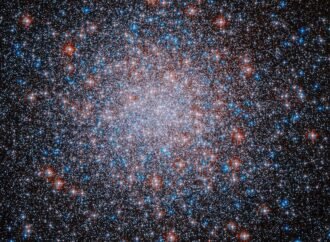
This image from NASA’s Hubble Space Telescope shows Messier 3 (M3), one of the Milky Way’s most massive globular clusters, or spherical collections of gravitationally bound stars. Globular clusters are made up of ancient stars that formed around the same time from the same cloud of gas, giving them similar ages. About 150 known globular