The U.S. Army has detonated a dangerous and degraded stockpile of lead azide in Iowa on Wednesday. Here’s what to know about lead azide, and why local officials and scientists have some concerns about potential health and environmental effects from the explosion. Lead azide, which typically appears as a white or colorless crystalline powder or
Maps falsely claiming to show the projected fallout of a controlled detonation of lead azide in Iowa on Wednesday spread widely on social media in advance of the blast. One showed lead dust spreading throughout the Midwest and Southeast. Another had it reaching Illinois, Indiana, Kentucky, Michigan and Ohio. In a third, the contamination enveloped
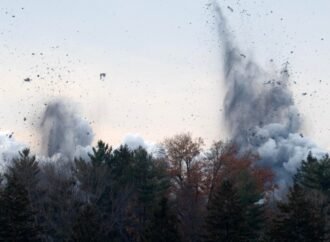
Saying it was necessary to prevent the possible spontaneous explosion of a stockpile of material used in igniters and blasting caps, the US Army conducted a controlled detonation of over 9,700 pounds of lead azide today at the Iowa Army Ammunition Plant (IAAAP) in Middletown, Iowa. Videos of the detonation showed plumes of smoke several
Middletown Mayor Rodney Johnson told the BBC he felt “relieved” and “vindicated” after the detonation. He watched the blast from his job at a manufacturing plant eight miles (12km) away from the blast – and monitored a camera at his two-bedroom home just one mile from the detonation site. “We did not feel anything. We
On Wednesday morning, the US Army detonated nearly five tons of degraded lead azide outside of Middletown, Iowa. Environmental Protection Administration chief Lee Zeldin told CNN shortly after the explosion that preliminary monitoring from the site detected no lead in the air around the site. But the full extent of the fallout may not be
The U.S. Army is planning to detonate 5 tons of degraded and dangerous lead azide in southeastern Iowa Wednesday in what military officials say is an unprecedented effort to prevent a spontaneous, uncontrolled explosion at the site. While authorities say a host of safety measures will be in place to limit the plume of lead