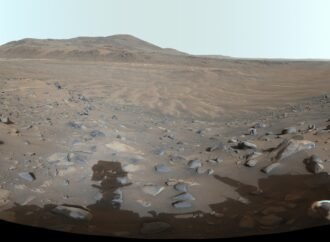
Over 1,645 Martian days, NASA’s Perseverance Mars rover measured the fine and ultrafine Martian dust particles found clinging to samples of spacesuit materials that are carried aboard the rover, including some that are small enough to penetrate the lungs and enter the bloodstream. The findings will be published Tuesday, Oct. 27, in the Proceedings of
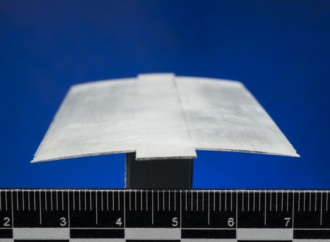
NASA researchers are developing the future of flight on Mars, laying the groundwork for helicopters with the ability to fly higher and farther while conducting science on the Red Planet. Using high-fidelity computer simulations and wind tunnel tests, engineers are reimagining the rotorcraft blades that could carry the next generation of Mars flyers. NASA’s Ingenuity helicopter
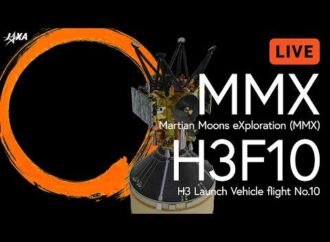
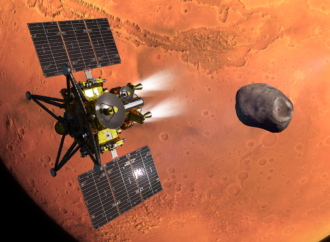
Japan launches a ground-breaking mission to the Mars moon Phobos today, and you can watch live. The JAXA (Japan Aerospace Exploration Agency) MMX (Martian Moons eXploration) mission aims to collect samples from Phobos, the larger of Mars’ two moons, and deliver it back to Earth for analysis. If successful, the samples could help solve long-standing
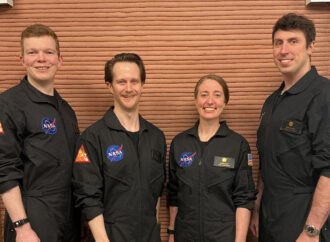
The four crew members in NASA’s simulated Mars mission have spent the past year living and working in isolation in a confined habitat at NASA’s Johnson Space Center in Houston. For the past 365 days, the Crew Health and Performance Exploration Analog (CHAPEA) Mission 2 crew members have operated as though they were on the
NASA is playing an important role in JAXA’s (Japan Aerospace Exploration Agency) MMX (Martian Moons eXploration) mission, to advance our understanding of Mars’ moons and build on the agency’s long history of exploring the Red Planet. The mission aims to characterize and determine the origin of Mars’ moons Phobos and Deimos and deliver a sample
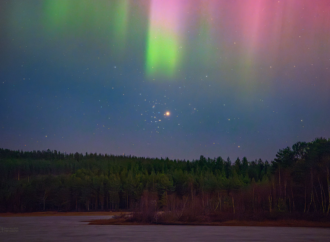
Explanation: What a cosmic coincidence! In today’s image, Mars joins the Beehive cluster (M44 or Praesepe) below an auroral curtain and above a horizon of happy little trees near Lansjärv, Sweden. An eruption off the Sun reached Earth on October 10th, 2026 causing strong disturbances in Earth’s magnetic field. Energetic particles from the eruption collide