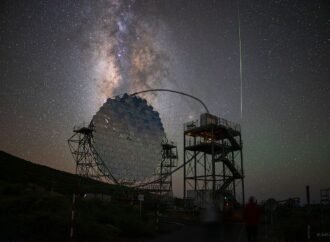
Explanation: On August 15, this perseid meteor streaked through night skies over the Observatorio del Roque de los Muchachos at La Palma, Canary Islands, Spain. The bright and colorful meteor trail was captured next to the central Milky Way, whose dark interstellar dust clouds and luminous starlight reach above the horizon. In the foreground of
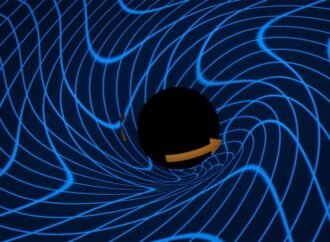
The universe is full of cool and interesting things, like black hole stars and nightmare planets that get scorched by their host star. Now researchers have found a star that moves ridiculously fast, and it’s right in our celestial backyard, whipping around the Milky Way’s supermassive black hole. Say hello to S301, a star near
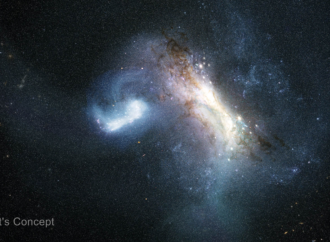
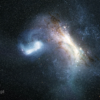
This artist’s concept, released on Aug. 17, 2026, depicts a collision between our Milky Way galaxy and a dwarf galaxy known as LKH that happened about 12 billion years ago. A study of data from NASA’s Hubble Space Telescope, recently published in the journal Nature Astronomy, shows definitive evidence of a dwarf galaxy merging with the young
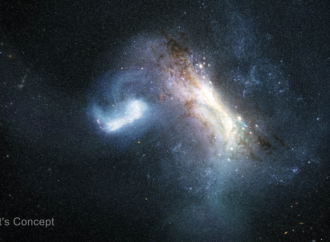
About 12 billion years ago, a dwarf galaxy known as LKH collided with a young Milky Way and merged with it. This artist’s concept portrays that collision. NASA’s Hubble Space Telescope uncovered definitive evidence of this collision by studying globular star clusters. Illustration: NASA, ESA, Joseph Olmsted (STScI) Our home galaxy, the Milky Way, grew
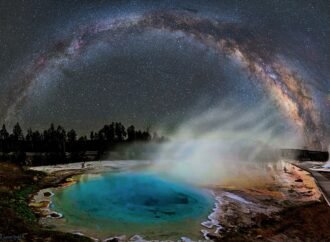
Explanation: The Milky Way was not created by an evaporating lake. The colorful pool of water, about 10 meters across, is known as Silex Spring and is located in Yellowstone National Park in Wyoming, USA. Illuminated artificially, the colors are caused by layers of bacteria that grow in the hot spring. Steam rises off the
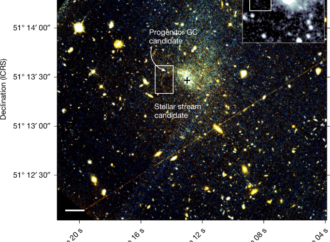
Data The HST Advanced Camera for Surveys (ACS) images use the Wide Field Channel (WFC) in the F555W and F814W filters, have an angular resolution of 0.1″ and reach exposure times of 2,406 s and 2,439 s, respectively. The observations were carried out in September 2022 under HST programme ID 16890 (ref. 52) and the resulting images of