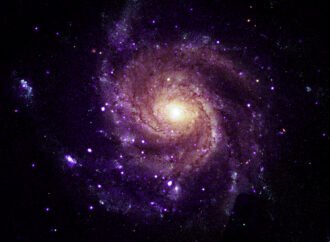
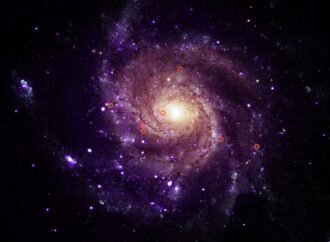
Using NASA’s Chandra X-ray Observatory, researchers found mysterious objects that give off unusually low-energy X-rays but intense levels of ultraviolet radiation. One of the galaxies they studied, M101, is pictured here in this image released on Sept. 9, 2026. Astronomers suggest these newly spotted objects in other galaxies may help solve not one, but two
Using NASA’s Chandra X-ray Observatory, scientists have discovered a new class of objects behaving unlike any they have seen before. Astronomers suggest these newly spotted objects in other galaxies may help solve not one, but two long-standing questions in astrophysics. These mysterious objects give off unusually low-energy X-rays but intense levels of ultraviolet radiation. This
This artist’s concept depicts a Trans-Neptunian Object, a small, faint, icy body orbiting the Sun beyond the orbit of Neptune. These objects are so small that even with NASA’s Hubble and Webb space telescopes, they appear only as tiny points of light. Artwork: NASA, ESA, Leah Hustak (STScI) For the first time, scientists used the
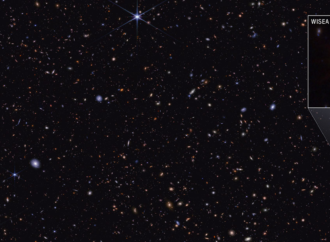
Since their discovery by NASA’s James Webb Space Telescope in 2022, small red dots (LRDs) have been the subject of great interest to astronomers. Understanding the nature of these compact and extremely distant red sources has been a perplexing scientific endeavor. One popular theory is that the small red dots are supermassive black holes known