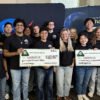
NASA announced the winners of the Deep Space Food Challenge: Mars to Table Thursday, with the top $300,000 prize being awarded to Chinyere Ukeje of Philadelphia, Pa. for the Adaptive Nourishment Infrastructure (ANI) food system concept. This competition challenged solvers to explore innovative solutions for integrated space food systems that would provide safe, nutritious meals
Researcher Miki Takahara accepts an Ig Nobel on behalf of the late Tokuji Unno.Credit: Fabrice Coffrini/AFP/Getty Hands up if you’ve been to a science awards ceremony. Black tie, fine dining, long speeches and polite applause. Any humour has to be calibrated carefully. Compare this with the Ig Nobel awards. These also celebrate genuine, published research
Researchers found that land use is a key factor in the decomposition of underwear, more so than other soil characteristics.Credit: Gabriela Brändle/Agroscope The recognition and prestige of a Nobel prize for groundbreaking work comes with a gold medal and the equivalent of about US$1 million. The parody version, an Ig Nobel prize, devised to celebrate
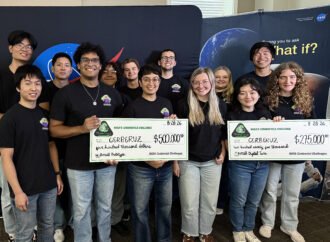
NASA named a team from the Massachusetts Institute of Technology (MIT) as the first prize winner for Phase 2 of the agency’s LunaRecycle Challenge, which focused on developing solutions for reducing waste during missions to the Moon or deep space by recycling common materials, like fabrics, plastics, foam, and metals. The Composites for Extraterrestrial Recycling By Engineering the Reuse and Upcycling of Zotek (CERBERUZ) team, comprised of undergraduate, graduate, and doctoral students at MIT, received a total of $775,000 in awards. The technology grinds mixed trash into a fine powder,
NASA will announce the winners of the final phase of its LunaRecycle Challenge on Friday, Aug. 28, at The University of Alabama (UA) Lee Styslinger College of Engineering in Tuscaloosa, Alabama. Launched in 2024, the challenge incentivizes the invention of new recycling systems that could support non-metabolic waste management efforts for future lunar missions. Media
The Orbital Clarity Challenge — the sixth in the NASA TechLeap Prize series — is a collaborative effort between NASA’s Heliophysics Division, Flight Opportunities program, and Center of Excellence for Collaborative Innovation. The Heliophysics Division studies space weather, including how it heats and expands Earth’s outer atmosphere during intense solar activity, creating orbital drag through atmospheric density changes. The