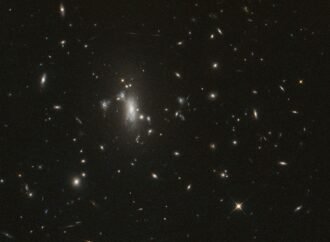
NASA’s Hubble Space Telescope captured this image of massive galaxy cluster MACS J0417 (left of center) on Sept. 19, 2026. This galaxy cluster acts as a gravitational lens, bending and magnifying light from objects far behind it. Supernova Athena, discovered by NASA’s James Webb Space Telescope in 2025, is predicted to reappear between now and
NASA announced Wednesday a mission to explore the history and evolution of the universe, PRIMA (PRobe far-Infrared Mission for Astrophysics), is advancing to the next phase of development. This space telescope is the first in a new class of NASA astrophysics missions, called Probe Explorers, within the agency’s longstanding Explorers Program. “The PRIMA mission is
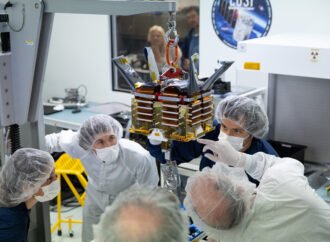
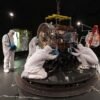
UC Berkeley engineers and managers watch as the COSI (Compton Spectrometer and Imager) detector assembly is slowly raised from a table in this July 8, 2026, image. The four pieces of silver material on the top of the detector box cover the flex circuits, which carry signals from the detectors to the readout electronics. COSI
NASA has carried out some notable rescue missions over the past few years, including bringing home the astronauts stranded on the International Space Station last year. More recently, the agency sent up a probe in hopes of saving the Neil Gehrels Swift Observatory, a satellite first launched in 2004 that began falling out of our
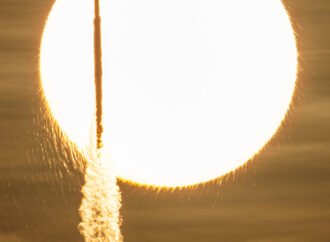
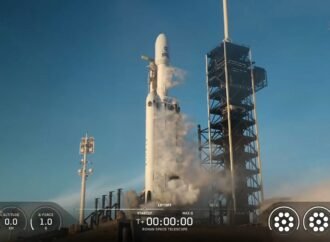
NASA’s Nancy Grace Roman Space Telescope, aboard a SpaceX Falcon Heavy rocket, transits the Sun during launch from the agency’s Kennedy Space Center in Florida on Aug. 30, 2026. Roman is named after the agency’s first chief astronomer. Roman will survey billions of stars and galaxies with a field of view far larger than Hubble’s,
Explanation: A new telescope has been launched into space to study the universe. The Nancy Grace Roman Space Telescope (RST) has the same size main mirror as the Hubble Space Telescope (HST) but sees 100 times more sky during each snapshot. This is possible because when compared to HST, RST’s main mirror is more curved,