
About a decade ago, Tesla entered its era of home solar with its controversial acquisition of SolarCity. Now, Tesla’s solar dreams are taking a different shape as the company enters its AI era. Tesla has signed two long-term agreements to purchase power from utility-scale solar projects totaling about 600 megawatts of planned capacity. ContourGlobal, a
About a decade ago, Tesla entered its era of home solar with its controversial acquisition of SolarCity.
Now, Tesla’s solar dreams are taking a different shape as the company enters its AI era.
Tesla has signed two long-term agreements to purchase power from utility-scale solar projects totaling about 600 megawatts of planned capacity.
ContourGlobal, a global energy producer, announced Tuesday that Tesla signed a long-term agreement to purchase 1 terawatt-hour of electricity per year from Project Sterling, ContourGlobal’s solar and battery storage project in Arizona. The deal covers about 90% of the project’s expected output: roughly enough electricity to power about 100,000 U.S. homes a year.
Renewable energy developer Zelestra separately announced Tuesday that Tesla would purchase all of the output from its 140-megawatt Lumen Farm solar project in northeast Texas. Zelestra CEO Phil North said in a statement that the project will support Tesla’s “growing energy needs in Texas.”
The deals reflect Elon Musk’s latest move from harnessing solar power for consumer homes to using solar power in industrial settings, which could include artificial intelligence infrastructure.
Tesla’s humble $2.6 billion solar beginnings
When the CEO proposed buying SolarCity, a rooftop solar installer and financier, in 2016, Musk pitched the $2.6 billion deal as a way to create a seamless end-to-end solution that combined solar, battery storage and electric vehicles.
“Tesla customers can drive clean cars and can use our battery packs to help consume energy more efficiently, but they still need access to the most sustainable energy source available: the sun,” Tesla said at the time.
The rooftop solar business didn’t go away. Tesla said in its first-quarter shareholder update in April that it had begun “significant customer deployments” of residential solar panels produced at its New York Gigafactory. Tesla also continues to sell Powerwall batteries for homes.

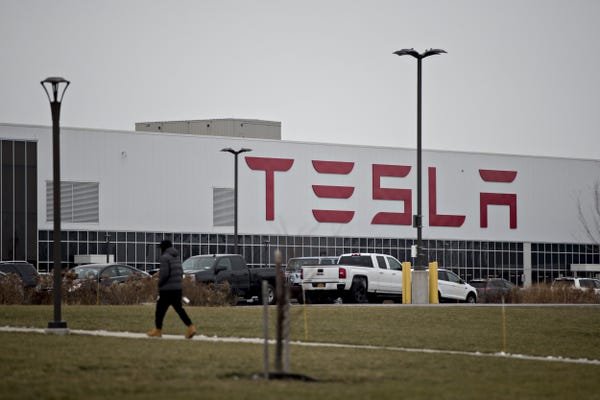
Tesla produces solar panels at its factory in Buffalo, New York. Andrew Harrer/Bloomberg via Getty Images
However, in recent years, Musk has increasingly focused his solar ambitions on the grid, as AI is expected to drive growing energy demand and Tesla bets more of its future on AI and robotics.
Tesla’s bet on AI is based on the sun
Tesla has warned investors that the data centers supporting its AI services and products will have “substantial power requirements.”
The company said in April it expected capital spending in 2026 to exceed $25 billion as it builds factories and infrastructure for projects including its Robotaxi business and the Optimus humanoid robot. Both companies rely on large-scale AI training infrastructure. Tesla also plans to build a semiconductor research factory as part of its long-term chip manufacturing ambitions.
At the same time, Musk has been raising bets on industrial solar power amid the AI boom. On an earnings call in January, the CEO said that “the solar opportunity is underrated” and that solar combined with batteries was the “best way” to add more power to the grid.
During Tesla’s latest earnings conference call, on July 22, Musk said hyperscalers are struggling to secure enough electricity for AI computing, which needs alternative energy sources.
“There’s a lot more energy available from the sun than anything else, by far,” Musk said. “We think power limitations are going to be (already are) a major issue for AI.”
The latest two solar deals make Tesla a major buyer of commercial-scale solar. The electric vehicle maker has committed to purchasing nearly all of Project Sterling’s annual electrical output and all of Zelestra’s Lumen Farm output.
ContourGlobal said commercial operations are expected to begin in 2028 and that Sterling will be the company’s “largest renewable asset to date.” Zelestra said he expects full operations to begin in 2029.
Neither agreement identified exactly which Tesla operations will support energy purchases. Spokespeople for ContourGlobal, Zelestra and Tesla did not respond to requests for comment.
As the focus shifts to Musk’s broader scope for solar energy, solar power is no longer just powering homes and cars, but also the infrastructure of an AI-powered future.
Do you have any advice? Contact this journalist by email at lloydlee@businessinsider.com or Signal on lloydlee.71. Using a personal email address, non-work WiFi network, and non-work device; here is our guide to sharing information securely.