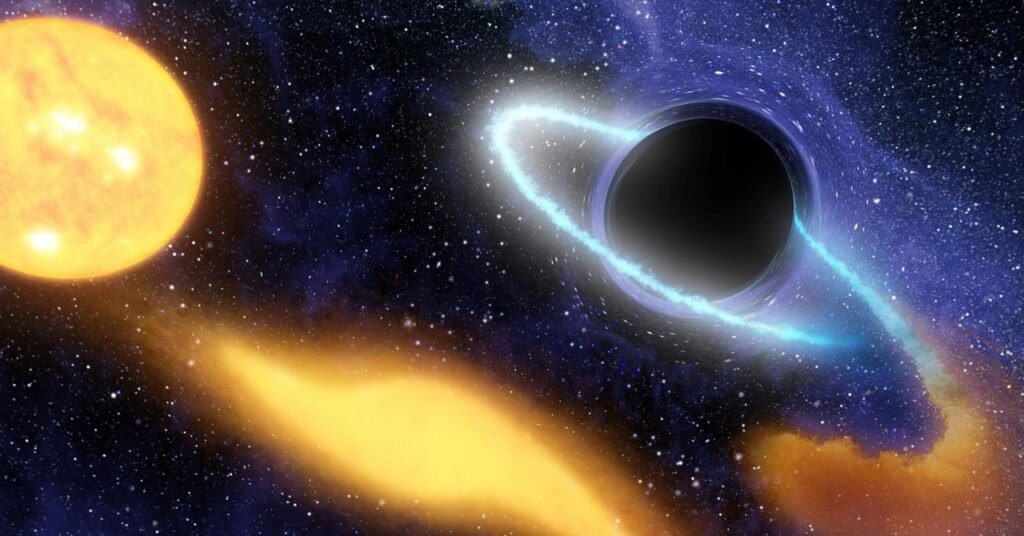
A team of astronomers has just detected the fastest star in the galaxy. Its anomalous speed has a more unsettling explanation: It orbits Sagittarius A*, the supermassive black hole at the center of the Milky Way, the mass of which is equivalent to four million times that of the sun. S301, as astronomers have named
A team of astronomers has just detected the fastest star in the galaxy. Its anomalous speed has a more unsettling explanation: It orbits Sagittarius A*, the supermassive black hole at the center of the Milky Way, the mass of which is equivalent to four million times that of the sun.
S301, as astronomers have named the star, reaches 25,000 kilometers per second (km/s) at its maximum speed and takes 8.7 years to complete one orbit around Sagittarius A*. (By comparison, the sun orbits the center of the galaxy at about 230 km/s.) At its peak speed, S301 moves more than 100 times faster than our star, and reaches 8 percent of the speed of light.
The key to S301’s speed lies in how close it passes to the supermassive black hole. According to the European Southern Observatory (ESO), at its closest approach, the distance between the two is comparable to that between Saturn and the sun.
The enormous gravitational pull of Sagittarius A* accelerates the star as it approaches the black hole. S301, however, does not fall directly into it, but instead follows an extremely elongated orbit around it.
The shape of its orbit also explains why its speed varies so much. At its closest approach, it moves faster, while when it is farther away, it moves more slowly. Something similar happens in the solar system with some comets, such as Halley’s Comet.
S301 is the star with the highest-known orbital velocity in the Milky Way, and also the one that comes closest to Sagittarius A*. It likely did not form where we see it today, and may have lost a companion along the way.
“S301’s orbital properties, and the fact that stars cannot form so close to a massive black hole, indicate that the star was likely part of a binary pair that was torn apart by the tidal forces of Sagittarius A*. In the process, S301 became trapped by the black hole’s gravity while its companion star was kicked out with high velocity, most likely enough to leave the galaxy altogether,” explains the ESO.
Astronomers believe that within 10 years they will be able to determine the rotation of Sagittarius A*. Mass and rotation, or spin, are two of the fundamental properties that scientists use to describe a black hole astrophysically. So far, there are signs that Sagittarius A* is spinning, but it is not yet possible to determine precisely how much or in which direction it is spinning.
Check back often for more exciting news!