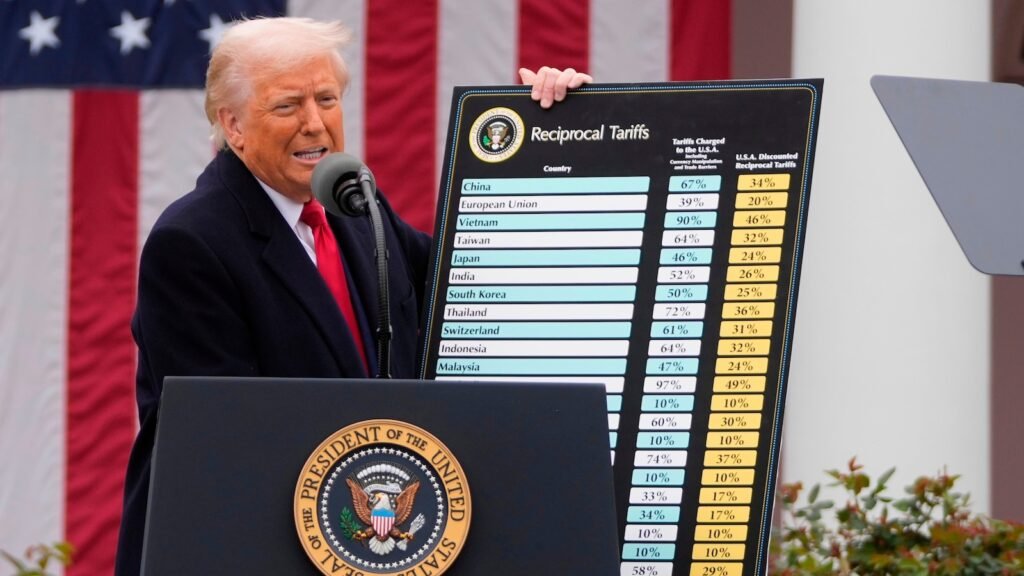
WASHINGTON– President Donald Trump is moving ahead with imposing new double-digit tariffs on dozens of U.S. trading partners just as time runs out Friday on interim taxes he imposed after a tough Supreme Court defeat. The United States will impose taxes of 10% to 12.5% on imports from 60 trading partners that account for 99%
WASHINGTON– President Donald Trump is moving ahead with imposing new double-digit tariffs on dozens of U.S. trading partners just as time runs out Friday on interim taxes he imposed after a tough Supreme Court defeat.
The United States will impose taxes of 10% to 12.5% on imports from 60 trading partners that account for 99% of American imports, charging that it has inadequately enforced bans on goods produced through forced labor.
“The United States has banned the importation of forced labor for nearly a century and rigorously enforces it; it is time for our trading partners to do the same,” said U.S. Trade Representative Jamieson Greer.
The new tariffs will take effect just as temporary 10% tariffs around the world expire at 12:01 a.m. Friday. Trump turned to those temporary taxes after the Supreme Court struck down his biggest and boldest tariffs in February.
It is now taking advantage of longer-lasting tariffs under Section 301 of the Trade Act of 1974, which allows the president to impose import taxes and other sanctions against countries that engage in “unjustifiable,” “unreasonable” or “discriminatory” trade practices. Trump used Section 301 to impose large tariffs on China in his first term, and they survived court challenges.
More Section 301 Tariffs Likely: The U.S. Trade Representative’s office has launched an investigation to determine whether 16 countries (accounting for 70% of U.S. imports) have overproduced goods, driving down prices and putting U.S. companies at a disadvantage in global markets. The administration has yet to complete that investigation.
Trump, who maintains that high tariffs will revive American manufacturing, last year reversed decades of American policy that favored lower tariffs and increasingly free trade. Invoking the International Emergency Economic Powers Act (IEEPA) of 1977, he imposed double-digit tariffs on imports from nearly every country on Earth, saying the United States’ long-standing trade deficit amounted to a national emergency.
But the Supreme Court ruled that IEEPA did not authorize fees. The decision forced the administration to pay refunds to importers who had paid the tariffs.
In response, Trump announced 10% global tariffs under Section 122 of the Trade Act of 1974. But he can only use Section 122 taxes for 150 days; They run out of time on Friday.
The administration initially proposed the forced labor tariffs last month. Since then, some countries have tightened enforcement of forced labor and qualified for lower tariffs, said a senior administration official who spoke on condition of anonymity because he was not authorized to speak publicly on the matter. For example, the official said, the tariff on imports from India was initially set at 12.5% but will now be 10%.
Some products, including oil, gas and fertilizers, are exempt from the new tariffs announced Thursday. Also spared are products that qualify for duty-free status under the United States-Mexico-Canada Agreement, the North American trade pact that Trump negotiated in his first term.
The tariffs drew immediate criticism from critics.
“The current justification for forced labor is too convenient to take seriously,” said U.S. Rep. Richard Neal of Massachusetts, the ranking Democrat on the House Ways and Means Committee. “Forced labor is a real and widespread problem in our supply chains and demands strict enforcement. It must never be debased and become a pretext for tariff policy based on dubious legal theories and personal grievances.”
Brazil, which faces a 12.5% tariff for forced labor, called the US measure “arbitrary and unjustified” in a statement. It plans to activate its reciprocity law, which could demand retaliatory tariffs from the United States, and file a complaint with the World Trade Organization. The United States, the Brazilian government said, “chose to manipulate an issue of great importance to human rights and workers’ struggles around the world to accuse 59 countries and the European Union of unfair practices.”
Chile’s Undersecretary of International Economic Relations, Paula Estévez, said the country has “solid labor institutions, a robust regulatory framework and a firm commitment to the prevention and eradication of forced labor.” Chile faces a rate of 12.5%.
“The Government of Chile considers that the application of this measure to our country is inconsistent with these standards, as well as with the technical, political and legal background presented throughout the investigation process,” he said.
Tariffs are paid by companies in the United States that import foreign products. Importers often try to pass on the cost by charging higher prices to consumers. Americans are already frustrated by the high cost of living. Therefore, the administration is taking a risk by implementing new tariffs before the Nov. 3 midterm elections.
Human rights observers say it is reasonable to be skeptical about the motivation behind the tariffs. But they say taxes could have an impact on the forced labor problem.
The tariffs are being imposed on countries that the United States says did not impose or effectively enforce a ban on importing goods made with forced labor.
Forced labor is defined in the International Labor Organization’s Forced Labor Convention of 1930 as “any work or service exacted from a person under threat of any penalty and for which that person has not volunteered.”
According to the latest statistics from the ILO, which is a UN agency focused on human and labor rights, around 27.6 million people were in forced labor around the world on any given day in 2021.
“We have been advocating for years to ban imports, not as a magic bullet, not a silver bullet, but as a potentially effective tool to combat forced labor around the world,” said Martina Vandenberg, founder and president of the Human Trafficking Law Center.
“It is possible to be extremely critical of tariffs, as we are, and be very concerned about blanket tariffs being used as cudgels against countries,” he said. “And yet I think it’s undeniable that there is a significant response in terms of the adoption of import bans.”
However, Vandenberg and his organization urged in their testimony that the tariffs be implemented gradually to give countries time to implement a ban or a plan for its implementation.
“Our concern is that import bans are small pieces of paper with no enforcement,” he said. “Countries need time to create import ban mechanisms that are meaningful and enforceable.”
Kenya Davis, a partner at Boies Schiller Flexner, said the Uyghur Forced Labor Prevention Act, a U.S. federal law passed in 2021 that prohibits the importation of goods manufactured in whole or in part in China’s Xinjiang region or by designated entities, is the most significant forced labor-related legislation the U.S. has passed before the tariffs.
“The level of effectiveness is certainly up for debate, but it has certainly drawn attention to the issue of labor trafficking and forced labor,” he said. “And so, at the very least, these import bans will serve the purpose of raising greater awareness about forced labor.”
But without a “comprehensive approach” that provides transparency about what the investigations consisted of and programs that give countries help enforcing the bans, “I’m very cautious in my enthusiasm for the (tariffs),” she said.
Isabelle Glimcher, senior research scientist on global work at New York University’s Stern Center for Human Rights, said a flaw with tariffs is that they focus on imposing the tax on countries based on the goods they import, not the goods they make domestically.
But he said the looming tariff threat has prompted several countries, such as India, to modify their foreign trade policies to include a ban on forced labor imports. The European Union’s forced labor regulations that come into force at the end of next year are also contributing, he said.
“Not all of these things are necessarily or entirely attributable to Section 301 investigations, but it appears that countries are responding and starting to take all of this seriously,” he said.
___
Anderson reported from New York.
AP writers Nayara Batschke in Santiago, Chile, and Mauricio Savarese in Sao Paulo contributed to this article.
Keep following us for the latest insights.