
Ukrainian special operators are learning to keep a close watch in the skies as they advance to assault Russian-controlled trenches, while the rise of drones on the battlefield forces soldiers to constantly change the way they fight. “Our training has changed,” an operator from the 4th Ranger Regiment of the Ukrainian Special Operations Forces told
Ukrainian special operators are learning to keep a close watch in the skies as they advance to assault Russian-controlled trenches, while the rise of drones on the battlefield forces soldiers to constantly change the way they fight.
“Our training has changed,” an operator from the 4th Ranger Regiment of the Ukrainian Special Operations Forces told Business Insider. “We have started using [uncrewed aerial vehicles] “More and we pay much more attention to the fight against drones.”
“We also constantly train to infiltrate small groups,” the operator, second in command of a small unit, said in an interview. He asked to be identified only by his call sign “Gur” for security reasons.
The front line stretching across southern and eastern Ukraine has become what soldiers and officials describe as a “kill zone,” an area heavily saturated with drones that can attack anything that moves, from people to vehicles.
The kill zone varies in width, but typically extends approximately 10 to 20 kilometers from the line of contact. However, Ukrainian officials have said it is expanding, forcing commanders to make tactical adjustments.
For Ukraine’s elite special operators, drones are increasingly part of their training, which once focused primarily on surviving Russian artillery fire.
Gur said that Ukrainian drone pilots participate in training exercises. Operators will be on the lookout for threats from above, attacking “enemy” drones, covering soldiers next to them, and seeking cover. If the focus is on movement, they will practice concealment and cover, and once the drone passes by, they will continue walking.

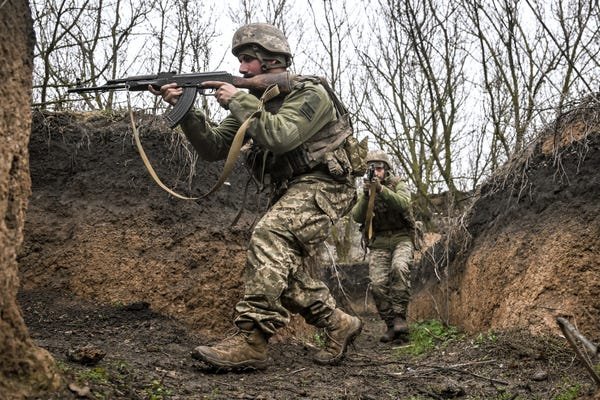
The rise of drones on the battlefield has changed the way Ukraine trains to clear trenches. Smoliyenko Dmytro/Ukrinform/ABACA via Reuters Connect
Operators also use pump-action shotguns during live-fire training. Ukrainian soldiers have described these weapons as an ideal, last-resort defense against first-person view (FPV) drones, particularly fiber-optic drones that cannot be jammed with electronic warfare.
The incredible proliferation of drones on the battlefield has also changed the way special operators approach trench clearance operations, a style of fighting that warfare has largely reclaimed.
Trench warfare in Ukraine has drawn comparisons to World War I, although the presence of drones and robots on the battlefield has given it a futuristic twist, making an already difficult mission much more difficult.
Gur described a scenario in which a group of four people need to clear a trench, so they move in teams. In each pair, the first soldier keeps a gun pointed towards the trench, while the second soldier walks a few meters behind, scanning the sky.
If they detect a Russian drone, they open fire. “You can do it with a standard rifle or a pump shotgun,” Gur said.
Meanwhile, the second duo covers the first until they reach the trench and begin clearing it. At this point, the first duo calls on the second pair to move forward. When the four soldiers are together, at least one of them looks at the sky.
“If they are divided into pairs, one soldier works in the trench, while the other helps him and monitors the airspace above them,” Gur said. “When we leave the trench, the first soldier looks at the ground and the horizon, while his partner looks at the sky.”
“And then we continue moving forward in the same way,” Gur added. “There always has to be someone looking at the sky. It has to be done constantly.”