ONE BIG THING White House delivered misleading stats on oil shipments from the Gulf You will be shocked to learn that a politician may have said something misleading. U.S. Energy Secretary Chris Wright raised eyebrows in energy markets Wednesday when he said more oil exports left the Middle East on Monday—between the Strait of Hormuz
ONE BIG THING
White House delivered misleading stats on oil shipments from the Gulf
You will be shocked to learn that a politician may have said something misleading. U.S. Energy Secretary Chris Wright raised eyebrows in energy markets Wednesday when he said more oil exports left the Middle East on Monday—between the Strait of Hormuz and alternative routes—than before the beginning of the Iran war. “Monday was our record ever through, since the conflict began. Over 17 million barrels of oil flowed through the Strait of Hormuz on ships on Monday. If you add the bypass export pipelines, more than left the region [than] in the pre-conflict,” he said.
Really? More oil is getting through the Strait now than before the war? Really?
It appears that Wright is adding up transfers over multiple days into a single day, said Samir Madani, co-founder of TankerTrackers.com, jokingly calling it “mathemagics.”
In reality, on Monday, Aug. 31, only an estimated 9.14 million barrels of oil exited the Arabian Sea—including volumes through Hormuz and other routes, Madani told Fortune’s Jordan Blum. (And that explains why oil has stayed above $95 per barrel.)
MORE FROM FORTUNE
Can We Trust OpenAI to Protect Our Power Grid? | Fortune Daily
One of MacKenzie Scott’s latest donations takes her HBCU giving to well over $1 billion – Sydney Lake
China demands answers after a man dies hours after entering ICE custody—the fifth Chinese national to die in U.S. immigration custody since 2025 – The AP
Big tech is investing millions in data centers and saving a quick tax buck while doing it—leaving some states collecting revenue loss – Joshua Hong
‘Critical employees will begin to retire’: Trump’s new pay plan will deny most federal roles a raise, and it has workers warning of a retention crunch – Sasha Rogelberg
Toilet paper becomes a kitchen table issue for Trump again as Canada’s retaliatory tariffs could spell another shortage – Catherina Gioino
Moody’s head of sustainable finance: Asia is embracing a ‘pragmatic transition’ on energy – Angelica Ang
Tim Cook stepped down as Apple CEO, but the ‘Trump whisperer’ isn’t going anywhere – Tatiana Sataua
THE MISSING WORKFORCE
‘Near-zero employment growth in August,’ Vanguard says
Vanguard’s 401(k) database—of the 2,500 companies that use its services for their 5 million workers—“shows near-zero employment growth in August,” according to Senior Economist Adam Schickling. Retirement plan take-up isn’t an exact proxy for new job creation, of course. But Schickling said in an email that it’s worrying because it occurs at the same time as a large number of workers have simply dropped out of the labor force. If they were still looking for work, the unemployment rate would be much higher than 4.1%, its current level.
“The 25-54-year-old labor force participation rate has declined ~50bps [year to date], one of the largest non-recessionary drops in history. This has helped keep the unemployment rate relatively stable despite a cumulative 833,000 decline in household employment since January. If prime-age participation had not fallen, we estimate that the current unemployment rate would be 4.4%,” he said in an email.
Schickling predicts that the dropouts will reverse course in the coming months, “creating upward pressure on the unemployment rate as these workers re-enter the labor force faster than they find jobs.”
QUOTE OF THE DAY
“The board doesn’t all get sacked because we did something silly.”
—Dyson founder James Dyson, upon the launch of his $499 toothbrush that features a camera so you can see inside your mouth as you brush. He told the WSJ he has no clue whether there is a market for such a product or how many he might sell.
THE MARKETS
Stocks climb as bond yields catch their breath
The selloff in U.S. bonds appears to be taking a breather today. The yield on the 30-year Treasury was 5.25%, below its recent peak of 5.31%. The 10-year was at 4.78%, around its record high but not moving higher. Stocks reacted by moving modestly upward in Asia and Europe. The S&P 500 closed up yesterday, and U.S. futures point toward more gains this morning before the open in New York.
- S&P 500 futures were up 0.11% this morning. The index rose 0.46% yesterday.
- In Europe, the Stoxx 600 was up 0.28% in early trading, and the U.K.’s FTSE 100 was up 0.12% before lunch.
- Asia: South Korea’s KOSPI was up 0.26%. Japan’s Nikkei 225 was down 0.17%. India’s Nifty 50 was flat. China’s CSI 300 was up 0.10%.
- Brent crude was $95 per barrel this morning.
- Bitcoin was at $77,865.
Ignore the national debt—this is normal, Deutsche Bank says
OK, “ignore” is perhaps too strong a word. The worry of the day in the markets is, of course, the global selloff in government bonds that’s driving yields ever-higher, which in turn makes government debt more expensive for taxpayers to pay off. A lot of people are pointing to the massive pileup of government debt in many countries—$40 trillion in the U.S.—as the reason investors are demanding they be paid more for lending governments money.
But that ain’t it, according to Jim Reid, the global head of macro research at Deutsche Bank.
“The House View at DB has long been that the backdrop is generally supportive of higher global yields, thanks to the supply-demand balance, term premium, and the inflation outlook. My view is that the latest rise in global yields is a continuation of the normalization after the financial repression of the 2010s, rather than a sign that markets are yet focused on fiscal concerns,” he said in an email.
“That said, the higher yields move, the more uncomfortable the long-term fiscal trajectory looks for many countries.”
Never mind the bond yields, here’s the equities pivot*
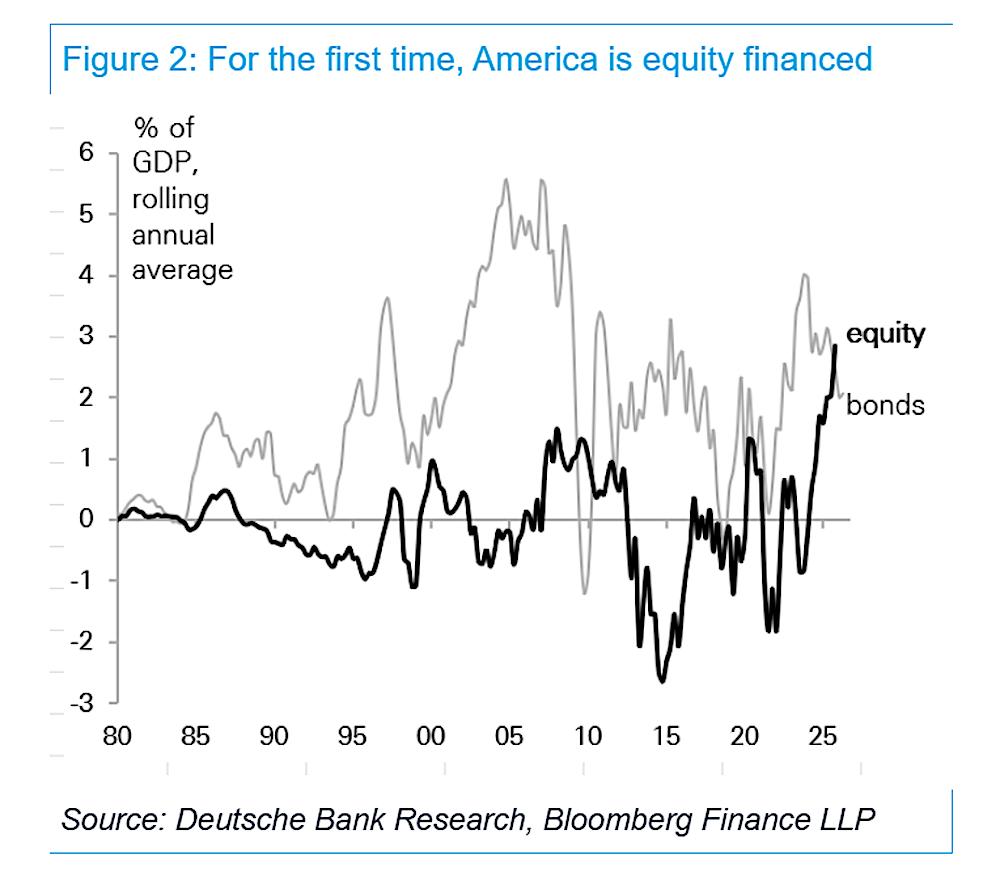
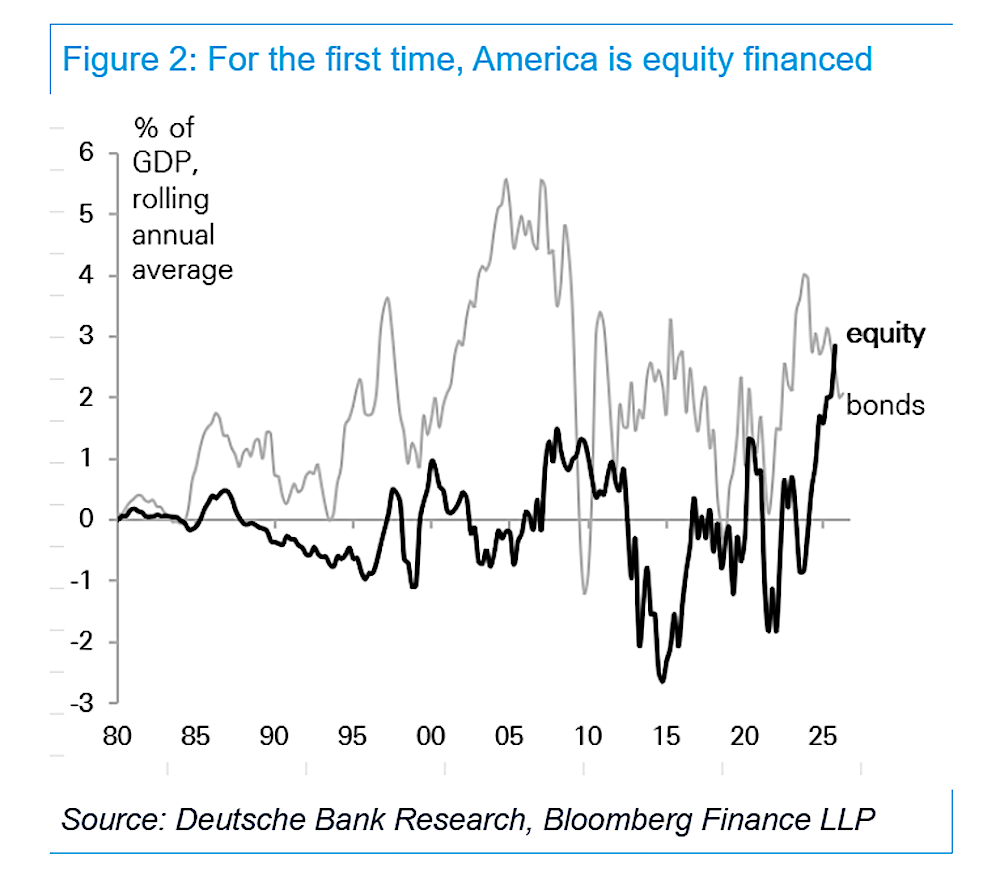
Reid’s colleague at Deutsche, George Saravelos, notes: “For the first time ever outside of the [Great Financial Crisis], equity inflows into the U.S. have overtaken fixed income. Why do foreigners love U.S. equities but dislike U.S. bonds? Because the American private balance sheet is booming (AI, record profit margins), but the public sector balance sheet keeps worsening (6%+ deficits until the eye can see).”
*You have my apologies.
CHART OF THE DAY
Elon Musk’s Starlink already dominates space
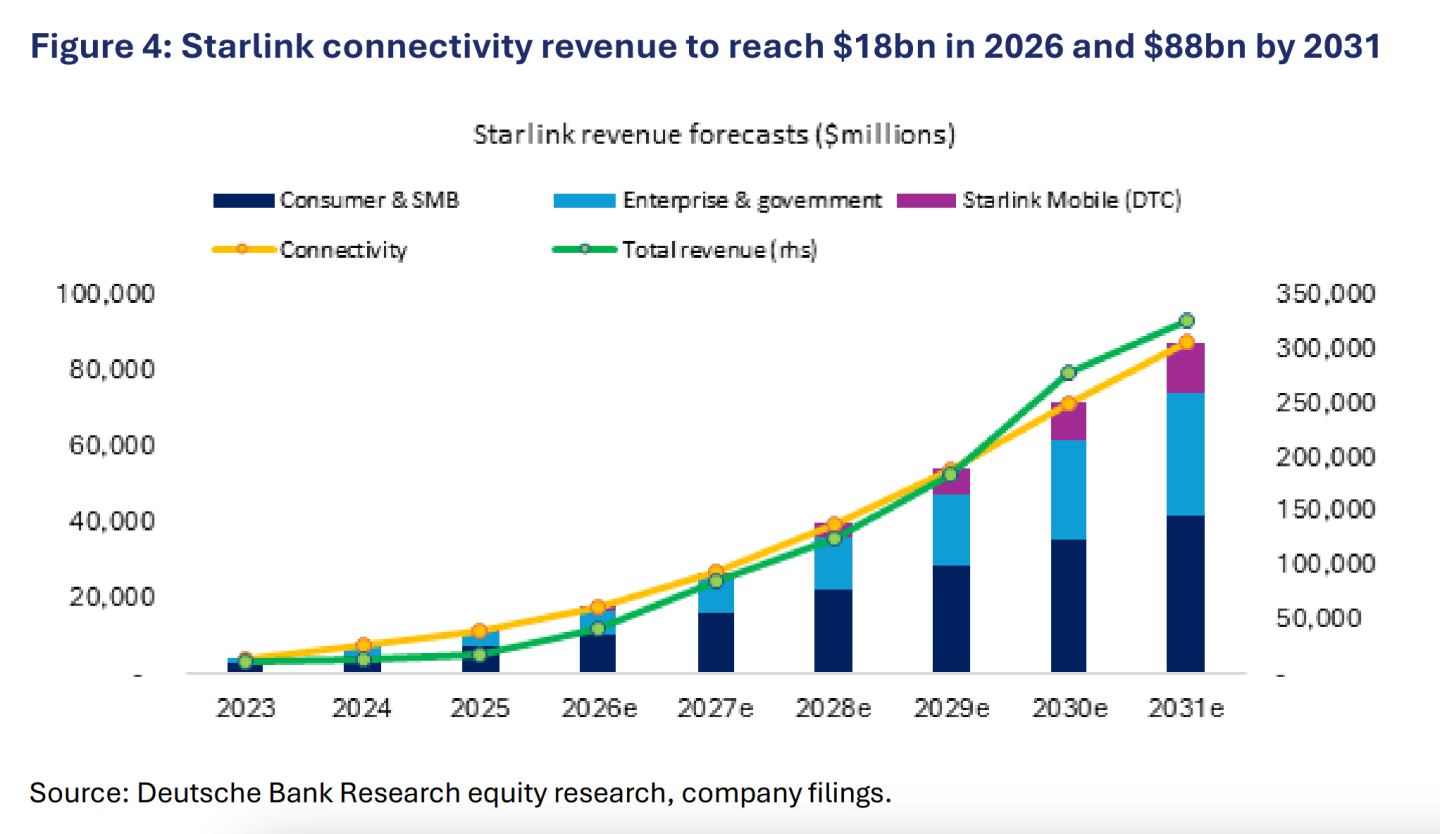
SpaceX’s Starlink unit owns 54% of all satellites in orbit, according to Deutsche Bank’s Marion Laboure and Camilla Siazon. There will be around 17 million subscribers to the service by the end of 2026. SpaceX’s “ability to simultaneously increase speeds while cutting hardware prices has made it very hard for anyone else to compete,” they said in a research note.
NUMBER OF THE DAY: Foldable iPhone
$2,000-$2,500
The estimated price of Apple’s new foldable iPhone Ultra, which is expected to be unveiled on Sept. 9, according to J.P. Morgan’s Samik Chatterjee and his colleagues. They estimate Apple will sell less than 10 million of them, as the launch edition will be mostly used as proof that Apple can launch a new platform.
THE FRONT PAGES TODAY
Dutch central bank moves gold bars out of New York over ‘geopolitical unrest’ – FT
The world appears to be entering a higher-rate era. Here’s who will pay the price – CNBC
Lutnick: Anthropic is “back on the right side” with Trump administration – Axios
How Anna Wintour’s Quest to Salvage John Galliano’s Legacy Was Thwarted – WSJ
China-US Spat at G20 Largely Came Down to Dispute Over One Word – Bloomberg
In a Big Win, Google Avoids a Breakup of Its Ad Tech Business – NYT
SCOTUS should weigh in on prediction markets, says New Jersey AG who wants to shut down sites like Kalshi, Polymarket – NY Post
ONE MORE THING
Women and Millennials want a date to out-earn them—by a lot
When asked how much, ideally, they would like their romantic partners to earn, U.S. Millennials (aged 30 to 45) had the highest income expectations of any generation for a potential partner, at $160,000, Fortune’s Ellie Pringle reports.
That’s kind of a problem because the median annual earnings for that age group are just $72,020.
It’s especially bad news for men. When financial expectations are broken down by gender, men ideally would like their partners to earn $101,000 a year, while women would like partners to earn $172,000 a year.
Check back often for more exciting news!