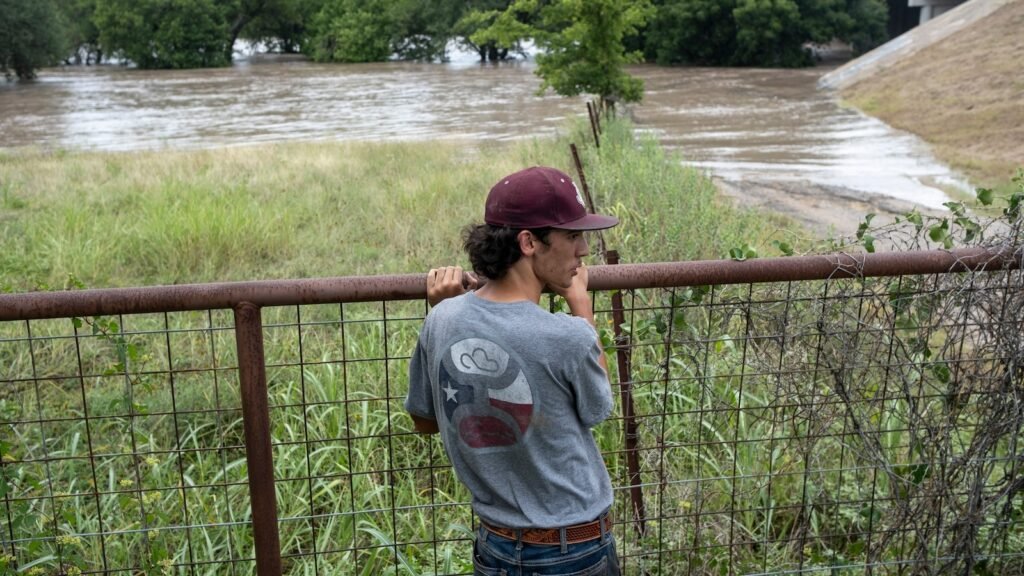
WASHINGTON– Well before dawn in Texas, a shallow point of the Guadalupe River rose above the height of a two-story house Thursday in just five hours, sending a rush of water across a region still affected by last summer’s fatal flash floods. Dangerous flooding for the second year in a row prompted dozens of high-water
WASHINGTON– Well before dawn in Texas, a shallow point of the Guadalupe River rose above the height of a two-story house Thursday in just five hours, sending a rush of water across a region still affected by last summer’s fatal flash floods.
Dangerous flooding for the second year in a row prompted dozens of high-water rescues, washed away roads and killed at least one person, authorities said. The relentless downpours served as another frightening reminder of the flood-prone Texas Hill Country after what experts said was fueled this time by the right combination of air and plenty of available moisture.
“Last year, a big wave came in. And it swept everything away, then it receded, and then we were able to deal with the damage. This time, we’re on the third day of heavy rain and everything is still increasing, and rain is expected today and tonight,” said Suzanne Sutphin Gschwind of Kerrville, where some of the worst flooding occurred.
Warm weather in the central continental United States ensured that the storms that formed were slow-moving, with rounds of rain over the past three days or so reaching several inches per hour at times. The flooding is “as bad as it gets,” conditions that are normally rare, said Bob Oravec, a meteorologist with the National Weather Service.
“Obviously something like this doesn’t happen every year, but it has happened two years in a row and it has happened in a region that is prone to flash flooding because of its topography,” Oravec said.
Nearly 1 billion gallons of water fell on the three hardest-hit Texas counties over three days; Uvalde County alone received more rain in that period than California has seen over the past month, according to Ryan Maue, former chief scientist at the National Oceanic and Atmospheric Association.
Floods over the Fourth of July weekend last year killed more than 100 people, including about two dozen children and camp counselors at Camp Mystic, a now-closed Christian girls’ camp. These storms dumped rain over a broader area, overlapping with some of the places where flooding overturned cars, uprooted trees and sent rescuers scrambling to save lives last July.
A local official in Travis County, which includes Austin, said people were trapped on barn roofs and in trees. Texas Governor Greg Abbott said drones and helicopters were in the air to perform rescues.
“We are scanning every square inch of the entire area for anyone who may be stranded anywhere. And there will be help very quickly for those who may be displaced, wherever they are,” Abbott said.
Rain hit the Texas Hill Country, a part of central and southern Texas with steep terrain. Shallow soil covers limestone hills that have been soaked for days. Instead of the water being absorbed by the land, it rushes into rivers with steep banks.
That causes the water to rise quickly, a dangerous scenario that takes people by surprise.
When rivers rise that fast “it’s almost like a river tsunami,” said Tyler Roys, senior meteorologist at forecasting company AccuWeather. These conditions are so deadly because the water is heavy and moves quickly. Just one cubic foot of water (imagine a box slightly larger than the size of a basketball) weighs about 62 pounds (28 kilograms).
Compared to last year’s flood, the rain fell hard, but in some places it was not as intense and rivers in many places did not rise as quickly, said Texas state climatologist John Nielsen-Gammon. Furthermore, the rains of the previous days foreshadowed the threat of flooding.
“This one is producing higher precipitation totals overall, but it’s doing it primarily with lower rainfall rates. They’re still pretty high, but not as high as they were last year,” he said.
Although swollen by rain, Guadalupe River levels have so far remained largely below record levels, some of which were reached during last year’s deadly floods. The river surpassed last year’s mark in the small community of Comfort, rising to 37 feet (11.3 meters) early Thursday, a mark 1.5 feet (0.5 meters) higher than it reached last year. So at its peak, water weighing as much as the Empire State Building flowed downstream about every minute.
The river record at this location is 12.9 meters (42.3 ft), set in 1869.
It is difficult, especially when storms occur, to know whether climate change has made the event more likely or worse.
Oravec said the conditions that created this storm (warm air directing and slowing storms) have been around for a long time, but climate change could make these conditions more common. A warmer atmosphere also has the potential to retain more moisture and heavier rainfall.
Last year’s floods raised awareness about the dangers flooding creates, especially when it occurs at night, Oravec said.
“I think that in general it has been a good forecast. The effects are catastrophic, but the signal was there of possible heavy rains,” he said.
___
Associated Press writers Christopher L. Keller in Albuquerque, New Mexico, Claudia Lauer in Philadelphia and Kathy McCormack in Concord, New Hampshire, contributed.
___
The Associated Press receives support from the Walton Family Foundation for coverage of environmental and water policy. The AP is solely responsible for all content. For all of AP’s environmental coverage, visit https://apnews.com/hub/climate-and-environment
Keep following us for the latest insights.