Over the past 50 years, musician “Weird Al” Yankovic has become the first artist to have a comedy album debut at #1 on the Billboard Top 200, been given a star on the Hollywood Walk of Fame, amassed five Grammy awards, and one Emmy. As if that weren’t enough, the “Amish Paradise,” “Eat It,” and
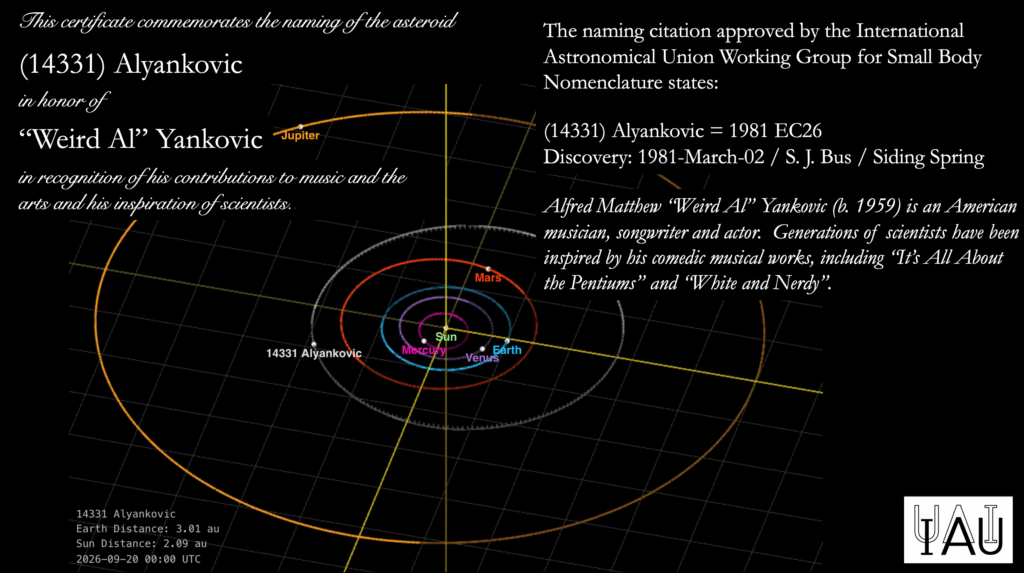
Over the past 50 years, musician “Weird Al” Yankovic has become the first artist to have a comedy album debut at #1 on the Billboard Top 200, been given a star on the Hollywood Walk of Fame, amassed five Grammy awards, and one Emmy. As if that weren’t enough, the “Amish Paradise,” “Eat It,” and “The Saga Begins” singer now has an asteroid named in his honor.
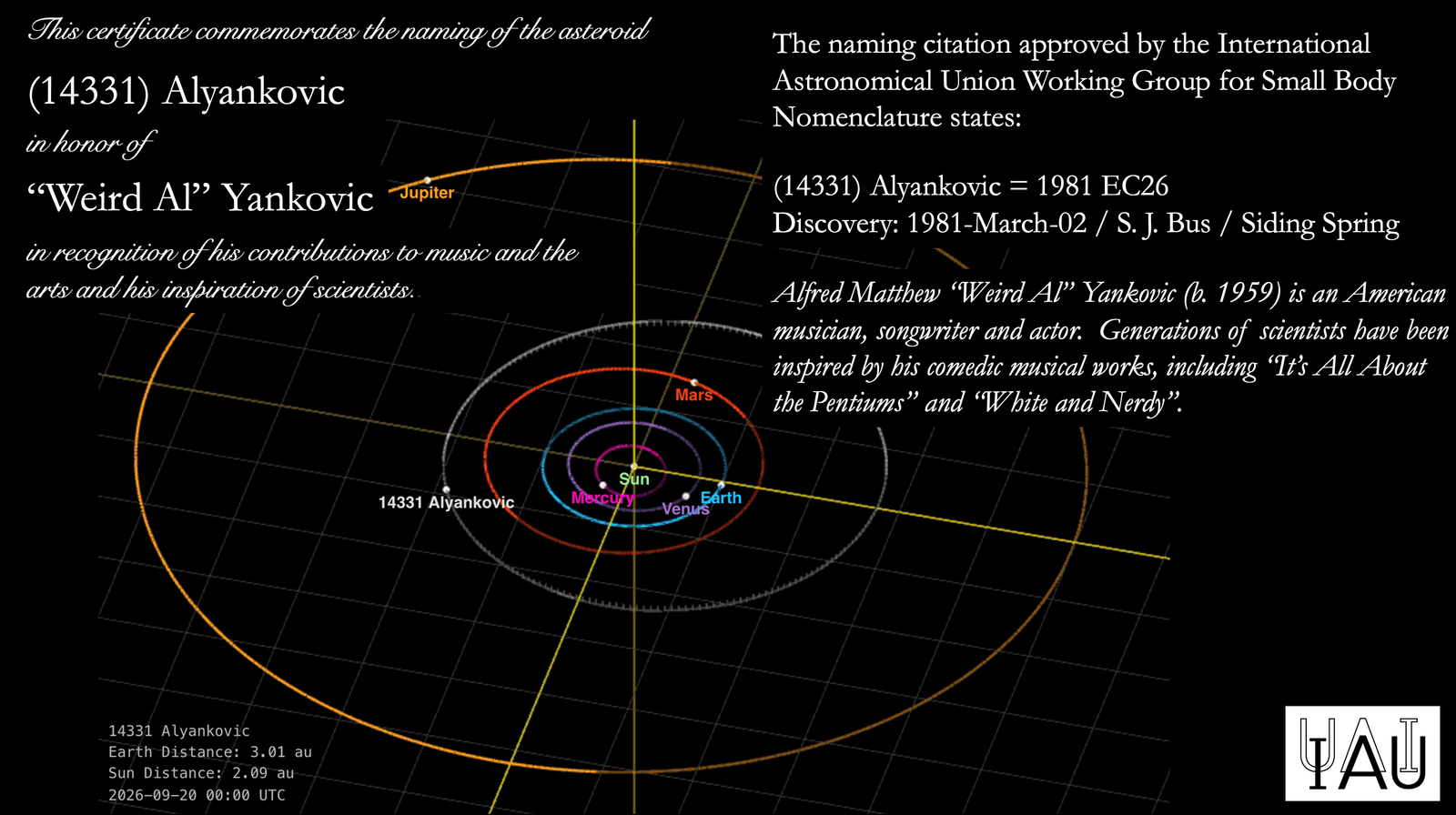
The International Astronomical Union (IAU) officially approved the naming of asteroid (14331) Alyankovic earlier this month. The naming citation was published in the WGSBN Bulletin as well as the Minor Planet Center and the Jet Propulsion Laboratory’s Small Bodies Search.
Asteroid names are often used to honor researchers, educators, explorers, and individuals who have made lasting scientific contributions to society. Occasionally, the scientific community will recognize people outside of science whose work has inspired curiosity, creativity, and learning. Many celebrities also have animal species named after them, including Harrison Ford, Queen Victoria, and Kermit the Frog.
This particular asteroid award recognizes Weird Al’s influence on scientists, engineers, educators, and students. For many scientists working today, songs such as “It’s All About the Pentiums,” “White and Nerdy,” and “Word Crimes,” and his 2009 short film Al’s Brain: A 3-D Journey Through the Human Brain made intelligence, technology, science, and being unapologetically curious feel fun rather than embarrassing. Weird Al has a long history of encouraging people to celebrate learning through humor.
“The asteroid science community believes Weird Al’s influence extends far beyond music,” said Dr. Allison McGraw, a planetary scientist at the Lunar and Planetary Institute in Houston, Texas. “Many of us grew up listening to Weird Al’s music while learning about computers, science, mathematics, and technology. For countless scientists, engineers, programmers, educators, and students, his work helped create an environment where being enthusiastic about learning was something worth celebrating. His work has inspired curiosity, creativity, lifelong learning, and a sense of joy in discovering how the world works. That is precisely why we felt he belonged among the stars.”
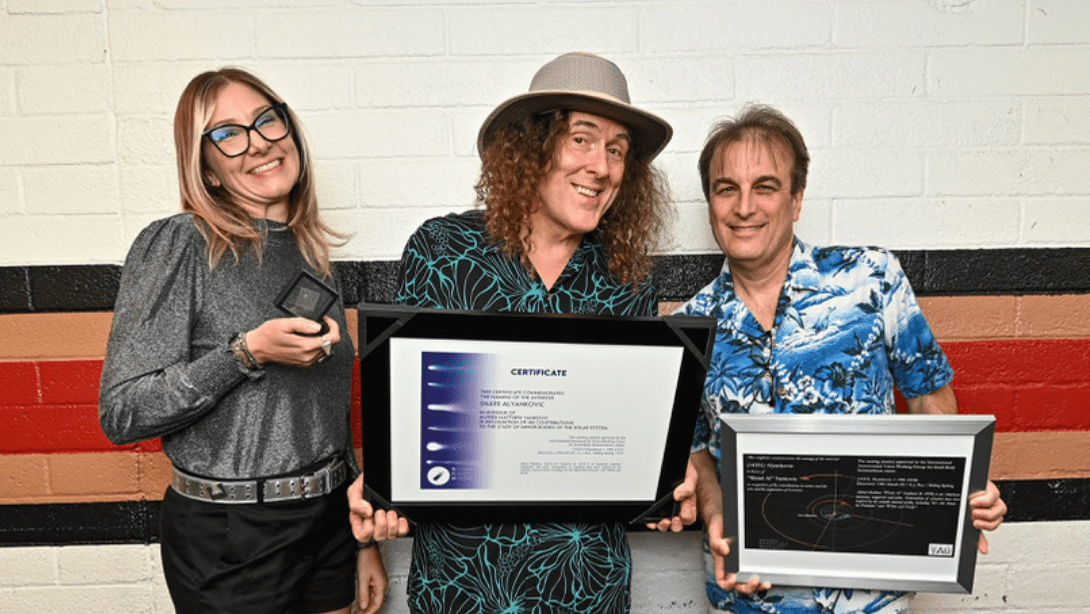
Asteroid (14331) Alyankovic was initially discovered by Stephen J. Bus at the Siding Spring Observatory in Australia on March 2, 1981. It is located in the Main Asteroid Belt between Mars and Jupiter and has an estimated diameter of roughly 1 to 1.25 miles. It takes roughly 1,378 Earth days to orbit the sun. It is considered a silicate (or S-type asteroid). According to NASA, this type of asteroid dominates the inner region of the asteroid belt, but comprises only about 17 percent of all known asteroids.
“This is perhaps the greatest honor I’ve ever received,” said Yankovic. “I just hope this isn’t the asteroid that winds up destroying the Earth.”
Weird Al is currently on tour through October 17.

2026 Popular Science Home of the Future Awards
For more tech updates, stay tuned to our blog.