
This As-Told essay is based on a conversation with Mohamed Zeeshan, 32, an Indian citizen and green card holder, who lives in Arlington, Virginia. The following has been edited for length and clarity. My parents are both Indian. I was born in Indonesia because my father’s job took him there, but we returned to India
This As-Told essay is based on a conversation with Mohamed Zeeshan, 32, an Indian citizen and green card holder, who lives in Arlington, Virginia. The following has been edited for length and clarity.
My parents are both Indian. I was born in Indonesia because my father’s job took him there, but we returned to India when I was 7 years old. In Indonesia, everyone knew me as the Indian boy, and in India, everyone knew me as the Indonesian boy.
As I spent my early years as a foreigner, I developed an interest in international affairs. That led me to the US, where I earned a master’s degree in the field at Columbia in 2016.
The United States attracted me because I was in love with the Ivy League universities. I was also a big fan of President Barack Obama, who I identified with because he grew up in Indonesia and has spoken publicly about his identity in different cultures.

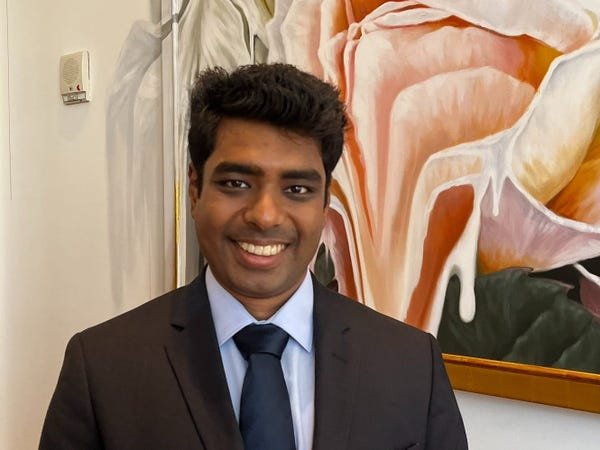
Zeeshan studied international affairs at Columbia. Courtesy of Mohamed Zeeshan
My family was worried about my decision. I come from a family of engineers, doctors, bankers and lawyers, and education in international affairs was considered strange and unconventional, but we came to an agreement; I could do it if I could get tuition help.
I graduated from Columbia in 2018 and obtained a green card in 2023. I am patriotic about American values and would like to become a US citizen. Recently, I have been concerned that it is becoming more uncertain and unpredictable for immigrants to build a life here.
My path to a green card was not linear
I wanted to stay in the US after I graduated. and find a job using my Optional Practical Training (OPT), a work authorization for international students.
After the 2016 election, changes in rhetoric around immigration policies created uncertainty. I felt that employers were not willing to take risks with an international student like me. Instead of relying on the path from OPT to H-1B, as many students do, I left the US and went to the Middle East to work at a management consulting company.
A few years later, in 2021, I followed an alternative path to the United States: applying for a green card from abroad on my own.
I had to present exhaustive evidence showing that my work was in the national interest. My research experience and work on public interest issues helped me build a solid portfolio.
I got it in 2023 and no longer needed a visa or employer sponsorship to work in the US. Today, my wife and I rented a apartment in Arlington, Virginia. Our family life is unconventional by Indian standards, as couples are expected to have children immediately after marriage, and we have not had them yet.
We are postponing the process because my wife is still waiting for her green card and we want to minimize uncertainty about her situation before having children.
I was attracted to the United States for its values, but the current uncertainty is worrying
Economic improvement was not the reason I moved to the United States. When I lived in Dubai, I paid no income taxes and earned more there than after getting my green card and my first job in the United States.

Zeeshan appreciates America’s freedom of expression and business culture. Courtesy of Mohamed Zeeshan
Instead, I was drawn to the American ideals of free speech: the ability to write and speak freely about topics, even if they are controversial. India is a democracy, but it has a Hindu majority and I am Muslim.
I wrote a book on India as an emerging power and I care about improving policymaking there, but I felt like people hated me for criticizing Indian policymaking in my writings.
In 2025, I started my own consulting company. In the United States I feel that I can pursue my business ambitions with less bureaucratic regulation.
I think social and cultural reasons are a big part of why people still want to move to the United States. My Indian friends have told me that the United States offers more freedom to pursue the careers and lives they want.
That being said, I now also see family and friends looking for other options like Germany and Australia because it has become difficult to get a job and visa in the US after graduating.
The H-1B temporary work visa was already an uncertain and inefficient route when I was graduating. Your visa is tied to an employer who can fire you at any time, and losing your job makes you vulnerable to having to leave the country. You are always on the edge.
Recent immigration changes, such as the introduction of a $100,000 H-1B fee that was later struck down by a federal judge but remains stuck in court, have increased uncertainty.
I try to tell other people that they have options outside of the H-1B track, like the EB-1A visa for “extraordinary” people. That said, even these requests seem harder to get, as data shows EB-1A denial rates are increasing..
Today I would not come to the United States on an H-1B visa.

Zeeshan wants to become an American citizen. Courtesy of Mohamed Zeeshan
I intend to naturalize and become a US citizen, unless something makes it difficult. We can’t say what rule changes might occur.
I came to the US as a permanent resident, but if I had to rely on an H-1B visa to come here today, I don’t think I would.