NASA’s Neil Gehrels Swift Observatory captured an “orphan” black hole lighting up as it devoured a star on the outskirts of a distant galaxy. For starters, these phenomena are rare and none have ever been seen so far outside the core of a galaxy before. “We were looking for these star destruction events as a
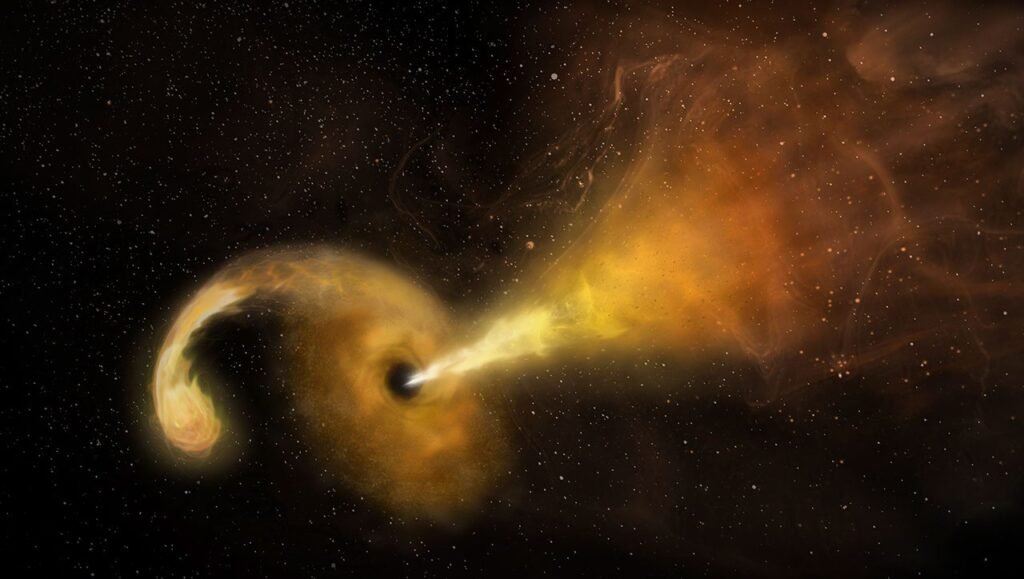
NASA’s Neil Gehrels Swift Observatory captured an “orphan” black hole lighting up as it devoured a star on the outskirts of a distant galaxy. For starters, these phenomena are rare and none have ever been seen so far outside the core of a galaxy before.
“We were looking for these star destruction events as a way to find invisible supermassive black holes moving away from the galactic nuclei where they normally reside,” said Robert Stein, a researcher at the University of Maryland, College Park and NASA’s Goddard Space Flight Center in Greenbelt, Maryland. “With this discovery, which is one of two that have been confirmed so far, we have validated a new technique and can use it to search for more.”
A paper describing the results, led by Stein, was published Monday in The Astrophysical Journal Letters.
Researchers saw an ultra-bright flare unleashed by a star that was torn apart by extreme gravitational forces after getting too close to a monstrous black hole, a phenomenon called a tidal disruption event. The black hole behind the explosion weighs about a million times the mass of the Sun. Its existence was first noted in November 2025 as an unusual glow in a galaxy about 750 million light-years away by ZTF (Zwicky Transient Facility), a study conducted by the Palomar Observatory in Southern California.
“Of the half a million flares that ZTF detects each night, our new artificial intelligence algorithm automatically recognized a flare that closely resembled a tidal disruption event, despite its unusual location on the outskirts of a galaxy,” Stein said. For a few months, the tidal disturbance event eclipsed its entire host galaxy in ultraviolet wavelengths, temporarily radiating the light of about 10 billion suns.
Other telescopes, including the SOAR (Southern Astrophysical Research) telescope in Chile, followed the ZTF source to observe the spectrum of the event, which revealed features supporting that it was likely a tidal disturbance event. Astronomers then used NASA’s Swift to observe wavelengths they can’t detect with ground-based telescopes and discover new information. For example, Swift’s UVOT (ultraviolet/optical telescope) took the temperature of the signal and found that it was quite feverish, around 54,000 degrees Fahrenheit (30,000 degrees Celsius).
“Combining all of this data helped us rule out other explanations and say with confidence that this is a tidal disturbance event, despite its strange location,” said Jonathan Carney, a doctoral student at the University of North Carolina at Chapel Hill, who took the first spectra that supported the interpretation of the flare as a tidal disturbance event.
Almost all galaxies in the universe are anchored by a supermassive black hole located right in the center. About once every 100,000 years, a star will get too close to this invisible heavyweight and trigger a tidal disturbance event.
While they are quite rare in any given galaxy, scientists track them in millions of galaxies. Each year, astronomical studies typically detect around 30 tidal disturbance events occurring somewhere in the universe.
Before 2024, they had only been seen in galaxy cores. This is partly because astronomers primarily looked for them there; After all, it’s where all the known supermassive black holes were, and you can’t have a tidal disturbance event without one (the gravitational pull of lighter black holes isn’t strong enough).
Then scientists saw the telltale signs of a star being torn apart 2,600 light years from the center of its host galaxy. That inspired more astronomers to look for similar events beyond the cores of galaxies, and now a team has identified one more than 30,000 light-years away from the center of a galaxy.
So how did the newly discovered black hole become so unbalanced?
“It must have originated in the center of a galaxy, but not the one now on the outskirts,” Stein said. “We think the host galaxy’s supermassive black hole is still in its core, but the one eating the star could have started in a small galaxy that merged with the large one we see today.”
The researchers have outlined two possibilities. It is possible that three or more galaxies have merged, and the gravitational tug-of-war between their central supermassive black holes has thrown the lighter black hole toward the edge of the galaxy.
Or a dwarf galaxy could be halfway through a merger. When the dwarf’s stars fell into the larger galaxy, one of them may have passed too close to the dwarf’s supermassive black hole.
“New discoveries could reveal the origin of this apparent ‘orphan’ black hole,” Stein said. “The key scientific question we want to answer is: How common are wandering black holes?”
The answer may soon be within our reach. “Spot science observations with Swift’s UVOT and The spacecraft, whose primary mission ran from 2004 to 2006, is slowly sinking toward Earth due to atmospheric drag after more than 20 years of observations of the changing universe. Pushing it into a higher orbit could extend its lifespan even further. “Once it resumes normal operations, Swift could continue searching for more examples of out-of-place black holes.”
In the coming years, scientists will use the new technique to search for disintegrating stars in observations from the newly operational Vera C. Rubin Observatory, jointly funded by the U.S. Department of Energy and the National Science Foundation, in Chile, and NASA’s upcoming Nancy Grace Roman Space Telescope.
“Rubin’s broad and deep surveys will reveal a much larger sample of tidal disturbance events than current observatories are capable of collecting, including those that are off-center,” Carney said. “And Roman’s space studies will expand the current search zone by looking at those that are further away, going back to 9 billion years of cosmic history.” Adding their observations to those of Swift and those of ground-based observatories will bring astronomers closer than ever to completing a census of the universe’s gigantic black holes.
For more information about the Swift mission, visit:
https://nasa.gov/swift
By Ashley Balzer
NASA Goddard Space Flight CenterGreenbelt, Maryland.
Media Contact:
Claire Andreoli
NASA Goddard Space Flight Center, Greenbelt, Maryland.
301-286-1940
Check back often for more exciting news!